AMD Zen 6 could hit 7 GHz and 24 cores in desktop CPUs

Skye Jacobs

Posts: 2,006   +58
Staff
Rumor mill: As AMD preps its upcoming Zen 6 architecture, independent reports from industry insiders are shedding light on what users can expect from the next generation of Ryzen desktop processors. Two prominent sources – Yuri Bubily, known in the enthusiast community as 1usmus, and techtuber Moore's Law Is Dead – have independently shared details that paint a picture of a chip generation focused on incremental yet meaningful improvements.
Yuri Bubily, creator of the Hydra tuning software, revealed on his official Discord that engineering samples of Zen 6-based Ryzen CPUs have already reached AMD's industry partners. According to Bubily, Zen 6 is best described as an evolution of Zen 5, rather than a complete overhaul. The new architecture brings a notable increase in CPU core counts per chiplet, with up to 12 cores per CCD expected. This could allow desktop processors to reach up to 24 cores and 48 threads when two CCDs are paired on a single chip, a significant leap from previous generations.
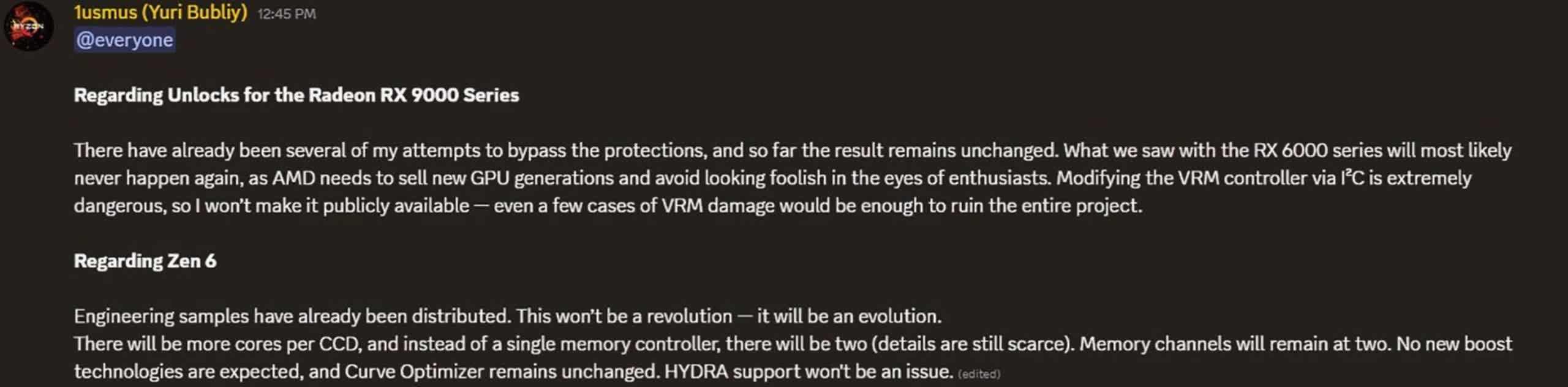
The cache subsystem is also getting a boost, with each CCD featuring up to 48 MB of L3 cache. Bubily notes that the integrated memory controller is being redesigned: Zen 6 will implement a dual IMC configuration, but will retain the familiar two-channel DDR5 memory setup. This means users should not expect quad-channel memory support on mainstream platforms, but higher memory speeds are anticipated. The client I/O die will also be updated, likely moving to a newer EUV process node, which should improve efficiency and bandwidth.

Importantly, Bubily emphasizes that there are no major changes expected for AMD's boosting algorithms or the Curve Optimizer feature – both staples for enthusiasts who fine-tune their systems. He reassures users that Hydra support for Zen 6 will be straightforward and that the new CPUs will remain compatible with existing AM5 motherboards. This stands in contrast to Intel's upcoming Nova Lake-S processors, which will require a new socket and motherboard.

While 1usmus focuses on architectural refinements, Moore's Law Is Dead highlights AMD's aggressive push for higher clock speeds and advanced manufacturing. He reports that AMD is internally testing Zen 6 desktop CPUs that already achieve 6.4 GHz, with an ambitious target of surpassing 7 GHz on the high-end N2X process node from TSMC. This would represent the highest-clocked x86 processor AMD has ever produced, and a dramatic leap over the current Zen 4's 5.7 GHz peak.

The YouTuber explains that only the top-tier desktop variants will use the N2X node, which is an enhanced version of TSMC's 2nm process. Other Zen 6 products, such as the Medusa Point APUs and Venice-class EPYC server chips, will rely on more mature N2P or N3P nodes. These chips may not reach the same raw frequencies but are expected to deliver notable gains in efficiency and performance-per-watt. For mobile platforms, clock speeds are projected to top out around 6.2 to 6.5 GHz, still a substantial uplift over current generation mobile CPUs.

The move to these advanced nodes is not just about frequency. It also enables higher transistor density, which supports the increased core counts and larger caches described by Bubily. Moore's Law also reports that AMD is exploring the possibility of stacking multiple layers of 3D V-Cache, potentially pushing total L3 cache as high as 240 MB for certain gaming-focused SKUs.

Both sources agree that Zen 6 will continue to use the AM5 socket, preserving upgrade paths for current Ryzen users. The architecture is expected to bring double-digit improvements in instructions per clock, higher DDR5 memory speed support, and similar thermal design power profiles compared to Zen 5.

While the exact launch date remains unconfirmed, most indications point to a release window in mid-to-late 2026, aligning with the debut of Intel's Nova Lake-S desktop CPUs.

Permalink to story:

 
I'm sticking with my 5800x3d until socket AM6 at the very lease, so every upgrade is one step closer tot he monster I'll build in 2030.
I waited for the second gen AM5 for better DDR5 speed and prices, so I'll be interested to see how long AM5 sticks around. If the 11800x3D can drop in that would be awesome.

The 5800x3D is still great and in my primary gaming PC. The 9800x3D was mostly about the productivity gains on my primary work PC (but also my future gaming as I my last work PC becomes my living room gaming PC).
 
Those clocks are boosted, peaks, not sustained ones. I don't think that N2 process is capable of doing such speeds. AMD knows it needs higher clocks for better performance, but it's always 10 ~ 15% tradeoffs going smaller or denser.

And even with 12 cores, a all core 5.5Ghz will be some serious power and heat.
 
Those clocks are boosted, peaks, not sustained ones. I don't think that N2 process is capable of doing such speeds.
And what have you based this speculation upon? BTW: Intel has already hit 5.7 GHz on TSMC 3N.
AMD knows it needs higher clocks for better performance, but it's always 10 ~ 15% tradeoffs going smaller or denser.
Again, where are you getting these numbers from? The smaller nodes have been pushing clocks FASTER, not slower.
And even with 12 cores, a all core 5.5Ghz will be some serious power and heat.
Again, the intel 265 and 285k have proven this works fine, using an architecture that is significantly less efficient then AMDs.
 
Sure, NOW they tell me how awesome the 10800x3D will be after I buy a 9800x3D.
Seriously, though, Zen 7 will be a massive change and you can just skip Zen 6.

I skip 2-3 generations. I'm on Zen 3 and will wait for Zen 6 or Nova Lake. I was thinking of getting Arrow Lake due to the insane discounts on 265K/KF and MB combo's, but it's a dead end, I won't be able to reuse the Z890 for Nova Lake. I don't do a huge amount of gaming and so wasn't prepared to pay $850AU for 9800X3D and the regular Zen 5% cpu's are utterly meh.
 
Seriously, though, Zen 7 will be a massive change and you can just skip Zen 6.

I skip 2-3 generations. I'm on Zen 3 and will wait for Zen 6 or Nova Lake. I was thinking of getting Arrow Lake due to the insane discounts on 265K/KF and MB combo's, but it's a dead end, I won't be able to reuse the Z890 for Nova Lake. I don't do a huge amount of gaming and so wasn't prepared to pay $850AU for 9800X3D and the regular Zen 5% cpu's are utterly meh.
There will always be something better around the corner.

Why would you need nova lake if you have arrow lake? If you dont do a huge amount of gaming, those chips should easily last you a decade. I will never understand the constant need to upgrade for 5-10% performance increases when, unless you're buying halo GPUs every 2 years a CPU will almost never be a bottleneck in a system until its really REALLY old.
AMD Pentium 4, is that you in disguise?
Someone else that doesnt understand the difference between TDP and efficiency.
 
Someone else that doesnt understand the difference between TDP and efficiency.

It's alright. It was a joke.
Having said that, it's still interesting how electron migration / leakage was taken care of.
AFAICT, smaller nodes require shorter paths, which impose certain design restrictions that go against the idea of high frequency operation.

I'm certainly digging AMD's upcoming stuff out.
 
Last edited:
It's alright. It was a joke.
Having said that, it's still interesting how electron migration / leakage was taken care of.
AFAICT, smaller nodes require shorter paths, which impose certain design restrictions that go against the idea of high frequency operation.

I'm certainly digging AMD's upcoming stuff out.

They could have increased the number of pipeline stages, helping with higher frequencies apart from the node. More of the die's electrical layout could be tuned by hand, though I think these days, they mostly use libraries.
 
Power efficiency is still relevant, WTF are you on about?

Oh wait, are you one of those people that doesnt understand the difference between power use and power use per capita?
Oh I dont know if I am one of those people, maybe you should explain it to me? I would say your "capita" probably didnt get what I am on about
 
It's alright. It was a joke.
Having said that, it's still interesting how electron migration / leakage was taken care of.
AFAICT, smaller nodes require shorter paths, which impose certain design restrictions that go against the idea of high frequency operation.

I'm certainly digging AMD's upcoming stuff out.
Intel shrunk the piplines as Pentium 4 kept flushing it. Intel thought everyone would be running videos on P4. Their Israeli lab saw what Athlons were doing and developed a similar short pipeline design that was named Core in its second generation. Apparently, the farther away Intel engineers are from HQ, the better decisions they make.
 
I reckon they’ll end up at around 6,5 ghz to maintain a middle ground of performance vs heat. If they manage to stack 3dv cache we could be looking at a fairly large leap in performance. Currently the 9800x3d is not bottlenecking the 5090 at 1440p, so no need to upgrade for gaming unless you’re trying to hit 800 frames per second in 1080p, which I guess would be something a very niché crowd would attempt ..just for the «look at me» perspective
 
Intel shrunk the piplines as Pentium 4 kept flushing it. Intel thought everyone would be running videos on P4. Their Israeli lab saw what Athlons were doing and developed a similar short pipeline design that was named Core in its second generation. Apparently, the farther away Intel engineers are from HQ, the better decisions they make.
Intel had two competitive designs: Pentium 4 Tejas aimed high frequencies and another (Core) was originally for mobile devices. When Tejas samples were ready, it was evident that Core line is better choice. Tejas got cancelled ending Pentium 4 line.
 
Intel Core was based on the initial Pentium architecture that kept evolving through Pentium III and Pentium Mobile. According to Wikipedia, at least.
 
It goes back to the original Pentium Pro, or P6 microarchitecture. Later, Pentium M carried on from the Pentium III Tualatin.

Intel's aim with the Pentium 4 was to reach high clock speeds, projecting 10 GHz. To do this, they increased the pipeline stages, first to 20 in Willamette and Northwood, and 31 in Prescott. It had low IPC compared to the Athlon and Pentium III, and reached a dead end at 3.8 GHz, owing to power and heat.

The Core microarchitecture, carrying on from the Pentium M, saved them, returning to a shorter 14-stage pipeline, lower clock speeds, and higher IPC. AMD did not recover till Ryzen a decade later.
 
It goes back to the original Pentium Pro, or P6 microarchitecture. Later, Pentium M carried on from the Pentium III Tualatin.

Intel's aim with the Pentium 4 was to reach high clock speeds, projecting 10 GHz. To do this, they increased the pipeline stages, first to 20 in Willamette and Northwood, and 31 in Prescott. It had low IPC compared to the Athlon and Pentium III, and reached a dead end at 3.8 GHz, owing to power and heat.

The Core microarchitecture, carrying on from the Pentium M, saved them, returning to a shorter 14-stage pipeline, lower clock speeds, and higher IPC. AMD did not recover till Ryzen a decade later.
Intel didn't need Core or Core 2 to "save" them. Prescott successor Tejas was quite ready when Intel just decided Pentium M is better choice. Intel would have done just fine with Pentium 4 too. No idea where this Core saved Intel -thing comes from. Maybe Tejas existence was just ignored.

Because at same time AMD messed at least two architectures, probably three and Bulldozer was very rushed one. No real competition was coming from AMD even if Intel just continued with Pentium 4 line.
 
Seriously, though, Zen 7 will be a massive change and you can just skip Zen 6.

I skip 2-3 generations. I'm on Zen 3 and will wait for Zen 6 or Nova Lake. I was thinking of getting Arrow Lake due to the insane discounts on 265K/KF and MB combo's, but it's a dead end, I won't be able to reuse the Z890 for Nova Lake. I don't do a huge amount of gaming and so wasn't prepared to pay $850AU for 9800X3D and the regular Zen 5% cpu's are utterly meh.
What is coming for Zen 7? Zen 6 is already better node a more cores per chiplet.

I generally skip 1-2 generations depending on uplift, but I work and game on it.

i7-4770K (intel stagnation) >> i7-8700K (6 cores!) >> 3900X (12 cores!) >> 5900X (much faster cores!) >> 9800x3D (work now doesn't scale across as my cores, so even 4 really fast cores beats 12 slower ones).
 
Back