Asus pushes 2,600W into RTX 5090 to prove new cableless GPU power connector works

Daniel Sims

Posts: 2,416   +73
Staff
Forward-looking: As cases of burning and melting RTX 5090 power cables continue to mount, Asus has demonstrated that its new Back to the Future (BTF) power connector design can maintain safe temperatures while delivering more than triple the GPU's stock wattage limit. The test also revealed that BTF can work in tandem with traditional 16-pin connectors – just in case anyone ever wants to attempt a 2,600W overclock.
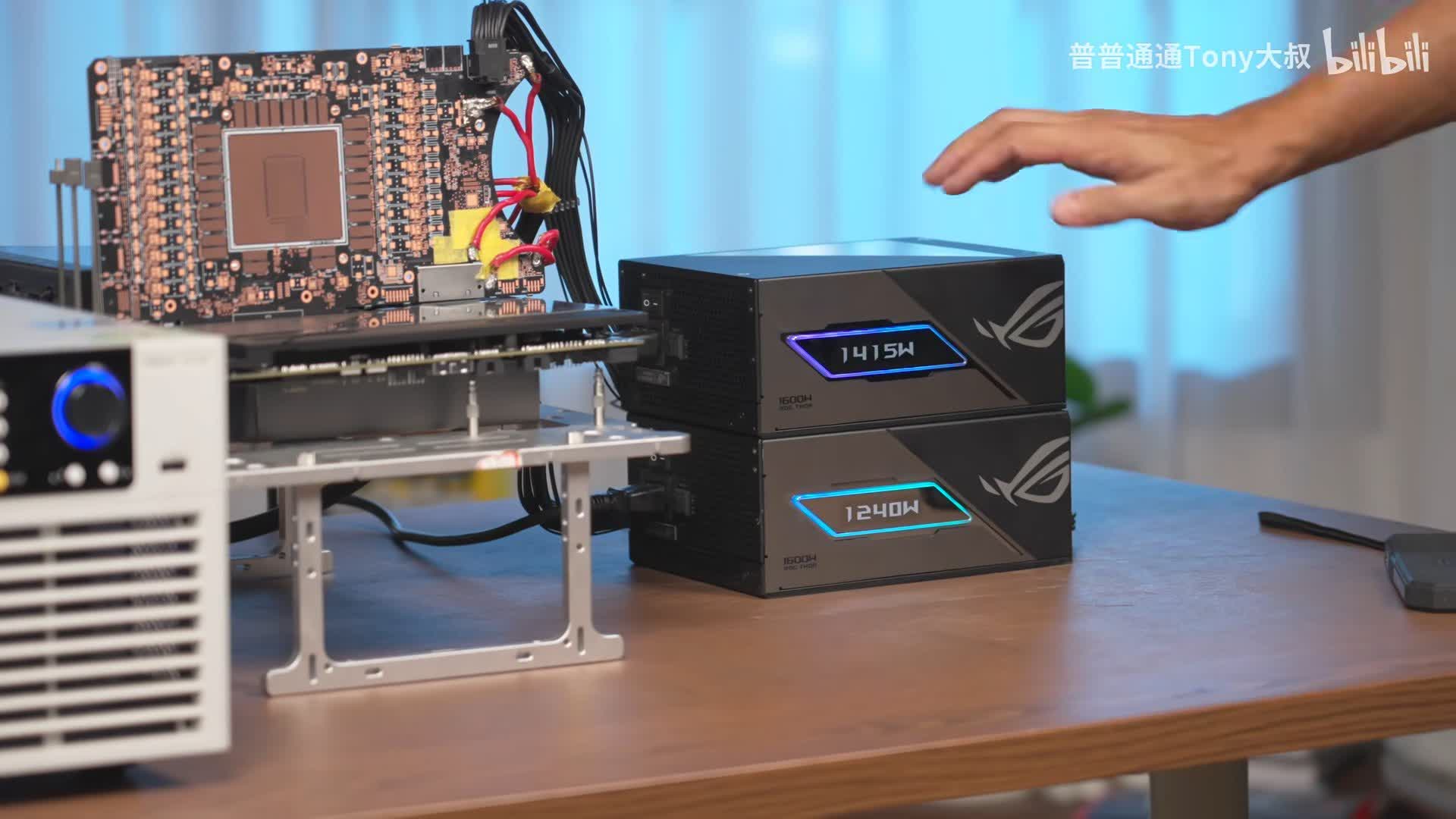
In a recent Bilibili video, translated by Tom's Hardware, Asus China GM Tony Yu pumped nearly 2 kilowatts into an Nvidia RTX 5090 to showcase the resilience of the company's alternative GPU power connector design. If other manufacturers adopt Asus's BTF standard, it could reduce fire hazards and spark a fundamental shift in custom PC design.

The tech emerged after widespread reports of burning and melting RTX 4090 power cables that started surfacing a couple of years ago. Hundreds of confirmed incidents were attributed to a combination of issues: improperly connected cables, tight bends near connectors, the use of adapters for older ATX 2.0 power supplies, and inherent flaws in the 12VHPWR connector design.

Despite newer connector revisions and Nvidia's promise that the RTX 5090 would avoid its predecessor's fate, at least six confirmed cases of damaged connectors have already been reported for the 5090.

BTF addresses these risks by eliminating the need for external GPU power cables. Instead, it introduces a new connector on the motherboard, streamlining the installation process and reducing the number of components that could fail.

Compatible GPUs and motherboards include an additional gold finger and a GC-HPWR socket adjacent to the PCIe connector.

Initial BTF designs were rated for 600W, just above the RTX 5090's 575W stock draw. BTF 2.5 raised the ceiling to 1,000W, and Yu's demonstration nearly doubled that figure while maintaining safe temperatures.

When delivering 607W to the GPU, the GC-HPWR connector stayed around 35°C. At 1,300W, it only reached 38°C. Even after hitting just over 1,900W – enough to theoretically power three RTX 5090s – the temperature topped out at just 41°C.

In a final test, Yu went further. To compare heat levels between the GC-HPWR and traditional 16-pin connectors, he connected a separate power supply to each on the same card. Delivering about 1,200W through one and 1,400W through the other, Yu fed more than 2,600W into the RTX 5090 – more than triple Der8auer's recent 800W shunt mod overclock. Under these extreme conditions, the 16-pin connectors reached around 70°C.

While the results are impressive, it's still unclear when BTF-compatible GPUs and motherboards will become widely available. Broad industry adoption could make GC-HPWR connectors a more reliable and safer solution for powering high-end add-on boards.

Permalink to story:

 
"Der8auer's recent 800W shunt mod overclock."
He mentions something about Astral 5090 liquid performance like a rtx6000 at fraction of the cost with mod/tweak.
 
I hope GPUs will offer both old and new connectors because people that already bought AM4 or AM5 motherboards probably hoped to keep upgrading components for many more years.
 
BTF... Back To Front?

Nope, Back To The Future.

That sounds stu... Are you SURE it's not supposed to be (FTB) Front To Back? That makes way more sense and it's descriptive.

Nah. BTF sounds way cooler!

😐
 
Cool. Now run it for a couple of months, then we talk. No one cares about a tech demo, it’s the durability that’s problematic.
This style connectors are typically considered to be very robust. In fact, it looks very similar to a Molex 0461144241.

https://www.digikey.com/en/products/detail/molex/0461144241/3311500

Which this specific part is rated for 250V and 30A (7.5KW), and up to 105C. And if you really go digging, you'll find PS-46114-001-001, which says its rated for 250 insertion cycles, too. This kind of performance is pretty typical for PCB-PCB blind-mate connectors.

For context, your typical 6-pin GPU connector (Molex 0430250600; https://www.digikey.com/en/products/detail/molex/0430250600/252498) is rated for 500V and about 5A per pin (1KW per pin, 3KW on a 6-pin connector, accounting for return circuits), and 30 insertion cycles.

These style connector that Asus are advocating for are used in a lot of high-power, PCB-to-PCB applications already. Honestly, this was probably the direction the ATX standard should have gone with originally when they were writing the 3.0 standard, over the HWP12V connector. Don't forget, before GPUs became power-hungry monsters, they used to draw all their power through a PCB-PCB connector (the PCI/PCIe port). The 6-pin (then 8-pin, then 2x6-pin, then 2x8-pin) molex cable was a cheap stop-gap that was already compatible with the existing ATX 1.x/2.x standard at the time. Going back to a proper PCB-PCB connector is the right move, I just don't know if it will catch on unless ATX rolls it into their standard (ATX3.2?)
 
I'd be more interested if they could reduce the power requirements for GPU's generally.

Honestly, my 5070 can run anything @70% (175W) in 4K DLSS Performance and look superb. Nvidia's certainly gone a long way to doing that considering it's almost 10x better performance than my GTX 1070 for similar power, and about 3x my 6800XT for 100W less. Again, this is DLSS4 at work, but not frame generated, and looks great (and way better than my old FSR3).

We don't HAVE to use 600W GPUs.
 
This could be the road Nvidia takes if their next or after the next gen requires much more power to make cards that beat AMD in premium tier
 
Well - Asus needs to sell the rights to use their patent and we’ll have a better standard for new cards
 
Honestly, my 5070 can run anything @70% (175W) in 4K DLSS Performance and look superb. Nvidia's certainly gone a long way to doing that considering it's almost 10x better performance than my GTX 1070 for similar power, and about 3x my 6800XT for 100W less. Again, this is DLSS4 at work, but not frame generated, and looks great (and way better than my old FSR3).

We don't HAVE to use 600W GPUs.
True also 600 watts gpus can perform 90 to 95% or almost similar performance if power limited to use 450 to 500 watts.
 
Well - Asus needs to sell the rights to use their patent and we’ll have a better standard for new cards
I don't think they've patented this. This looks like a standard off-the-shelf connector, likely being supplied by a dedicated power layer in the motherboard (with either the sense lines on the same layer, or on an adjoining layer).

This is a """standard""" that Asus is trying to get to catch on. Hopefully, they submitted it to ATX and are pushing it there, too.
 
I see no reason a computer can't have one plug for the PSU and one plug for the GPU. The 110v socket delivers 1500 Watts.

120v socket delivers 2400 Watts.
 
I would be all for adopting this or something like it as a standard instead of the melty-burning crap jack currently in use.
 
I see no reason a computer can't have one plug for the PSU and one plug for the GPU. The 110v socket delivers 1500 Watts.

120v socket delivers 2400 Watts.
Seriously, that would make total sense too.. just put a C13 AC connector on the rear and let us plug directly in.

Because all those electronics for the PSU? They don't magically disappear just because you're now powering a GPU "directly".

The voltage from your wall in North America is 120VAC at 60Hz, with a typical NEMA 5-15 socket supplying up-to 15A of current. This gives you approximately 1700W of available power on a typical household circuit (not necessarily per plug, unless a plug has its own dedicated circuit), accounting for inefficiencies.

But your GPU is still looking for 600W of that available power, yes, but it needs it supplied at 12VDC (not AC). So now you need to convert, and do so 'cleanly' so that as other items on the the same wall circuit (like the 'rest' of the PC and its monitors) don't cause voltage drops or ripples as they operate and their current draws change. So, a power supply. If you want the GPU to have a C13 plug for its power on the rear, you building a whole 600W power supply into the card, too - which will take up the same amount of volume and mass as a regular 600W PSU. This would likely necessitate relocating the GPU so it no longer hangs off the motherboard, necessitating new cases, and possibly even entirely new motherboard designs.

Or you can just use a dedicated power layer in the motherboard itself, with nice fat copper pours and some PCB-to-PCB power connectors like the Molex 0461144241 I linked to above, and call it a day. I have seen such hardware configurations handle way more voltage at much higher currents than what GPUs these days need.

Though, what might make more sense is bumping up the voltage supplied to GPUs, and letting them step the voltage down as required. A higher DC voltage supplied should let the GPU draw less current, reducing heating just in general. Plus, both legacy Microfit Molex and PCB-to-PCB connectors are typically rated for several hundred of volts DC of potential across their contacts, and current GPUs are only putting 12VDC across them.
 
Because all those electronics for the PSU? They don't magically disappear just because you're now powering a GPU "directly".

The voltage from your wall in North America is 120VAC at 60Hz, with a typical NEMA 5-15 socket supplying up-to 15A of current. This gives you approximately 1700W of available power on a typical household circuit (not necessarily per plug, unless a plug has its own dedicated circuit), accounting for inefficiencies.

But your GPU is still looking for 600W of that available power, yes, but it needs it supplied at 12VDC (not AC). So now you need to convert, and do so 'cleanly' so that as other items on the the same wall circuit (like the 'rest' of the PC and its monitors) don't cause voltage drops or ripples as they operate and their current draws change. So, a power supply. If you want the GPU to have a C13 plug for its power on the rear, you building a whole 600W power supply into the card, too - which will take up the same amount of volume and mass as a regular 600W PSU. This would likely necessitate relocating the GPU so it no longer hangs off the motherboard, necessitating new cases, and possibly even entirely new motherboard designs.

Or you can just use a dedicated power layer in the motherboard itself, with nice fat copper pours and some PCB-to-PCB power connectors like the Molex 0461144241 I linked to above, and call it a day. I have seen such hardware configurations handle way more voltage at much higher currents than what GPUs these days need.

Though, what might make more sense is bumping up the voltage supplied to GPUs, and letting them step the voltage down as required. A higher DC voltage supplied should let the GPU draw less current, reducing heating just in general. Plus, both legacy Microfit Molex and PCB-to-PCB connectors are typically rated for several hundred of volts DC of potential across their contacts, and current GPUs are only putting 12VDC across them.
My computer has dual 1000W PSUs (I'm running a Threadripper PRO 7965 WX). I have it running on two dedicated 20A circuits (each outlet is on a separate dedicated circuit). I'm okay with running another circuit for my video card. That said, I do wish they would make GPU centric power supplies in that, that's all they were used for that had special functions dedicated to GPUs.

My motherboard (AS Rock WRX90 WS EVO) has a dedicated PSU just for the PCI-E Rails and GPUs, having two 8-pins and two 6-pin power inputs right on the board for this purpose so that the 7 PCIe slots have extra power. There are so many potential solutions to resolve GPU power, like solid solutions you mentioned. I don't understand why manufacturers feel the need to try and reinvent the wheel. These problems have been solved long ago with far simpler cabling tech. :/
 
Back