Asus unveils 3,000W PSU that can power up to four GeForce RTX 5090 GPUs

Alfonso Maruccia

Posts: 2,598   +977
Staff
You Cannot Afford This: Asus is set to put on quite a show at this year's Computex. The Taiwanese manufacturer will showcase new "caseless" PC builds, monitors, and everything in between, including a truly massive PSU designed for over-the-top systems.
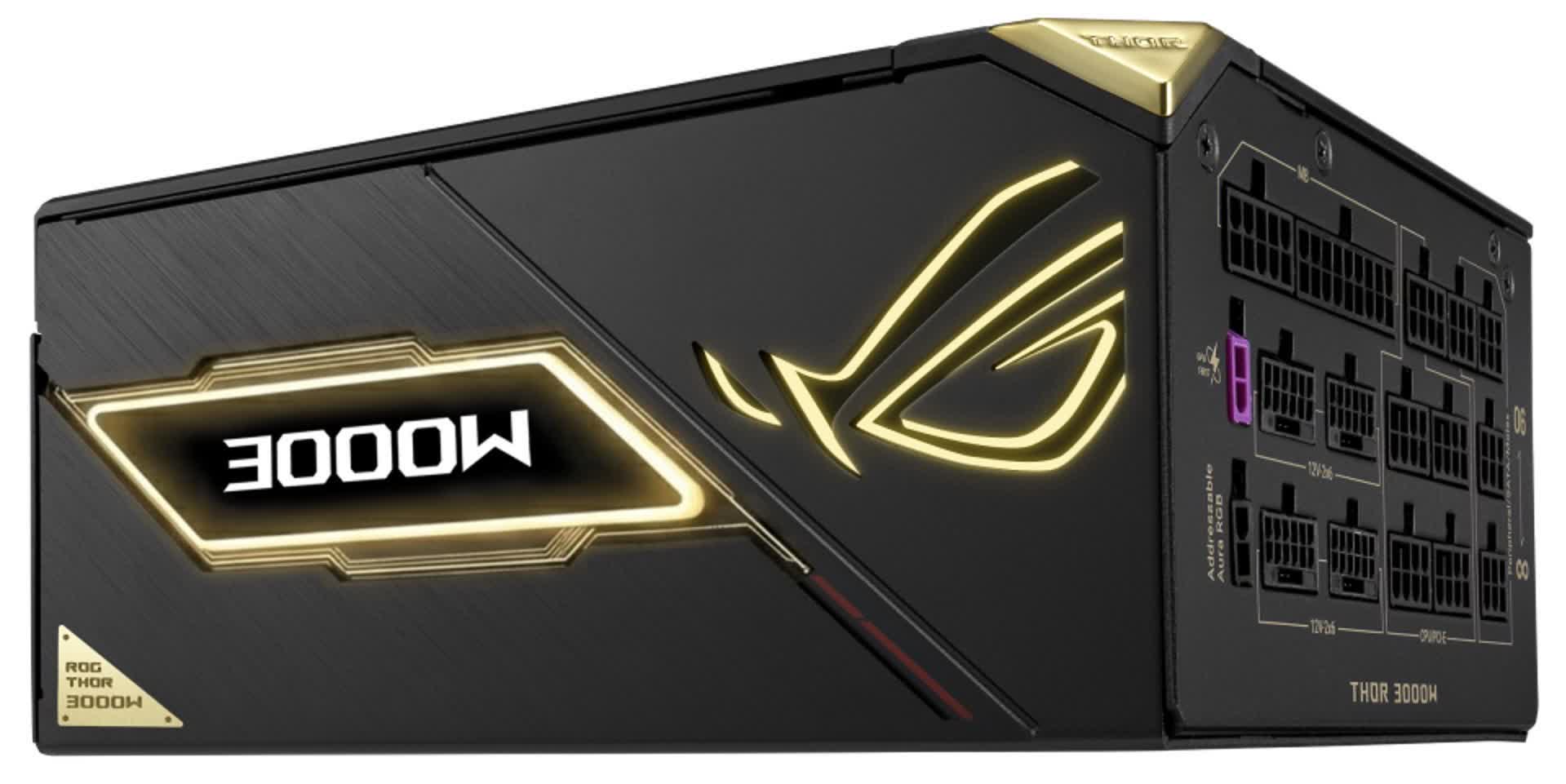
The ROG Thor 3,000W Titanium III Edition 20 is part of this year's celebration of the Republic of Gamers brand, which Asus has used for gaming-focused peripherals and hardware since 2006. The ROG lineup tends to favor a bombastic, show-off style in its product design and marketing, and the newly introduced PSU appears to fit right into that trend.

Asus officially describes the new unit as the pinnacle of power supplies in the ROG lineup. The PSU is designed to support extreme ATX12V builds, including configurations capable of powering up to four GeForce RTX 5090 GPUs. It is based on server-grade GaN MOSFETs, which are intended to improve power efficiency while reducing energy waste.

Asus said the GaN MOSFETs enable high power delivery at lower temperatures than traditional PSU designs. Furthermore, this power is reportedly managed through the company's patented "ROG Equalizer" 12V-2x6 PCIe power cable. According to Asus, the cable can help reduce operating temperatures significantly, keeping thermal performance stable and below the 105°C material limit.

Additional features of the Thor 3,000W Titanium III include the GPU-First Intelligent Voltage Stabilizer, which is designed to maintain stable voltage levels during peak overclocking scenarios. Unsurprisingly, the PSU also features an OLED display capable of monitoring several power metrics in real time. Thanks to a USB extender, the display can be positioned in different locations within a system for improved visibility.

The PSU also features a dual-voltage adaptive design, delivering its full 3,000W output in regions with 230V mains power and up to 1,600W in regions using 115V service. It comes with a 10-year warranty, an 80 Plus Titanium efficiency rating, ARGB Aura Sync support, and a range of built-in protection features.

Asus has yet to disclose pricing, though it is safe to assume the unit will cost significantly more than a typical consumer-grade PSU.

Asus introduced a different 3,000W power supply in early 2025, positioning it as a workstation- and server-oriented product. The new Titanium III model, however, is part of the ROG lineup. While the Republic of Gamers branding emphasizes gaming hardware, it is difficult to imagine many gamers needing a system capable of powering four GeForce RTX 5090 GPUs simultaneously.

Permalink to story:

 
Couldn't afford 5070Ti with those interest rates, but OK. Will be on sale soon, as peripherals manufacturers going extinct soon. High end 1kW PSUs dropped 50% in half a year already.
 
If you'd really be able to use this thing at maximum capacity, it would trip the breakers in your house. What is even the point of this thing.
You either didnt read the article or dont understand home electrical. On 115V like most houses in the USA, a 15amp breaker can supply 1600-1800watts. The power supply will only produce 1600 watts in 115 volt mode but if you have 220 avaliable in your house which can be done and is standard in other parts of the world it can supply 3000Watts
 
You either didnt read the article or dont understand home electrical. On 115V like most houses in the USA, a 15amp breaker can supply 1600-1800watts. The power supply will only produce 1600 watts in 115 volt mode but if you have 220 avaliable in your house which can be done and is standard in other parts of the world it can supply 3000Watts

Hmm, I read the article and you just randomly assumed and concluded a bunch of things.
Most outlets in my house are on 10A breakers, which can pull at maximum 2300W (10A x 230V). So I would not be able to use 3000W, unless I replace my washer/dryer which is on a 16A breaker.
 
I'd like to thank Nvidia for killing off SLI so these Facebook/Instagram showoffs with credit cards can't so easily buy up all the 5090 (best cards) to take a vanity pic of some dual or multi-GPU machine nothing but useless crypto could use.
 
"Difficult to imagine many gamers needing this" is the understatement of the year. You'd also need a dedicated 240V circuit, probably an electrician, and the kind of monthly power bill that makes your landlord personally call you. This is a data center component wearing an ROG badge.
 
Couldn't afford 5070Ti with those interest rates, but OK. Will be on sale soon, as peripherals manufacturers going extinct soon. High end 1kW PSUs dropped 50% in half a year already.
Exactly, I don't see the point in a 3000W PSU, when most components have dropped in sales 50% or more, some vendors have warehouses full of hardware that nobody is buying since there's no point in building a PC.
And the fact that nothing needs a 3000W PSU unless someone is powering more than a single 5090, and that has to be a niche within a niche of customers.
 
Hmm, I read the article and you just randomly assumed and concluded a bunch of things.
Most outlets in my house are on 10A breakers, which can pull at maximum 2300W (10A x 230V). So I would not be able to use 3000W, unless I replace my washer/dryer which is on a 16A breaker.
Then you didn’t understand the article… PSUs above 2300W have existed for a long time - and the ability to wire your house to utilize them has also existed for a long time.

While it might not be suitable (or affordable) for YOU, don’t assume that applies to everyone else.
 
Hmm, I read the article and you just randomly assumed and concluded a bunch of things.
Most outlets in my house are on 10A breakers, which can pull at maximum 2300W (10A x 230V). So I would not be able to use 3000W, unless I replace my washer/dryer which is on a 16A breaker.
How old is your house? 15 amp circuits have been code in the US since the 1930s.

(Or do you live in an outlier country)
 
How old is your house? 15 amp circuits have been code in the US since the 1930s.

(Or do you live in an outlier country)
I live in Europe. There are a bunch of different configurations possible.
Home appliances you can buy in my area max out at around 2000W (toasters, electric kettles, space heaters), because of standard 10A breakers. Dish washers and washer/dryers are usually on groups with 16A breakers.
So you're right, you can certainly make it happen, but it's not very typical to have a 3000W household appliance, you'd need to be careful not to plug it in just anywhere.

So I reckoned for most people this doesn't make sense. Is there even any consumer pc that can be configured to use 3000W?
With 2x 5090 (at 1200W) and an unlocked 13th Gen Intel processor you're still shy of 2000 W.
 
I live in Europe. There are a bunch of different configurations possible.
Home appliances you can buy in my area max out at around 2000W (toasters, electric kettles, space heaters), because of standard 10A breakers. Dish washers and washer/dryers are usually on groups with 16A breakers.
So you're right, you can certainly make it happen, but it's not very typical to have a 3000W household appliance, you'd need to be careful not to plug it in just anywhere.

So I reckoned for most people this doesn't make sense. Is there even any consumer pc that can be configured to use 3000W?
With 2x 5090 (at 1200W) and an unlocked 13th Gen Intel processor you're still shy of 2000 W.
“Most people” are clearly NOT who this PSU is geared towards!

This is a niche item able to support 4 x 5090s… not sure what you are complaining about.
 
I'd like to thank Nvidia for killing off SLI so these Facebook/Instagram showoffs with credit cards can't so easily buy up all the 5090 (best cards) to take a vanity pic of some dual or multi-GPU machine nothing but useless crypto could use.
To be fair, there's also World Community Grid and other BOINC projects that use GPUs. :)
 
This need three-phase current, for sure
If its powered by 240V, as it might be in the US or other parts of the world, the current draw would be somewhat above 12.5A because of its 80% efficiency and the fact that W = VxI where V=240 and I = 12.5 = 3000W by Ohm's Law. 240V in the US is single phase, but at 12.5A, there's no need for anything more than single phase.
 
If you'd really be able to use this thing at maximum capacity, it would trip the breakers in your house. What is even the point of this thing.
Incorrect. A standard 20A breaker @ 230V provides 4600 watts, and at 115V, the PSU only outputs 1600 watts.

How old is your house? 15 amp circuits have been code in the US since the 1930s.
My home has 20A breakers, with 30A for circuits intended for large appliances.
 
Last edited:
I live in Europe. There are a bunch of different configurations possible.
Home appliances you can buy in my area max out at around 2000W (toasters, electric kettles, space heaters), because of standard 10A breakers. Dish washers and washer/dryers are usually on groups with 16A breakers.
So you're right, you can certainly make it happen, but it's not very typical to have a 3000W household appliance, you'd need to be careful not to plug it in just anywhere.

So I reckoned for most people this doesn't make sense. Is there even any consumer pc that can be configured to use 3000W?
With 2x 5090 (at 1200W) and an unlocked 13th Gen Intel processor you're still shy of 2000 W.
Ah, I missed your earlier 230V.

Yes a typical circuit here is 1800W and beefier (non specialized) ones are 2400W. Our dryer/hot tub/run-four-5090s-at-once circuits do up to 7200W though 3600-6000W is more common for those.

This is definitely a niche product for the wealthy or silly. Although I suppose max efficiency for PSUs are usually around 50% so you could run 2 5090s "efficiently" on a typical circuit here or in Europe.
 
Although I suppose max efficiency for PSUs are usually around 50% so you could run 2 5090s "efficiently" on a typical circuit here or in Europe.
I don't know any PSUs that are only 50% max efficiency ... that's usually a "worst case" near idle figure. Gold grade PSUs are at least 90% efficient under half load, and never less than 87%.
 
Back