China just built the world's most powerful supercomputer – using Huawei chips and no GPUs

Alfonso Maruccia

Posts: 2,576   +957
Staff
Chinese Syndrome: Chinese institutions have been largely absent from the TOP500 HPC rankings since 2023, when worsening US-China relations led Beijing to stop submitting its most capable systems to the list. Now, the Asian country is hitting back with a vengeance thanks to a brand-new supercomputer system ranked as the most powerful in the world.
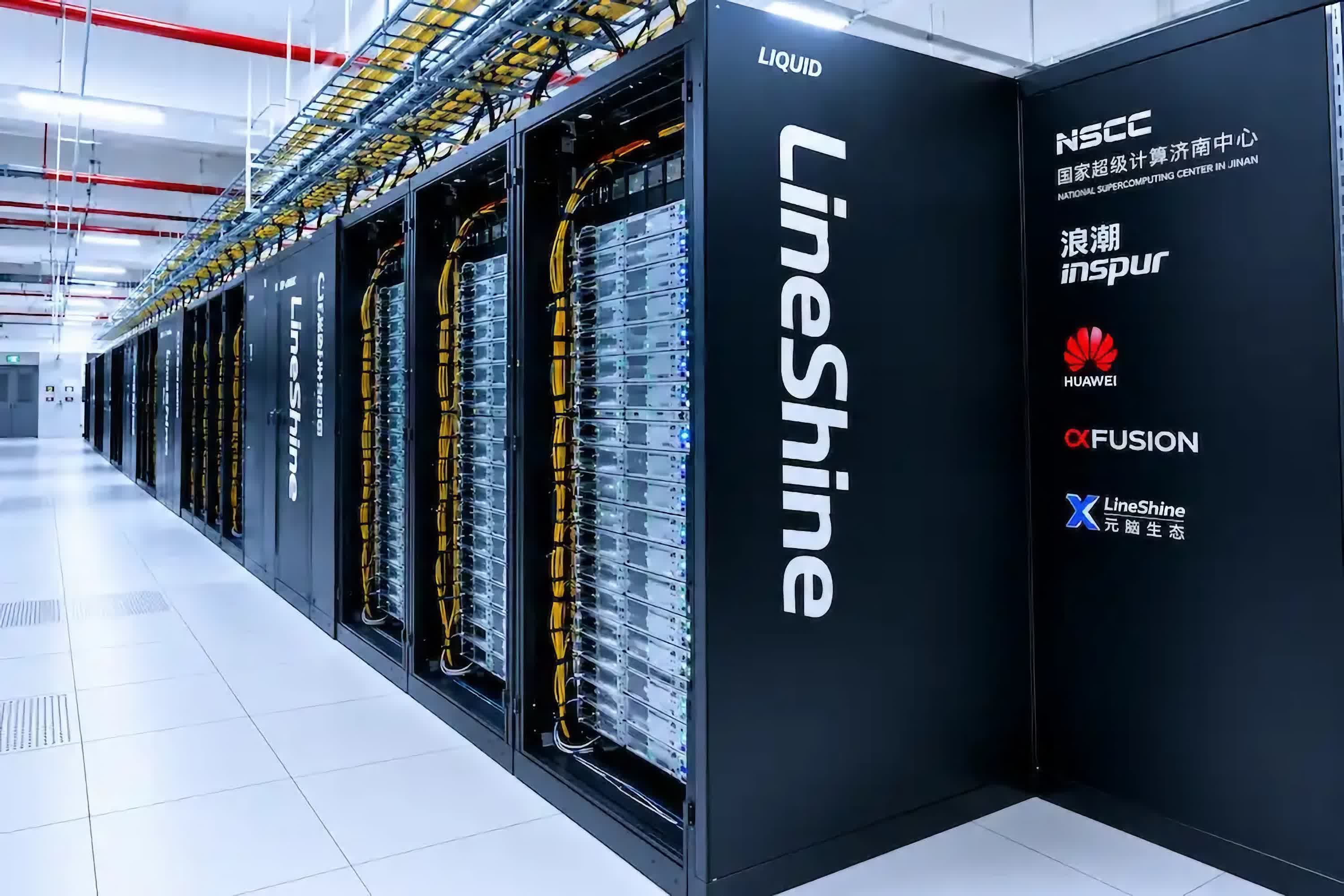
The TOP500 project has unveiled the 67th edition of its biannual ranking of the world's most powerful high-performance computing (HPC) systems. Announced at the ISC 2026 conference in Hamburg, Germany, the new list marks the surprise debut of LineShine, a previously unannounced Chinese machine that enters straight at No. 1, becoming the officially acknowledged most powerful supercomputer on the planet.

LineShine posted a 2.198 Exaflop/s result on the High Performance Linpack (HPL) benchmark, which the TOP500 organization says represents roughly 80% of the system's theoretical peak performance of 2.736 Exaflop/s. It is the first HPC system in history to exceed two exaflops of sustained double-precision performance – and it achieved this milestone using an all-CPU design, with no GPU accelerators anywhere in the stack.

TOP500 June 2026 – Top 5 Supercomputers

Rank System Site Country HPL (Exaflop/s)
1 LineShine National Supercomputer Center, Shenzhen China 2.198
2 El Capitan Lawrence Livermore National Laboratory United States 1.809
3 Frontier Oak Ridge National Laboratory United States 1.353
4 Aurora Argonne National Laboratory United States 1.012
5 JUPITER Booster Jülich Supercomputing Centre Germany 1.000

The system was installed at the National Supercomputing Centre in Shenzhen (NSCS) and built around the custom "LingKun" platform, using "LX2" processors thought to be designed by Huawei. The LX2 is based on the Armv9 architecture, with each chip integrating two compute dies (304 cores in total) plus eight on-package HBM stacks delivering 32 GB of high-bandwidth memory. The platform's 13.79 million computing cores are linked by the proprietary LingQi interconnect and run China's Kylin OS, a Linux-based operating system.

To put it in context, LineShine is a "made-in-China" HPC project: its processors, networking, and storage are all domestically developed, with the notable exception of relying on the Armv9 instruction set architecture, which was designed in the UK by Arm.
The most outstanding result is certainly reaching first place in the TOP500 rankings, scoring an unprecedented win against the US and other major HPC superpowers. US-made El Capitan was demoted to second place (1.809 Exaflop/s), though three of the five most powerful TOP500 systems – El Capitan, Frontier, and Aurora – are still based in the US.

The fifth most powerful HPC machine is Germany's JUPITER Booster, which achieved exactly 1.000 Exaflop/s on the HPL benchmark.

The TOP500 team notes several remarkable takeaways from this edition. LineShine employs an all-CPU design, while other super-systems use different kinds of CPU architectures, GPUs, APUs, or even custom-made accelerators. The ultimate take is that there is no single "best" technology for performing extreme computing workloads, at least when measured by the double-precision demands of the HPL benchmark.

According to the NSCS team, LineShine is the culmination of years of investment in developing domestic computing solutions independent of foreign supply chains. The system is currently being used for complex engineering simulations, scientific research, AI model development, and large-scale language model training.

Permalink to story:

 
The pendulum swings.
This is nowhere near the world's most powerful supercomputer. This TOP500 list is based on institutions voluntarily submitting their results ... and the most powerful computers (such as xAI's Colossus) are privately owned and don't participate.
 
It's not even the first time, china has taken top spots multiple times with their own homegrown supercomputers - and multiple times without relying on gpus at all like the sunway taihulight. They are also often surprisingly more efficient than ones using gpu accelerators. That's a trick only IBM managed to pull off in the past. And yes, participation is voluntary and it is limited to linpack and hpc - ai accelerators won't do nothing for that but these also won't do ai training or inference.
 
china [is] also often surprisingly more efficient than ones using gpu accelerators. That's a trick only IBM managed to pull off in the past.
Not true. China's LineShine beats El Capitan in the full precision benchmark by 21%, but consumes 42% more power. It's much worse in the mixed precision benchmark, where El Capitan, despite its lower power consumption, has more than double the performance of LineShine.
 
Not true. China's LineShine beats El Capitan in the full precision benchmark by 21%, but consumes 42% more power. It's much worse in the mixed precision benchmark, where El Capitan, despite its lower power consumption, has more than double the performance of LineShine.
I fear that was a misunderstanding again, I do not dispute anything you said but I did not say they were the most efficient. What I was saying was that lineshine and sunway back in the day showed impressive efficiency for being cpu only beating some mostly gpu machines that weren't ancient. Obviously that's because, like the IBM of old or the fujitsu vector machines, they are not per se general purpose cpus like in most western systems but custom tiny general purpose cores with insanely large vector units that makes them only good at linpack and the like, it's not magic. Cheers o/
 
This is nowhere near the world's most powerful supercomputer. This TOP500 list is based on institutions voluntarily submitting their results ... and the most powerful computers (such as xAI's Colossus) are privately owned and don't participate.
That comparison is misleading because TOP500 supercomputers and AI clusters are being measured at vastly different numerical precisions and for different workloads.

The Chinese system’s 2.198 exaflops figure is from HPL using FP64, or 64-bit floating-point math. That is the precision used for demanding scientific simulations where numerical accuracy matters.

Colossus is optimized for AI training, where most computation is done at BF16, FP16, FP8, or even lower precision using GPU tensor cores. Those operations can produce enormously larger “FLOPS” numbers, but they are not equivalent to FP64 scientific-computing performance.

Colossus is almost certainly far faster for training large neural networks. That does not establish that it is faster on FP64 HPL or traditional HPC workloads.

The fair statement is that the Chinese system is the fastest publicly benchmarked FP64 supercomputer on TOP500. Colossus is a specialized AI cluster and has not published a directly comparable HPL result.
 
That comparison is misleading because TOP500 supercomputers and AI clusters are being measured at vastly different numerical precisions and for different workloads.

The Chinese system’s 2.198 exaflops figure is from HPL using FP64, or 64-bit floating-point math.
That is the precision used for demanding scientific simulations where numerical accuracy matters. Colossus is optimized for AI training, where most computation is done at BF16, FP16, FP8, or even lower precision using GPU tensor cores. Those operations can produce enormously larger “FLOPS” numbers, but they are not equivalent to FP64 scientific-computing performance.
Correct. But xAI's Colossus 2 is built from some 550,000 GB200 and H100 GPUs, each having a maximum FP64 performance of 60 (H100) or 80 (GB200) TFLOPs. That gives it a maximum theoretical performance of 38.5 FP64 exaflops, or more than 18X the performance of China's Lineshine. On an actual benchmark, we'd expect a lower figure as scaling isn't perfectly linear, but Colossus 2 would certainly still take the crown.
 
"LineShine dethrones El Capitan with 2.198 exaflops, debuting at number one in TOP500 with an all-CPU Arm design"

The El Capitan just became El Subordinado...!
 
Yeah, let's make China great again. What could go wrong...
Well, looking with shock at the latest US voting, they might not be so different in a few years, if the so-called Democratic Socialists get their way. I mean, Marxist Islamist ideology........FFS. Poor old USA.

PS. I'm a Brit.
 
Yeah, let's make China great again. What could go wrong...
Those dismissing these acts by the brutal Chinese regime will certainly come to regret it; Their system is utterly incompatible with Western values. As an example from literally just hours ago, a small plane crashed into the highest skyscraper in that country. Within minutes, China's army of internet censors had removed all social media posts referencing the accident, and -- as of now -- their state-run media is enforcing a blackout, until they decide how to rewrite the event to present to their oppressed subjects.
 
Well, looking with shock at the latest US voting, they might not be so different in a few years, if the so-called Democratic Socialists get their way. I mean, Marxist Islamist ideology........FFS. Poor old USA.

PS. I'm a Brit
Well, looking with shock at the latest US voting, they might not be so different in a few years, if the so-called Democratic Socialists get their way. I mean, Marxist Islamist ideology........FFS. Poor old USA.

PS. I'm a Brit.
Yeah, the Muslims are running the Brit show. Enjoy Islam
 
Back