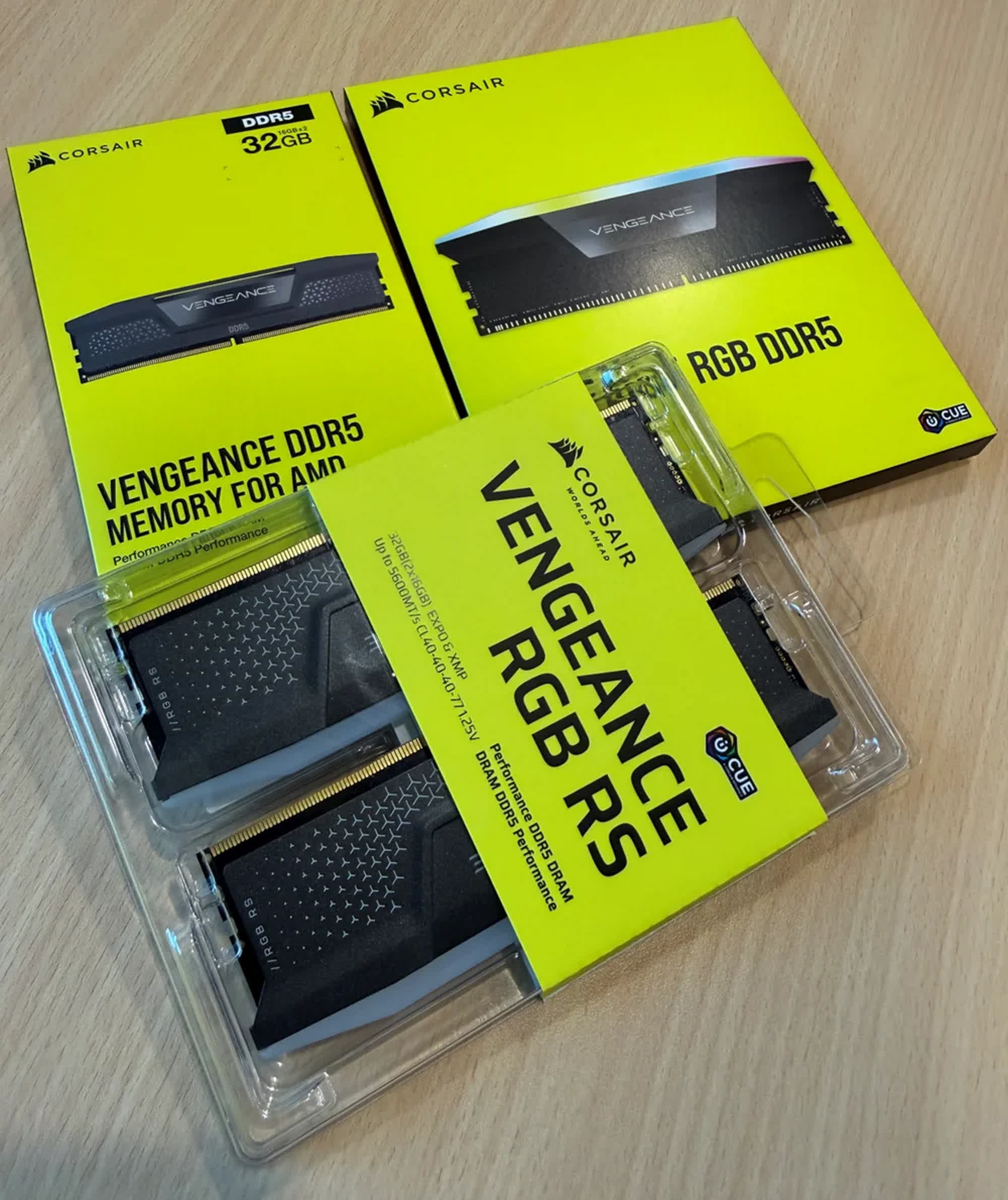
Unfortunately, I think you're wrong. The US has turned the money printers on full blast and they are aimed directly at money furnace. It's forgien companies that make all the memory and they aren't buying our US AI hype. It would take years to build new memory factories and billions of dollars to do so and they don't believe the AI boom will last. They're more than happy to make money off of selling AI hardware for the time being, but they have so little confidence in the long term profitability of AI that they won't expand capacity only to be left hold a bag that brings the cost of RAM down once the bubble bursts.
This AI thing is strictly big in the US, hardly anyone else in the world cares about. The US talks about how it wants to be a world leader in AI, makes policies to prevent other countries access to AI hardware and those countries are saying back to us "we literally didnt want your AI hardware"
But as the long as the money printers are printing and the money furnace are burning, we won't see an end to the RAM problem. It's also kinda funny that almost half of all AI hardware is just sitting in warehouses or "dark" data centers that can't be turned on.
I used to agree with this take on AI almost word for word.
I’ve been a huge skeptic of AI hype and argued against it pretty fiercely—even recently. And I still think most consumer-facing AI is borderline snake oil: flashy demos, shallow utility, and a lot of marketing dressed up as inevitability. For me, that’s still largely true when it comes to the slop companies like Microsoft and others keep bolting onto consumer products.
But something specific slightly shifted my perspective recently. I was awarded a contract to use AI to build extremely complex software prototypes for a U.S. defense contractor. No consumer focused slop. Hard engineering problems with real constraints—and effectively unlimited compute.
And I’ll be blunt: it increased my productivity by something on the order of 100x. And not in some vague “it feels faster” way, but in measurable output per day. Design cycles that would normally require multiple engineers working for months were compressed into days by a couple. Rapid iteration. Simulation support. Code scaffolding. Architecture exploration. When tuned properly, it stopped being hype and started becoming leveragable.
The catch, as I quickly discovered, is that tuning is more art than science. I think my specific background expertise allowed me to use it successfully in ways others were not able to do. Like any tool, user-skills matter.
Most people are using these systems incorrectly and applying them to the wrong categories of problems. They treat them like magic chatbots instead of probabilistic tools that require tight steering, validation layers, and deep domain knowledge. Used casually, they’re mediocre. Used deliberately, with some expertise in the how guiding them, the capability jump is real.
So I partly agree with you and partly don’t.
I absolutely agree that consumer AI adoption is wildly overhyped. I agree that outside the U.S., the cultural obsession with AI is far less intense. I agree that monetary distortion is clearly present. And I agree that some of the infrastructure build-out looks speculative and ahead of demand.
Where I hesitate is the idea that foreign manufacturers “don’t believe” in AI. The global memory and accelerator ecosystem—companies like Samsung Electronics, SK Hynix, Micron, NVIDIA, and AMD—operates on long capital cycles and strategic forecasting. Whether they’re bullish, cautious, or somewhere in between, I’m hesitant to think their decisions are being made on meme-timelines. These are multi-year, multi-billion-dollar capacity bets in an industry that cannot pivot overnight.
What I suspect we’re seeing is not disbelief, but capital cycle distortion layered on top of a technology that genuinely has asymmetric value in certain domains.
AI infrastructure right now is heavily influenced by government, defense priorities, and large enterprise spending. It’s been amplified by policy and, historically, cheap liquidity. That means capital allocation isn’t purely organic. But distorted capital allocation does not automatically imply nonexistent utility.
The “dark data center” argument is interesting. But overbuild often looks absurd before demand materializes. Fiber looked absurd in the early 2000s. Cloud capacity looked excessive before enterprise migration caught up. And In hindsight, those overbuild phases might have been messy, but they were not entirely irrational.
Where I strongly agree is that AI as a near-term consumer revolution is absurdly overstated. I don’t see a sweeping transformation of everyday life happening in any immediate future. The average person does not need a probabilistic co-pilot for most daily tasks. In fact, my experience with smart home tech proves that this is often quite undesirable once the novelty wears off.
But AI as a corporate, industrial, and military force multiplier? Based on my direct experience, that now feels quite different. In a serious engineering environment—where incentives are aligned, budgets are real, and experts are steering the system—it can meaningfully compress iteration cycles and expands what a small team can accomplish. That has some dramatic strategic implications regardless of whether or not it ever becomes a beloved consumer product.
As for the RAM shortage, I’m inclined to see it less as a narrative about belief or disbelief and more as a function of supply concentration, high-bandwidth memory reallocation, capital intensity, and the long lead times inherent in semiconductor fabrication. Memory fabs are not toggle switches. Capacity changes happen over years, not quarters.
I am still skeptical. Application matters. And I still think most of the hype-cycle is just financial theater.
But I’m no longer completely dismissive. How can I be? After seeing what properly tuned AI can do in a high-stakes technical context, I’d be very cautious about writing the entire phenomenon off as just another money-printer bubble.
Some of it absolutely is.
Some of it very clearly isn’t.
With that in mind, if other countries don’t want to compete in that space, that’s totally fine by me.