Europe's digital euro is one step closer, designed to cut out Visa and Mastercard

DragonSlayer101

Posts: 981   +14
Staff
The big picture: The European Parliament's Committee on Economic and Monetary Affairs has approved the establishment of the digital euro by a vote of 43 to 14. The digital version of the European currency is designed to facilitate fast, secure, and private transactions across the eurozone while reducing reliance on US payment network giants Visa and Mastercard.
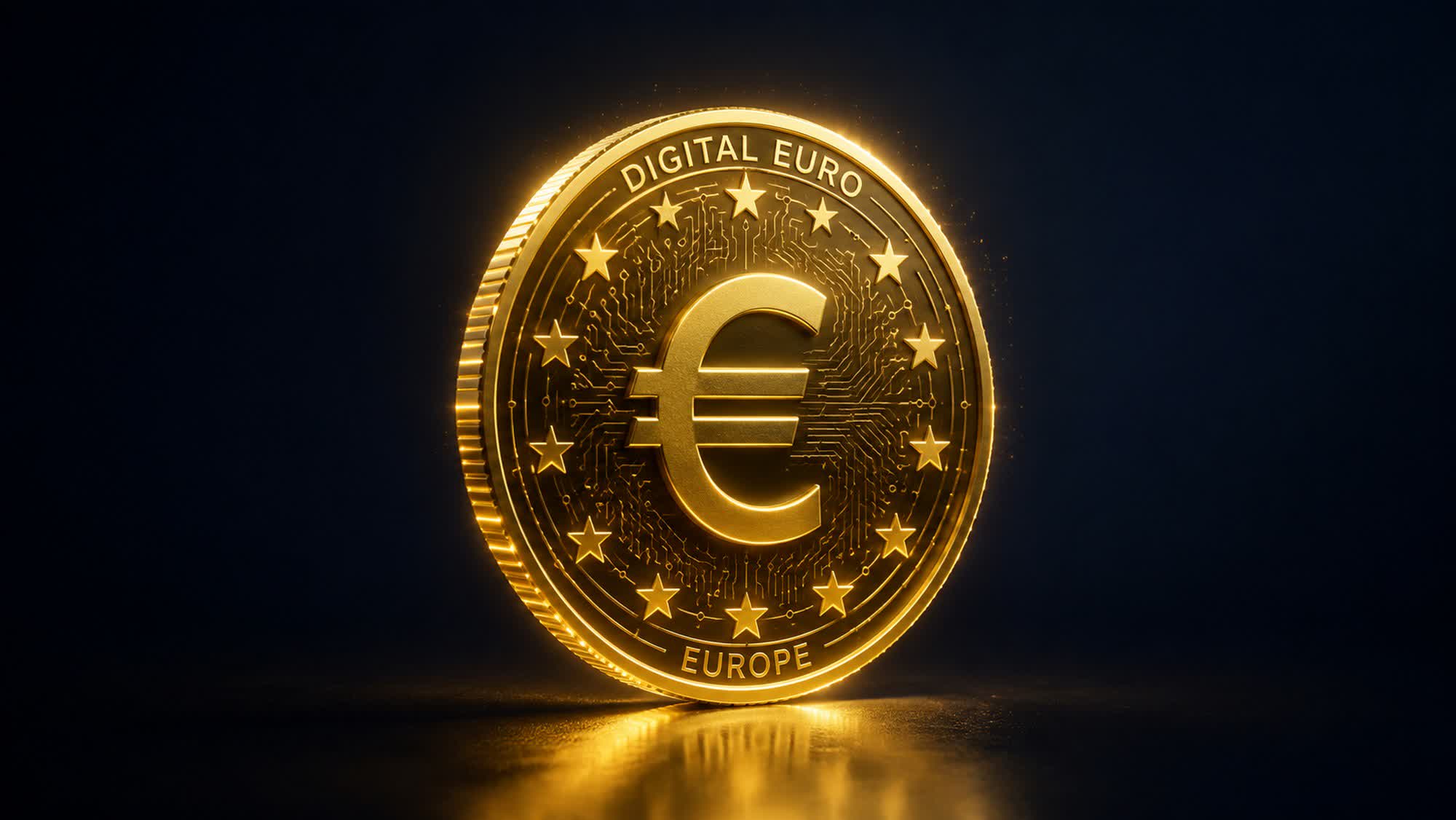
The European Parliament said the digital euro can be used to make both online and offline payments to merchants across Europe. Online payments would be processed through an account-based system, while offline payments would function more like cash, with transactions conducted directly via local storage devices such as smartphones.

The EU emphasized that the digital euro has been designed with a strong focus on privacy, using encryption and privacy-preserving technologies such as "zero-knowledge proofs." The authentication protocol is expected to allow transactions to be verified without exposing personal data to either the merchant, the European Central Bank, or any government agency.
All businesses operating within the EU, regardless of size, will be required to accept digital euro payments, with exceptions for "micro enterprises" that do not already accept other forms of digital payments.

While the digital euro is primarily designed for EU citizens, tourists and visitors from outside the eurozone will also be able to use it while traveling in Europe.

The digital euro will be free to use for consumers, but merchants will have to pay fees to the European Central Bank on each transaction. However, these fees are expected to be lower than the commissions charged by Visa and Mastercard. Financial institutions are also expected to be compensated for their role in the system, although the details have yet to be finalized.

The European Parliament is expected to formalize its approval of the digital euro during a plenary vote in Strasbourg next month. Following the vote, the ECB will begin negotiations with the EU's 27 member states, with lawmakers aiming to reach a general consensus by the end of the year.

Once the formalities are completed, the ECB plans to run a 12-month pilot of the digital euro starting in the second half of 2027, before an official launch in 2029. After launch, all payment service providers – including banks, post offices, digital wallet operators, and regulated crypto exchanges – will be eligible to distribute it to residents and visitors across the eurozone.

Permalink to story:

 
Huge win!

EU greatly reduces its reliance on US infrastructure.
Competition in a market where there is very little (and difficult to get get into).
Gets the euro another step closer to being a secondary world currency.
No money leaving the EU economy for transactions between EUropeans.
VISA/Mastercard have made it difficult for corn sites (imo that's up to the government whether you're allowed to spend your money on that - not the task of a payment provider). When companies try policing things I'm always happy to see them take a hit.
Lower prices due to lower fees.

This will be great for those in power. Horrible for everyone else who surrender more privacy and control.
How?
It's an alternative being added.
If you want to stick to using VISA/Mastercard then for now nothing will change. Getting an additional option benefits consumers, if not you than at least others.

If you want to take some cash out and use that in person - still possible.
Also, straight from the article:
The EU emphasized that the digital euro has been designed with a strong focus on privacy, using encryption and privacy-preserving technologies such as "zero-knowledge proofs." The authentication protocol is expected to allow transactions to be verified without exposing personal data to either the merchant, the European Central Bank, or any government agency.
 
Last edited:
Once these governments get us off of physical money, they are going to open up a world of fraud and grift that the human mind can't even possibly comprehend. We're talking about crimes, within crimes within crimes and no one knows what's happening.

You got it backwards; all digital transactions leave a record that makes it easier to track. By contrast, how are you going to stop all-cash transactions in a dark alley?
 
Any digital currency is a potential freedom and privacy nightmare.
Unless digital transactions are provably untraceable, which they aren't, any digital currency is a surveillance mechanism.
Even the most gullible wouldn't believe the purpose of the digital euro is "to cut out Visa and Mastercard". The obvious purpose is mass surveillance.
 
What I don't get is how everyone gets mixed up on what Visa and MC do. They are just a transaction processor, the items MOST complained about, the interest rates, late fees, most of the rules, are set by the banks. They also do not charge the consumer fees for anything, their money comes from the merchants. Almost all of the evils from MC and Visa come from the banks themselves, esp the "banks" that are set up just for handling credit cards (Capitol One, Synchrony, First Premier, etc.) If they lower fees to merchants, who pays for the bank share of the issues? Will there be any credit, or just limited to account balances? Are the banks still in charge of the terms outside of just the transaction?

The only real change will be instead of an independent private business doing the processing, the government will. The government won't have to worry what you can use the card for, they will have everything they need to trace everything, including what you would now pay cash for.

Great idea, isn't it?
 
Huge win!

EU greatly reduces its reliance on US infrastructure.
Competition in a market where there is very little (and difficult to get get into).
Gets the euro another step closer to being a secondary world currency.
No money leaving the EU economy for transactions between EUropeans.
VISA/Mastercard have made it difficult for corn sites (imo that's up to the government whether you're allowed to spend your money on that - not the task of a payment provider). When companies try policing things I'm always happy to see them take a hit.
Lower prices due to lower fees.


How?
It's an alternative being added.
If you want to stick to using VISA/Mastercard then for now nothing will change. Getting an additional option benefits consumers, if not you than at least others.

If you want to take some cash out and use that in person - still possible.
Also, straight from the article:
The most authoritative independent critique comes from the EU's own data protection regulators (EDPB and EDPS — independent of the ECB), not the ECB itself. In their joint opinion they flagged that to enforce the holding limit, the ECB and national central banks established a single access point that processes identifiers of digital euro users and their holding limits.

That single access point is the crux. Even if the ECB doesn't see your name attached to each coffee purchase, a centralized registry linking identities to holdings is exactly the infrastructure that makes a CBDC a surveillance concern. The regulators are saying the architecture didn't have to be built that way and questioning why it was.

A separate independent worry, from civil-liberties groups like EDRi, is broader: they argue the EU's wider digitalization push risks enabling surveillance and profiling through centralized data systems and excluding offline citizens, calling for a legally enforceable "right to analog." That's directed at the whole digital-ID/digital-payments stack, not the digital euro alone, but the holding-limit registry feeds the same concern.
 
You got it backwards; all digital transactions leave a record that makes it easier to track. By contrast, how are you going to stop all-cash transactions in a dark alley?
What happens if an "offline" transaction is able to be recorded on one device without involvement from another? This would mean a private key was stolen or there's a flaw in the cryptography somewhere. The device that made up the fake transaction (receiving money) would need to create this "zero-knowledge proof" that a second device didn't authorize. This essentially causes the duplication of money.

Later the ledgers on the two devices are reconciled via sync with an online system. If it's a blockchain system, the device with the fake proof wins as long as it happened before the second device. The second device's future transaction are all nullified as potentially fraudulent. If it's not a blockchain system (and relies on a balance or which token(s) were transferred), then once again the second device contains potentially fraudulent activity (trying to hide that it "overused" money). If all the money was stolen, then that device is now in debt with people who expected to rely on that money.

More than likely, the digital Euro system will rely on frequent online syncs so that fraudulent transaction can be detected right away and both parties can be notified immediately. That means it really isn't an "offline" system at all, and depends heavily on European servers (making it more costly). If they wanted to make it heavily cautious, then any discrepancy will require freezing both sides until it can be investigated/resolved. Of course, nefarious actors can take advantage of this situation with sophisticated attacks too (faking giving or receiving money when either device is offline). It's really no different from a digital mugging in a dark alley.
 
What happens if an "offline" transaction is able to be recorded on one device without involvement from another? This would mean a private key was stolen or there's a flaw in the cryptography somewhere. The device that made up the fake transaction (receiving money) would need to create this "zero-knowledge proof" that a second device didn't authorize. This essentially causes the duplication of money.

Later the ledgers on the two devices are reconciled via sync with an online system. If it's a blockchain system, the device with the fake proof wins as long as it happened before the second device. The second device's future transaction are all nullified as potentially fraudulent. If it's not a blockchain system (and relies on a balance or which token(s) were transferred), then once again the second device contains potentially fraudulent activity (trying to hide that it "overused" money). If all the money was stolen, then that device is now in debt with people who expected to rely on that money.

More than likely, the digital Euro system will rely on frequent online syncs so that fraudulent transaction can be detected right away and both parties can be notified immediately. That means it really isn't an "offline" system at all, and depends heavily on European servers (making it more costly). If they wanted to make it heavily cautious, then any discrepancy will require freezing both sides until it can be investigated/resolved. Of course, nefarious actors can take advantage of this situation with sophisticated attacks too (faking giving or receiving money when either device is offline). It's really no different from a digital mugging in a dark alley.
Why would that happen in a blockchain system? Normally you have to keep beating every other system calculating the blockchains validity and continue to do so to keep the money. That's a ton of power depending on the algorithm for the hashing. It's also what made bitcoin impossible to steal directly.
 
... Almost all of the evils from MC and Visa come from the banks themselves, esp the "banks" that are set up just for handling credit cards (Capitol One, Synchrony, First Premier, etc.) ...
The only real change will be instead of an independent private business doing the processing, the government will.
There is one big difference. MC/VISA are USA controlled and have proven many times over to be a political tool of that empire.
 
This will be great for those in power. Horrible for everyone else who surrender more privacy and control.

You think that visa/MC are some benevolent businesses? That they don’t serve the elites that own them and the political masters who ultimately influence them?

Please.

Anything that breaks up their hegemony is good for consumers in the area of personal credit and finance and maybe it will force down interest rates charged.
 
What I don't get is how everyone gets mixed up on what Visa and MC do. They are just a transaction processor, the items MOST complained about, the interest rates, late fees, most of the rules, are set by the banks. They also do not charge the consumer fees for anything, their money comes from the merchants. Almost all of the evils from MC and Visa come from the banks themselves
You do realise visa and MasterCard threatened steam and other companies to stop handling their payment because they decided that steam sell immoral games, right?

And you know visa and MasterCard banned eu politicians and activists from using their payment system for political reasons? Leaving no alternatives? https://www.theguardian.com/technol...rtment-visa-ban-former-eu-commissioner-europe

So, this is alternative. No one will force it, but foreign country won't have ability to use payment system as leverage to push their politics, or weird morals, influence. For me, that's a win.
 
As bad as banks, MC/Visa are, I'd rather have THEM doing it than government any day!
That's what Americans once said about Their private health system, and now 99% of Them has to hope They will not lose Their job JUST before cancer diagnosis, or similar. Yes, private will always be more efficient then state, but private will drive You dry eventually, while politicians has an election cicle to care for - cannot steal too much.
 
What I don't get is how everyone gets mixed up on what Visa and MC do. They are just a transaction processor, the items MOST complained about, the interest rates, late fees, most of the rules, are set by the banks. They also do not charge the consumer fees for anything, their money comes from the merchants. Almost all of the evils from MC and Visa come from the banks themselves, esp the "banks" that are set up just for handling credit cards (Capitol One, Synchrony, First Premier, etc.) If they lower fees to merchants, who pays for the bank share of the issues? Will there be any credit, or just limited to account balances? Are the banks still in charge of the terms outside of just the transaction?

The only real change will be instead of an independent private business doing the processing, the government will. The government won't have to worry what you can use the card for, they will have everything they need to trace everything, including what you would now pay cash for.

Great idea, isn't it?

So, you don't think the fees that MC / Visa hit the merchants with are passed on to you and you end up paying MC and Visa indirectly?? Nah, that can't be true!! As a business owner, let me tell you a little open secret: YES, YOU DO pay for them!!

You haven't seen a gas station (and tons of other businesses) in the US with 2 different prices: Cash / with a credit card, have you? What happens when you pay with a credit card?? Bingo!!

You mean the same people who believed that Mexico "will pay for the wall" and "China will pay for the tariffs" haven't found out yet that the US taxpayer has paid for both?????????
 
So, you don't think the fees that MC / Visa hit the merchants with are passed on to you and you end up paying MC and Visa indirectly??
You don't realize that the "digital Euro" will have similar fees, possibly even higher?

You mean the same people who believed that Mexico "will pay for the wall"
Mexico more than paid wall construction costs: their agreement to hold asylum seekers on their side of the border while claims were being heard saved the US more than 15X what was spent on the wall. People are still scratching their heads as to why Biden ended that policy Day 1 in office.
 
You got it backwards; all digital transactions leave a record that makes it easier to track. By contrast, how are you going to stop all-cash transactions in a dark alley?

Bro, cash is completely anonymous. If you value privacy, you ought to value cash. If you’re so naive to think because everything is on a public ledger, that the government and criminals will make their actions for all to see. Wake up dude, the transparency is for US so THEY can know what we’re up to and where OUR money is going. Loss of cash will be the single biggest loss of freedom in the history of mankind.
 
Back