Flock's fastest-growing business is 60 mph police drones that can read license plates from the sky

midian182

Posts: 11,836   +179
Staff member
A hot potato: There have been plenty of headlines about Flock's license plate-scanning technology lately, but that's not its only controversial business. The company says its Drone as First Responder, or DFR, tech – which can also read license plates from the air – is its fastest-growing segment.
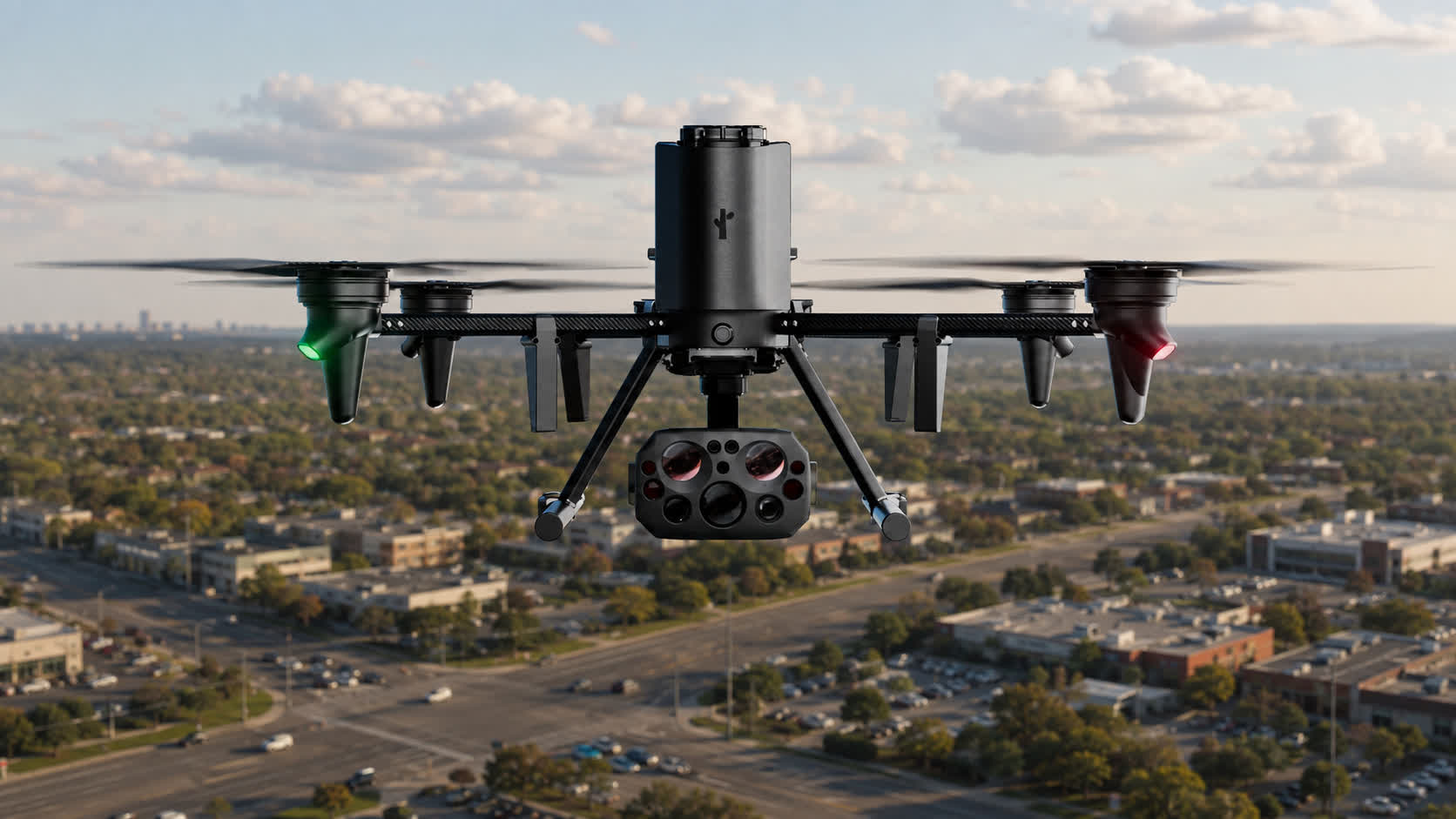
Flock is best known for the roadside cameras now operating in more than 6,000 US communities. But the company is increasingly betting on drones that can be dispatched to emergency scenes before police officers arrive.

A Flock spokesperson said the firm has secured more than 200 DFR customers, including police departments and private companies. It's also ramping up production of its US-designed drones, which will be built in Georgia.

In an interview with the All-In podcast, CEO Garrett Langley explained that the drones sit in climate-controlled rooftop docks, usually on police precincts or fire departments. "When a 911 call happens, instead of sending an officer first, you can send a drone," he said.

The aircraft can fly at 400 feet and reach 60 mph, while a 40x optical zoom allows operators to inspect the scene from a distance. Flock says its DFR system arrives in an average of 86 seconds and can resolve 20% of calls without an officer being sent.

Langley described a case in the Dallas-Fort Worth area in which a woman at a gas station called 911 after seeing a man pacing with what she believed was a gun. The drone arrived in under a minute and revealed that the object was a lighter. "Normally what would happen... is like one cop would have heard that, flip on the blue lights, race down there... and someone's about to die. Instead, they launch the drone," Langley said.

Flock presents the incident as an example of how DFR can de-escalate dangerous encounters and prevent unnecessary police deployments. It was previously reported that Dearborn, Michigan, has adopted a similar Skydio system that can reach incidents in around 2.5 minutes.

Like its numberplate-reading tech, the rapid spread of DFR programs is raising concerns. As of February, more than 1,000 public safety agencies had received FAA waivers needed to automate drone operations.

The EFF warns that the aircraft can observe people through windows, in backyards, and on roofs without their knowledge. Flock also added license plate-reading capabilities to its drones last year, effectively creating flying versions of its controversial roadside cameras. The Flock Alpha drone can read license plates from up to 2,000 feet away.

Flock says DFR only activates for calls for service and that every flight is logged, auditable, and displayed through a public-facing transparency dashboard.

Langley said most customers publish audit logs and flight patterns, albeit with a delay for active investigations. But he acknowledged that oversight remains limited. "There's very little state regulation. There's zero federal regulation outside of air safety," he said.

Flock's core cameras have produced large numbers of false alerts, while officers have allegedly used its systems to stalk partners and ex-girlfriends. Moving the same surveillance capabilities into the sky will likely amplify calls for more protections and make people even angrier.

Permalink to story:

 
"There is no reasonable expectation of privacy in public."
the Supreme Court has already ruled on this.

Furthermore: There is no constitutional right to drive.

If you're worried about your privacy, I suggest you buy a Metrocard and a niqab.

You have every right NOT to drive.

I don't like traffic anyway.
 
"There is no reasonable expectation of privacy in public."
the Supreme Court has already ruled on this.

Furthermore: There is no constitutional right to drive.

If you're worried about your privacy, I suggest you buy a Metrocard and a niqab.

You have every right NOT to drive.

I don't like traffic anyway.
Yet, if you follow someone in public with a camera recording them, you will be arrested for stalking.

And it goes beyond recording in the moment. Nobody consented for their license plate Info, travel data, ece to be collated by a private company and sold to the highest bidder. That goes beyond privacy in public.
 
Last edited:
Yet, if you follow someone in public with a camera recording them, you will be arrested for stalking.

And it goes beyond recording in the moment. Nobody consented for their license plate Info, travel data, ece to be collated by a private company and sold to the highest bidder. That goes beyond privacy in public.


If you Follow someone in public you will be arrested for stalking.

If you record someone in public, there's nothing they can do about it but leave.

As for consenting to license plate info: YES YOU DID. There is no right to drive. It's a privilege.
 
I am 100% behind using these in a First Responder situation while police are in route. They can usually get there faster and provide critical information to possibly save lives.

I am 1000% against using these for general observation of the general public.
 
I am 100% behind using these in a First Responder situation while police are in route. They can usually get there faster and provide critical information to possibly save lives.

I am 1000% against using these for general observation of the general public.


You can't have one without the other.
 
I am 100% behind using these in a First Responder situation while police are in route. They can usually get there faster and provide critical information to possibly save lives.

I am 1000% against using these for general observation of the general public.

We do this right now.

Many larger cities in the US (including my own) have drone programs, to where drones are immediately dispatched to certain calls ahead of time to canvas the area and provide responding officers with a sitrep of what they’re walking into.
 
If you Follow someone in public you will be arrested for stalking.

If you record someone in public, there's nothing they can do about it but leave.

As for consenting to license plate info: YES YOU DID. There is no right to drive. It's a privilege.
No, you didn't.

The right to drive, or lack thereof, has nothing to do with private companies recording and selling your data. Stop confuaing these two arguments.
You can't have one without the other.
Yes, you can.
 
"There is no reasonable expectation of privacy in public."
the Supreme Court has already ruled on this.

Furthermore: There is no constitutional right to drive.

If you're worried about your privacy, I suggest you buy a Metrocard and a niqab.

You have every right NOT to drive.

I don't like traffic anyway.
The default is every individual is born with inalienable rights - NOT the individual gets whatever rights the government decides they will allow them to have (until they change the rules again).

The difference is tyranny.

But sadly propaganda has convinced many that the latter is obviously the way it is supposed to be.
 
Last edited:
If you Follow someone in public you will be arrested for stalking.

If you record someone in public, there's nothing they can do about it but leave.

As for consenting to license plate info: YES YOU DID. There is no right to drive. It's a privilege.

As I pointed out before:

"The RIGHT of a CITIZEN to TRAVEL UPON THE PUBLIC HIGHWAYS and TO TRANSPORT HIS PROPERTY THEREON in the ordinary course of life and business is A COMMON RIGHT which he has under his RIGHT TO ENJOY LIFE AND LIBERTY.... It includes the RIGHT in so doing to use the ordinary and usual conveyances of the day; and under existing modes of travel includes the RIGHT to drive a horse-drawn carriage or wagon thereon, or TO OPERATE AN AUTOMOBILE THEREON for the usual and ordinary purposes of life and business. It is NOT A MERE PRIVILEGE, like the privilege of moving a house in the street, operating a business stand in the street, or transporting persons or property for hire along the street, which the city may permit or prohibit at will. Thompson v. Smith, 154 S.E. 579, 1929".

RIGHTS can not be voided by presidential fiat or congressional passage of a law, or by courts unlawfully, outside the LIMITS imposed by the Constitution, making law. Under our system, even Amendments cannot void the Bill of Rights; our Rights are not granted, but are pre-existing and guaranteed. So they can not be taken away. We can only surrender them, and if we choose not to . . .

--- shovelDriver, 2013-01-14 ( http://washington.cbslocal.com/2013...warrantless-blood-tests-in-dui-cases/#respond )

IIRC, someone responded to that comment by saying that the court decision was not binding except for that case. However, that begs the question of why any court decision is respected, since the law is supposed to apply equally to all. Obviously that is not accurate, but it does point out that courts make egregious mistakes all the time. That being so, what makes any court decision the correct one?

If we choose original intent, all we have to do is look at the history books. Licenses, gun laws, and almost every other administrative fiat was considered unconstitutional by the Founders. What changed? The so-called 16th Amendment (which even the Court acknowledged a few months afterward, had not met constitutional requirements for passage (but it's too late now), and everything that followed . . .
 
Back