Ford unveils $30,000 electric pickup and new platform to counter Chinese EVs

Skye Jacobs

Posts: 2,012   +59
Staff
What just happened? Ford's new Universal EV Platform will support a family of future electric models, with flexibility for different battery chemistries and export potential. With billions already invested and sweeping manufacturing changes, Ford bets that affordability, efficiency, and American engineering can defend against a rapidly evolving global EV landscape.

Ford has announced a significant new initiative aimed at countering the growing presence of inexpensive Chinese electric vehicles. The Wall Street Journal notes that plans to produce an affordable electric pickup for the US market are already underway. The $30,000 electric truck should land in dealerships in 2027.

A $2 billion overhaul of Ford's Louisville, Kentucky, manufacturing facility will anchor the development, as it transforms the plant into a production center for the automaker's next-generation EVs. The factory in Louisville will employ 2,200 hourly workers, with officials citing opportunities for future expansion.

The move comes at a time when American automakers face mounting pressure from Chinese competitors, who have gained international market share with low-cost, efficient EVs loaded with advanced digital features. While high tariffs and regulatory barriers have slowed Chinese vehicles' entry into the US, their rapid expansion elsewhere has forced legacy players like Ford to rethink strategies. Companies like BYD lead this global charge.
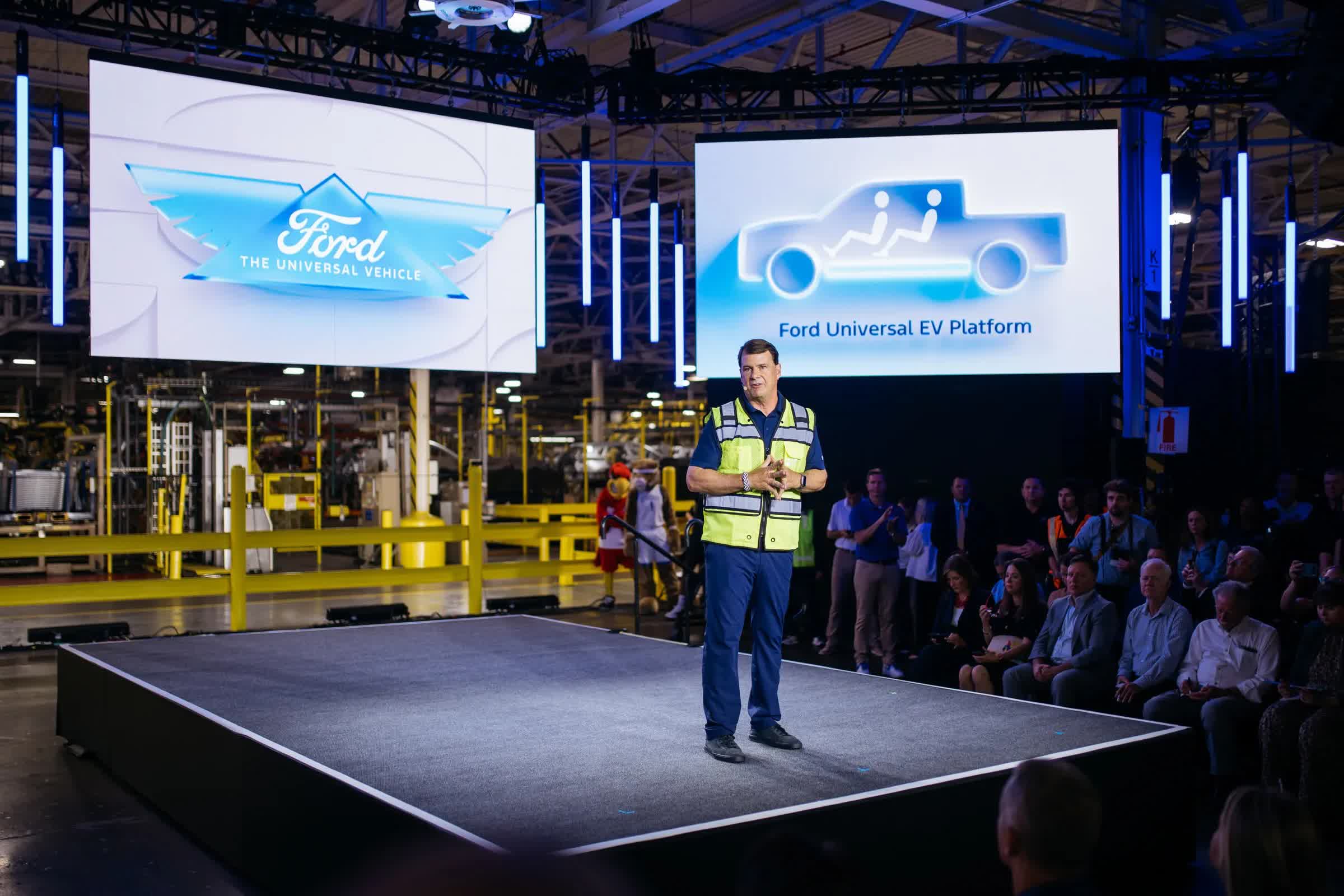
The company's leadership positions the project as a pivotal moment in Ford's Universal EV Program.

"We adopted a bold strategy to tackle a significant challenge: to design affordable vehicles that satisfy customers in every important aspect – including aesthetics, innovation, adaptability, spaciousness, driving enjoyment, and ownership costs – all while employing American workers," said Ford CEO Jim Farley.

The company has stated that its new EVs will employ a streamlined manufacturing process that reduces the number of parts by 20 percent. For example, the wiring harness in the new pickup will be 4,000 feet shorter and 10 kilograms lighter than those used in previous electric models.

The assembly process abandons the traditional single conveyor approach in favor of three parallel lines that converge, a change Ford believes will improve efficiency by 15 percent. Large, single-piece aluminum castings will replace dozens of smaller components, and ergonomic workstations will make the manufacturing process safer and more efficient.

A crucial technical detail is Ford's use of lithium iron phosphate batteries, which cost roughly 35 percent less to manufacture than traditional nickel- and cobalt-based cells. The battery pack integrates into the vehicle's floor, saving space and contributing to a quieter ride. Ford is investing an additional $3 billion in a Michigan battery facility to support domestic production of these power packs starting in 2026.
Despite the technical innovations and cost-saving measures, Ford executives have acknowledged the risks associated with building smaller, less expensive vehicles in the US. This market has historically favored larger pickups and SUVs. Ford's EV division reported a $5 billion loss in 2024 and expects further losses in 2025.

"I can't tell you with 100% certainty that this will all go right," Farley said. "This is a risk."

Broader industry challenges also loom. Electric vehicle demand in the US has softened after an initial surge, and federal policy changes will likely impact consumer affordability further. The scheduled end of a $7,500 federal tax credit for new and leased EVs in September exemplifies these shifts. Meanwhile, rivals such as Tesla and General Motors are revisiting their electric vehicle strategies, slowing new model rollouts amid weaker demand and increased overseas competition.

Ford's planned electric pickup will compete in a segment increasingly targeted by Chinese manufacturers. For comparison, BYD's mid-range Sea Lion EV offers more extended range and a lower starting price than Ford's Mach-E crossover. However, tariffs rose from 25 percent to 100 percent in May 2024, giving domestic manufacturers a window to develop more competitively priced EVs.

Permalink to story:

 
Does anyone believe this? All Farley has said here is " this is our model t moment" while belching the empty promises other automakers made 5 years ago. You can't even make a gas maverick for under $30k but I'm to expect you can make an electric SUV for $30k?

And it is of course only 2 years away, as always. And it will have MULTIPLE iPads on the dashboard instead of buttons because gosh darn we love our iPads! Thank God Honda learned their lesson....

Better move for Ford would be getting their atrocious quality control fixed. Over 90 recalls this year, more than the next 5 combined. IIRC ford now sits at over half of all recalls for 2025.
 
US Automakers have been over-promising and under-delivering for a long time, so I am skeptical. However I also believe that after two decades of electric car improvement, companies like Ford should have learned a few things and should be dramatically improving their offerings. However what I do not want is an abundance of electronic garbage bling and screen-controlled everything. Give me physical buttons and switches for everything, like the old days. If the car needs a video display for important information, fine, but please don't make me use that to open the trunk, operate the air conditioner, or tune the radio.
 
I am a bit pessimistic about it after Amazon electric truck.
What was its price, something like 25k? How much more
can they add for extra 5k? Are they going to add power windows
or other things a typical driver treats as a must have?
How much will they have to sacrifice to offer a 30k EV truck?
Battery range is the main suspect. And with vehicles that are supposed to carry heavy weight and therefore lose power quicker, it is a main issue in EV trucks.
It seems to me in general like an EV truck designed for real work is a bad idea right now.
 
Why does Ford keep trying with the pickup? Most pickup truck buyers don't want an EV. Doesn't sound like Ford knows their market very well. They should be making cheap, fun Focus sized EV's to start with. I'm not negating there are some people out there who would like and appreciate an EV pickup, but it isn't the majority. There are plenty of American's who still want a CAR, believe it or not.
 
The real challenge may be cultural as much as technical. The US market has favored large trucks for decades, and convincing those buyers to adopt a smaller electric pickup will require more than price and efficiency
 
You mean like the Ford Maverick? Was $20,000 now around $40,000!

Of course it is. The Navigator is well over $100,000. How else can they afford to loose money on the EV business. Think about this, Ford lost $5.5 billion last year alone in the EV boondoggle, yet made a profit?
That's because Farley will never give up his electric joke, and gouges every gas engine customer for everything they can to pay for the EV fantasy.

This clown needed to go years ago. Ford got rid of DEI, now they need to axe the guy who embraces the EVs at all costs.
 
Why does Ford keep trying with the pickup? Most pickup truck buyers don't want an EV. Doesn't sound like Ford knows their market very well. They should be making cheap, fun Focus sized EV's to start with. I'm not negating there are some people out there who would like and appreciate an EV pickup, but it isn't the majority. There are plenty of American's who still want a CAR, believe it or not.
Ford makes billions selling pickups, so that's their motivation. I agree that many truck buyers don't want electric right now. However Ford should devlop a platform that can be used for cars and light trucks. Most pickup trucks these days are just hauling the kids to the shopping mall. Don't need 4x4 or heavy duty capability for that. Offer a sensible electric platform in a variety of styles, while also selling ICE vehicles.
 
My dad sold Ford's from the time I was 6 years old in 1965, to 2000. My fondest memory is in 68 he had just come home and we were eating dinner. He asked if I wanted to go to the town 12 miles away, to watch our school play basketball against our "rival" town. We walk outside and my jaw dropped. Candy Apple Red Mach1. The road to the game was one of those hilly/curvy roads, and back then, the speed limit was
70mph. I still remember that clock, just above the dashboard.
I've driven NOTHING but Ford's since I got my license in the 70's. Have owned 5 Mustang's and still drive one.
But, the problem with Ford (and other American car companies), is they are not run by "car guys"!
Heck, I bet most of the CEO types have a limo they ride around in. All they worry about is THE STOCK
PRICE! Not customer satisfaction.
In the 70's, during the oil crisis, gas went up, and the Japanese swooped in with smaller fuel efficient
vehicles (a lot were junk) and American's gave up their big engine cars that had such a large trunk,
you could sneak 4-5 people into a drive in movie theater! LOL
Sadly, I don't know if I will own another FORD vehicle if/when my 2011 finally dies. These cars today
have WAY TOO MANY cameras, sensors, IPAD screens, computers and what not.
Ummm the responsibility to operate a vehicle is on THE DRIVER. Not some stupid computer that beeps
at you if you take your eyes off the road for 2-3 seconds. I guess I'm "old school". I prefer buttons, knobs, slides etc. I can keep my eyes on the road, and use one hand to adjust the climate controls, turn the volume up/down etc. With these IPAD thingys, you pretty much have to look at them to hit the right
area. Heck, I even still drive a manual transmission! (kind of a "new" security feature since a lot of people can't drive a manual LOL)
 
The real challenge may be cultural as much as technical. The US market has favored large trucks for decades, and convincing those buyers to adopt a smaller electric pickup will require more than price and efficiency
The maverick has been flying off shelves and Ford can't keep up with demand. The hybrid is nearly impossible to find on lots.

It doesn't take much to convince Americans. Make a good small truck at a fair price, and people will buy it. Charge $50k+ for a penalty box on wheels and it rots on the lot.
 
Does anyone believe this? All Farley has said here is " this is our model t moment" while belching the empty promises other automakers made 5 years ago. You can't even make a gas maverick for under $30k but I'm to expect you can make an electric SUV for $30k?

And it is of course only 2 years away, as always. And it will have MULTIPLE iPads on the dashboard instead of buttons because gosh darn we love our iPads! Thank God Honda learned their lesson....

Better move for Ford would be getting their atrocious quality control fixed. Over 90 recalls this year, more than the next 5 combined. IIRC ford now sits at over half of all recalls for 2025.
" And it will have MULTIPLE iPads on the dashboard instead of buttons because gosh darn we love our iPads! " Why would anyone come to this conclusion without any evidence to support it? Why form an opinion at all about it, certainly one you're willing to share? My opinion is "we'll see" and that's it. No point in getting upset for a made up situation that hasn't happened.
 
Why does Ford keep trying with the pickup? Most pickup truck buyers don't want an EV. Doesn't sound like Ford knows their market very well. They should be making cheap, fun Focus sized EV's to start with. I'm not negating there are some people out there who would like and appreciate an EV pickup, but it isn't the majority. There are plenty of American's who still want a CAR, believe it or not.
Because there is likely a market for "small" pickups that is being ignored right now.

Pickups got larger because larger vehicles get better crash ratings (because physics; more mass=more inertia=lower accelerations during a crash) and because you can fit larger engines and transmissions in them, boost hauling & towing capacity.

But EVs kind of flip this on its head. Between an ICE and EV of equivalent 'volumes', the EV is going to be more massive and have a lower center of gravity (so they get better crash ratings). And EVs also get higher torque out of their motors, so they can haul & tow a surprising amount for their size. So a small EV truck can likely get just as good crash ratings and move just as much as a larger ICE truck.

I know that I would personally be very interested in an old "90s/00s" Maverick or Tacoma/Hilux sized EV truck. Small, fits in a typical parking space, isn't a land yacht, but can still fit some plywood or lumber in the bed. Especially if the out-the-door price is sub $40k.
 
" And it will have MULTIPLE iPads on the dashboard instead of buttons because gosh darn we love our iPads! " Why would anyone come to this conclusion without any evidence to support it? Why form an opinion at all about it, certainly one you're willing to share? My opinion is "we'll see" and that's it. No point in getting upset for a made up situation that hasn't happened.
Perhaps you should look up the newest videos from Ford, with their "next Gen experience"? You will see, loans behold, two stacked screens in the center console, with no button in sight!

 
Because there is likely a market for "small" pickups that is being ignored right now.

Pickups got larger because larger vehicles get better crash ratings (because physics; more mass=more inertia=lower accelerations during a crash) and because you can fit larger engines and transmissions in them, boost hauling & towing capacity.

But EVs kind of flip this on its head. Between an ICE and EV of equivalent 'volumes', the EV is going to be more massive and have a lower center of gravity (so they get better crash ratings). And EVs also get higher torque out of their motors, so they can haul & tow a surprising amount for their size. So a small EV truck can likely get just as good crash ratings and move just as much as a larger ICE truck.

I know that I would personally be very interested in an old "90s/00s" Maverick or Tacoma/Hilux sized EV truck. Small, fits in a typical parking space, isn't a land yacht, but can still fit some plywood or lumber in the bed. Especially if the out-the-door price is sub $40k.
It's a common misconception that trucks have "gotten bigger". This is untrue. Half ton trucks have been roughly the same size since the 60s. My 1991 f250 has the same width and length dimensions as a modern f250 of the same cab and bed layout. What has changed has been the height, and that is largely down to the demands for higher tow ratings (needing better brakes which means bigger rims) and pedestrian safety making those huge flat noses mandatory.

Now the small trucks, those have grown substantially, much to the chagrin of owners, but then the maverick comes out and outsells everything but the Tacoma (hey consumers if you want smaller trucks stop buying the big ones kthnx).
 
"Ford unveils $30,000 electric pickup and new platform to counter Chinese EVs"

China is unstoppable no matter what US does...!
 
Ford is losing billion$ on EVs at twice that price so they have zero chance making a profit with low cost EVs. Legacy auto has dealers that cost them thousands on each EV so they better stick with ICE vehicles for now.
 
Last year I was considering a new truck, checked the dealership, for something nice, beefy, and fully-blinged. It'd end up being for more than my house was valued. A steady, noticeable, hefty price hike YOY over the past 20 years.
Now, apparently, it, apparently, actually is possible to produce a vehicle for 1/4 or 1/5 the price of the blingiest 4-wheel beast. Perhaps Ford, and other manufacturers, should again consider a friendlier volume sales strategy, they may get more overall revenue.
 
Last edited:
It's a common misconception that trucks have "gotten bigger". This is untrue. Half ton trucks have been roughly the same size since the 60s. My 1991 f250 has the same width and length dimensions as a modern f250 of the same cab and bed layout. What has changed has been the height, and that is largely down to the demands for higher tow ratings (needing better brakes which means bigger rims) and pedestrian safety making those huge flat noses mandatory.

Now the small trucks, those have grown substantially, much to the chagrin of owners, but then the maverick comes out and outsells everything but the Tacoma (hey consumers if you want smaller trucks stop buying the big ones kthnx).
The only reason you didn't see the large trucks get even larger had more to do with existing regulations regarding size and driver licensure. While the F350 and F250 haven't grown much, other than height, the F150 has absolutely become a monster of a truck compared to what it used to be.

And those flat grills are anything but safe for pedestrians. That why there has been debate about regulating grill heights above the road surface. Right now, if an adult male gets hit by an F150, they're taking that hit right to their torso and all their internal organs will literally take the hit. Lower grill are safer for pedestrians.
 
Back