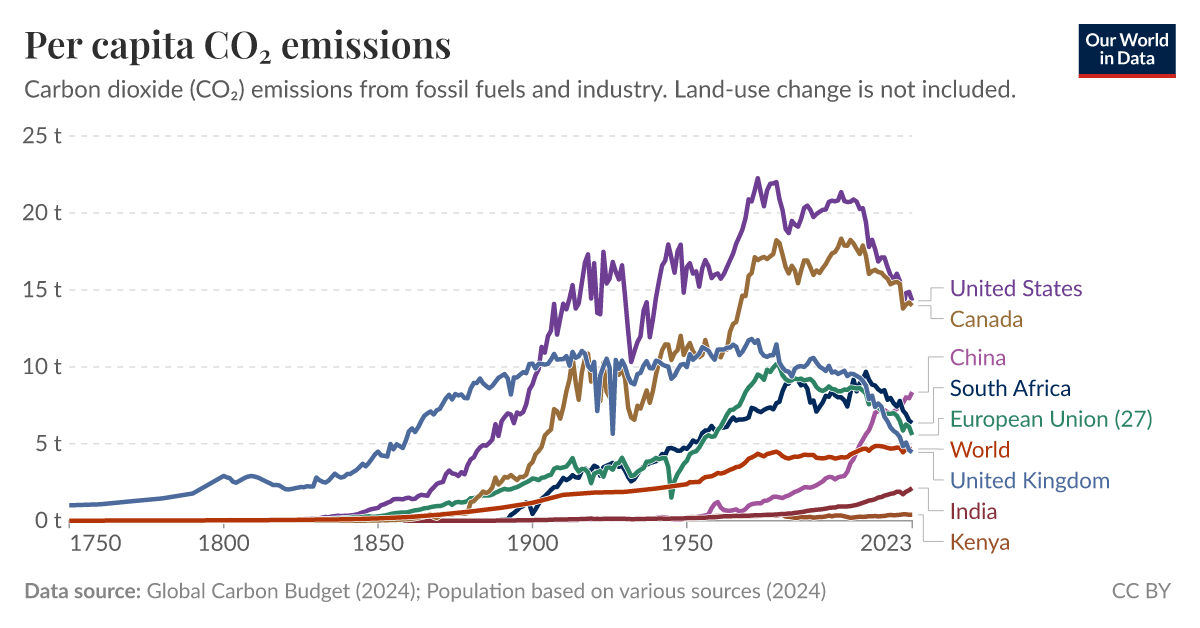
Whilst I agree that the US has lowered it's carbon emissions (prior to the current administration, they are now going up again) this is hardly surprising given how eye-wateringly bad US emissions were before. Attached is the very latest data showing per capita emissions... The US still leads the world with a terrible 14.2 tonnes per capita - the worldwide average is around 5. A good comparative country - the UK - with similar wealth per capita and standards of living is 4.5... All this nonsense about population density, etc etc is irrelevant, this is a measure of how much carbon the country creates per person. The US has always been a terrible polluter and this is still the case. The current administration (which a majority of you voted for) made it very clear that they didn't give a hoot about the climate and were going to burn fuel and mine coal and has pulled out of the Paris Climate Agreement. Pretty much every other country on the planet is inside, even Russia, China and North Korea - only 3 very unstable countries - Yemen, Iran and Libya are not in the Paris Accord - the US is joining them in January 2026, I think that says it all...
An interactive visualization from Our World in Data.

ourworldindata.org
I think there’s a fair amount of truth in what you’re saying, but some context matters.
Yes,
U.S. per-capita emissions are still very high—around
14 tonnes of CO2 per person, versus a global average of roughly
5, and countries like the UK at about
4–5. That’s not disputable and it absolutely puts the U.S. among the worst performers per person in the developed world.
It’s also true that
U.S. emissions declined substantially from the mid-2000s to the early 2020s, largely due to coal being replaced by gas, efficiency gains, and some renewables. But that decline came from an
extremely high starting point, and even after those reductions the U.S. still emits far more per capita than its peers. A decline does not equal “good performance.”
There’s also credible data showing
U.S. emissions have either flattened or ticked up slightly in the last couple years, which is concerning, given where they already sit. I mean, short-term increases don’t erase long-term declines, but they matter.
Nearly
every country on Earth is in the Paris Agreement. If the U.S. does formally exit again in 2026, that will indeed be joining a very small group of non-participants (Iran, Libya, Yemen). That comparison isn’t flattering, regardless of how you slice it.
Population density arguments don’t change the per-capita point. They’re exactly what they sound like: how much carbon each person is responsible for, on average. Density may explain
why emissions are high, but it doesn’t make the numbers less real.
One thing I will overwhelmingly push back on, though:
you don’t know who anyone voted for. Just stop. That assumption doesn’t help the discussion and just derails it. Trump is an old man that rambles worse than a dementia patient arguing with a broken toaster at 3 a.m. His climate policy record deserves heavy criticism. That doesn’t require assuming everyone you’re debating with supported him.
Bottom line: the U.S.
has reduced emissions, but it remains a very high per-capita emitter compared to its peers, and current policy direction doesn’t exactly inspire confidence. Both things can be true at the same time.