Game designer Sandy Petersen recalls how Quake's development "broke" id Software

Alfonso Maruccia

Posts: 2,563   +952
Staff
Quaked: Quake is now 30 years old, and developers who worked on the game are sharing interesting behind-the-scenes details about the project. According to Call of Cthulhu creator Sandy Petersen, the world's first fully 3D shooter was so demanding that it drained too much energy from the team and ultimately contributed to internal burnout.
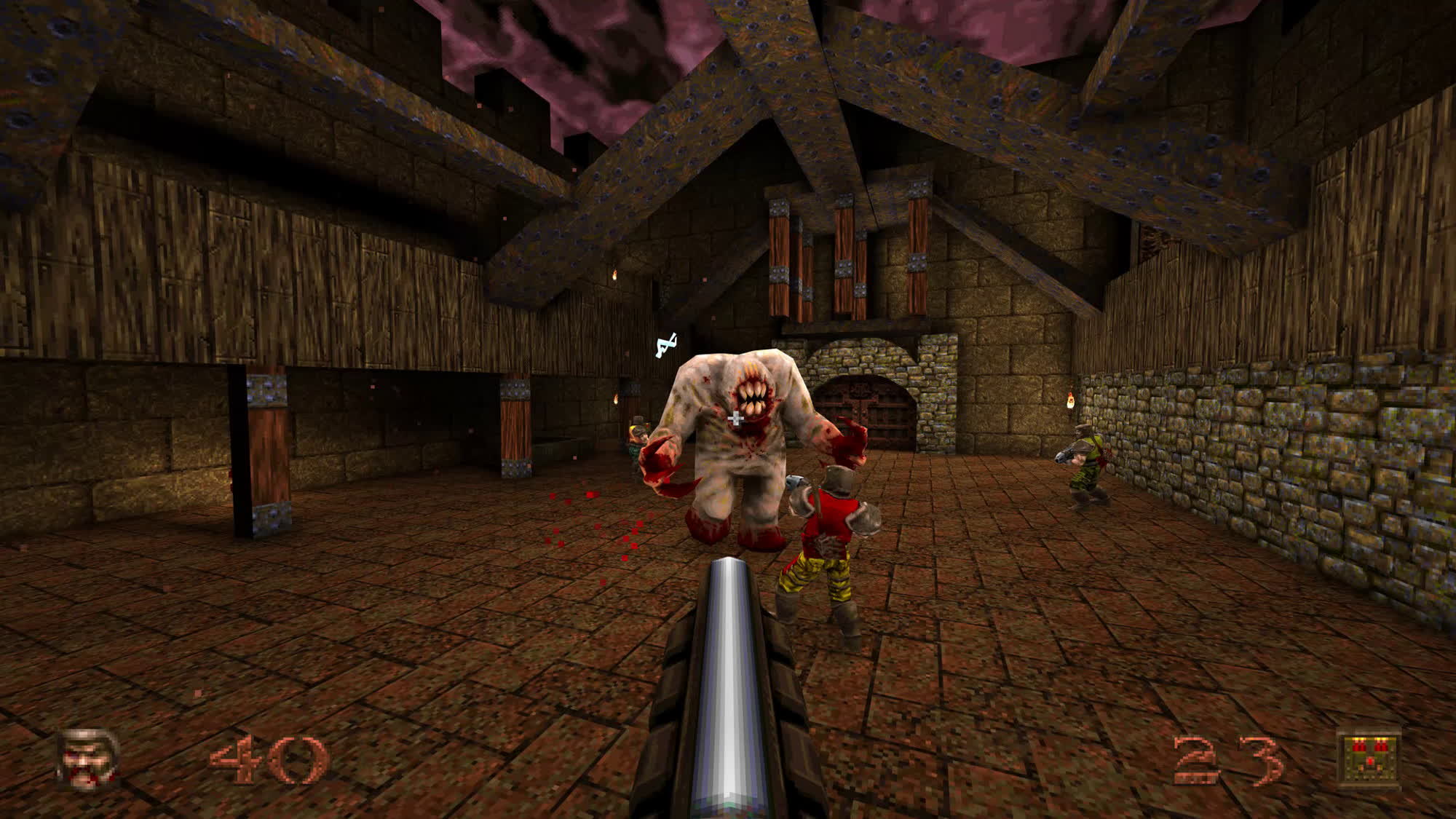
id Software and GT Interactive released Quake in 1996, marking a significant evolution in the first-person shooter genre just three years after Doom. Sandy Petersen, one of the studio's original designers from the Doom era, said that developing the first "true" 3D FPS took a heavy toll on the team.

Petersen said in a recent X thread that making Quake essentially "ruined" id Software. He added that the game deserves all the praise it is receiving for its 30th anniversary, calling it an impressive achievement in art, programming, and design. The result was a fast-paced action game that is still regarded as influential three decades later.

However, he also described the cost of creating such an unprecedented title as "grim." According to Petersen, id Software worked so intensely on Quake that the team was "spiritually" broken by the end of development. Within a couple of years after its release, several key figures, including John Romero, American McGee, and Petersen himself, had left id Software to pursue independent careers in the gaming industry.

The Texas-based studio was never the same after these high-profile departures. Petersen apparently dislikes id's whole production that came after Quake, except for the multiplayer-focused, mod-friendly Quake III experience. Quake gutted id Software, yet Petersen admits it was likely worth it. However, he regrets the other great games that the studio could have made if the "dream team" would have been together a bit longer.

Id co-founder and god-tier developer John Carmack later replied to Petersen's thread, stating that he was partially responsible for what happened to the company after Quake. The game was too ambitious from a technical standpoint, Carmack said. The team could have created some great multiplayer and FPS experience within a hypothetical "Doom++" engine instead, providing the designers with a stabler technology base while a fully 3D environment could have been part of a subsequent title.

"I pushed everyone too hard," Carmack admits, because he "didn't appreciate how maturing companies need more slack, and that running people at startup intensity constantly will wear them out. Quake was also where I really had to accept my personal limits. I was working pretty much as hard as humanly possible, and I was still slipping past my goal points."

To put it simply, creating the world's first 3D FPS made the man who built Doom's engine with a 28-hour coding marathon taste his own limits as a programmer. He also concedes that mistakes were made in the studio's original corporate stock arrangement, while the traditional Silicon Valley approach (vesting stock) would have been better.

In the end, Petersen is not blaming Carmack, noting that the programmer tended to "relax" by frantically coding at his desk. He added that the entire id "dream team" can be proud of what Quake became, and that its success was driven by the developers themselves rather than poor management from detached executives.

"Let's hope the cautionary tale warns other small devs," Petersen said.

Permalink to story:

 
And then they called it "the crunch" and it became standard practice for game development because money sees passion as a carrot on a stick.
Working in video game development is competitive in terms of finding a job. A massive portion of all programmers go to college because that's what they want to do, and it's a small fraction of the total work in software development. This isn't the best comparison, but just look at the difference between working as a pilot or a truck driver. It's way harder to become a pilot because way more people would rather do that.
 
And then they called it "the crunch" and it became standard practice for game development because money sees passion as a carrot on a stick.
Tbf im not sure if what they call crunch now is the same level of exhaustion Carmack pulled back then.

This is the guy that starts a keynote with “sorry I’m having a fever so this one might be a bit shorter” and then goes on to talk for 4.5 hours straight.
 
Tbf im not sure if what they call crunch now is the same level of exhaustion Carmack pulled back then.

This is the guy that starts a keynote with “sorry I’m having a fever so this one might be a bit shorter” and then goes on to talk for 4.5 hours straight.

He is a legend. He had the vision.
 
Possibly one of my favorite games of all time, not just because of the gameplay, but because of what it represented. Quake tech and true 3D graphics felt like a glimpse into the future. I was around 12 years old when it came out, and not long after, I started a small tech blog inspired by everything happening in the PC gaming scene. Looking back, Quake didn’t just influence the games I played, it helped spark a lifelong interest in technology.
 
I'm not sure any other games they might have made would have been 'great'. Subjectively, most iD games have been overshadowed by other games that licenced the same version of the engine. Instead of considering the games the original team could have made, I'd prefer to imagine a world where it was the optimised-to-the-hilt iD-Tech rather than the slower and now bloated Unreal Engine that became one of the backbones of the modern games industry.
 
Quake was a ground-breaking game, however, I think its somewhat misleading to say that Quake was truly "3D" as you could never be at a point in the game's map that was directly over or under any other point in the game's map.

Descent and its sequels, OTOH, allowed a player to be directly over or under any other point in the game's map, and allowed 6-degrees of freedom of movement.
 
Quake was a ground-breaking game, however, I think its somewhat misleading to say that Quake was truly "3D" as you could never be at a point in the game's map that was directly over or under any other point in the game's map.

Descent and its sequels, OTOH, allowed a player to be directly over or under any other point in the game's map, and allowed 6-degrees of freedom of movement.
Quake was very much full 3D with overlapping level geometry, because Doom before it was 2D as you describe and it was considered a minimal requirement to raise the bar for the new game. Duke Nukem 3D in between did a very good job of hiding that same problem with clever engine tech and level design cheats but was still nominally 2D and might be what you're thinking of?
 
Quake was very much full 3D with overlapping level geometry, because Doom before it was 2D as you describe and it was considered a minimal requirement to raise the bar for the new game. Duke Nukem 3D in between did a very good job of hiding that same problem with clever engine tech and level design cheats but was still nominally 2D and might be what you're thinking of?
No, I'm not thinking of that. Even the article I cited states pretty much exactly what I said.

Who was the first 3D game is, apparently, widely disputed. Quake was, apparently, recognized as such because of its success. In this thread at Reddit - some are claiming Battlezone was the first 3D game.

Quake was also the tech demo for the first 3d graphics cards, GLQuake, etc.:
And perhaps this is also part of the reason that Quake is recognized as the first 3D game. However, 3D graphics cards utilize vector graphics and polygons as their basis for rendering 3D images projected into 2D space (monitors).

I played Descent and in the game, it was possible to pull up a map of the "game sphere." The map itself was a 3D image projected into 2D space (monitors). Think of one of those habitats for mice with all the tubes interconnecting. That is what the Descent game sphere map looked like on a monitor. I no longer have the game installed anywhere, so I am unable to post a screenshot. (Besides, making my point is not important enough for me to try to install the game in a DOS emulator and make a screenshot - not to mention, having far more important things I have to take care of.) I don't believe, assuming it was possible to display a map of Quake space in the game, the rendition of the map would have been the same as that in Descent.

I'm not trying to enter into an argument here, and whatever anyone wants to decide on as to what game was truly the first 3D game is fine with me. Descent was released before Quake. What I am saying is that the best answer to the question of the first 3D game may not be as cut and dry as we would like to think. Just my $0.02 :)
 
Last edited:
its somewhat misleading to say that Quake was truly "3D" as you could never be at a point in the game's map that was directly over or under any other point in the game's map... Even the article I cited states pretty much exactly what I said.
And that Reddit post is as wrong as you are. A 3D engine defines the world geometry and the objects within as tuples of 3 orthogonal vectors. It doesn't imply viewpoint motion in all three dimensions. Doom wasn't 3D not because of character motion, but because so much of the assets were 2D sprites.

Side note: while 3D usually implies "x, y, z" coordinates, that's not a requirement. I remember one early 2D game that used r and θ polar coordinates instead.
 
Last edited:
And that Reddit post is as wrong as you are. A 3D engine defines the world geometry and the objects within as tuples of 3 orthogonal vectors. It doesn't imply viewpoint motion in all three dimensions. Doom wasn't 3D not because of character motion, but because so much of the assets were 2D sprites.

Side note: while 3D usually implies "x, y, z" coordinates, that's not a requirement. I remember one early 2D game that used r and θ polar coordinates instead.

Well your side note is fatally flawed, since that's exactly what 3D implies. The cardinal 3 dimensions - and there are only 3. Time isn't a dimension at all, it's simply a measurement of motion in one of those cardinal 3.

A 2D game's reference vectors have nothing to do with and do not support your fallacy at all. Three dimensions means three dimensions, and nothing else. Not 2, not 4, not 1 and not 0 dimensions. This intrinsic, basic math being so hard for people to grasp is absolutely hilarious and I commend you for being so brave about it.
 
Reminds me of the strain the development of Tomb Raider II (1997) put on developers. Apparently that game caused divorces for some of the 18 developers. Insane really that they made it in 8 months given the tech they had to work with back then.
 
Well your side note is fatally flawed, since that's exactly what 3D implies. The cardinal 3 dimensions - and there are only 3. Time isn't a dimension at all, it's simply a measurement of motion in one of those cardinal 3.

A 2D game's reference vectors have nothing to do with and do not support your fallacy at all. Three dimensions means three dimensions, and nothing else. Not 2, not 4, not 1 and not 0 dimensions. This intrinsic, basic math being so hard for people to grasp is absolutely hilarious and I commend you for being so brave about it.
Don't be too hard on him.........his ChatGPT let him down. ( or in the vernacular.........ooops)
 
Well your side note is fatally flawed, since that's exactly what 3D implies. The cardinal 3 dimensions - and there are only 3. Time isn't a dimension at all, it's simply a measurement of motion in one of those cardinal 3.

A 2D game's reference vectors have nothing to do with and do not support your fallacy at all. Three dimensions means three dimensions, and nothing else. Not 2, not 4, not 1 and not 0 dimensions. This intrinsic, basic math being so hard for people to grasp is absolutely hilarious and I commend you for being so brave about it.
I have no idea how you misinterpreted plain English to this degree. I didn't state that polar coordinates were a 3D basis (that would be spherical coordinates) and in fact I specifically noted it was "a 2D game". Nor is it clear why you're referencing time, which is not a dimension in the Newtonian mechanics of game engines, but is certainly one in Einsteinian mechanics.

By the way, I dislike appeals to authority, but I work regularly in Hamitonian mechanics, in which even a simple 2-body problem is represented in twelve dimensional phase space.

Don't be too hard on him.........his ChatGPT let him down. ( or in the vernacular.........ooops)
LOL, hardly. You chaps should really focus on vocabulary if you believe there were any errors in that.
 
Last edited:
A 3D engine defines the world geometry and the objects within as tuples of 3 orthogonal vectors. It doesn't imply viewpoint motion in all three dimensions. Doom wasn't 3D not because of character motion, but because so much of the assets were 2D sprites.
Couple of fun takes here. You could make a 3D engine entirely from spherical co-ordinates without an orthogonal vector in sight, but because the GPU only cares about Cartesian co-ordinates it's not worth the hassle.

What makes you blame the sprites for removing Doom's 3D badge? They're positioned and scaled based on the same maths used by engines everywhere, but are conveniently a lot cheaper to render (and arguably better looking) than the polygon-based alternative we couldn't afford in 1993. They're not enough on their own to say the game isn't 3D.

It occurs that because third party engines such as Doomsday can easily convert Doom's maps to models acceptable to a GPU using only the data in the original WAD file, there's no question that Doom is 3D in principle. The world just hates on it because of the restrictions placed upon it by the ray-casting engine, the limit of rendering technology at the time for domestic hardware.

The generally accepted definition of 3D for games seems to be "ability to move / rotate in all 3 axes, and put stuff wherever you like within that space". A test which Doom fails and Quake passes. Is Doom 3D in the mathematical sense? Yes. Is it a "3D" game? Not really.

I've no idea what a 12-dimensional game would be. That one's on you :D
 
You could make a 3D engine entirely from spherical co-ordinates without an orthogonal vector in sight
To correct a minor point, the components of spherical coordinates do form an orthogonal basis.
What makes you blame the sprites for removing Doom's 3D badge? They're positioned and scaled based on the same maths used by engines everywhere
Doom has a 3D world populated by 2D objects. I'm not the one who removed Doom's badge, but the "hard part" of a 3D engine isn't world geometry (there were many games before Doom that used 3D world coordinates) but in rendering 3D objects in real time.

The generally accepted definition of 3D for games seems to be "ability to move / rotate in all 3 axes
So if a studio made, say, a Counter-Strike variant where your enemies were the same 3-dimensionl models and you could rotate your viewpoint freely in 3 axes ... but were physically pinned to a single location, you wouldn't call that a 3D game?

3D world geometry is easy. Moving a viewpoint in that geometry is easy. The processing power demands come from 3D rendering.
 

...I think its somewhat misleading to say that Quake was truly "3D" as you could never be at a point in the game's map that was directly over or under any other point in the game's map.

That is patently false.

Doom/Duke3D were "2.5D" engines, in that the world was defined as 2D vertices connected to form "sectors" that themselves had a floor-height and a ceiling height. The Build engine that Duke3D used did allow for sloping floors, but the world was still ultimately defined using 2D points and lines connecting those points to form 2D sectors. As a result, you could not have a "room above a room", not without some hacks or tricks (Duke3D was more into that than Doom, which didn't even attempt it in any form). My brother and I did manage a sort of portal effect with overlapping spaces (non-Euclidean space) in the Build engine, which seemed to be more of a bug than a feature.

The 1996 Quake engine is as 3D as Unreal Engine 5 is, insofar as geometry and physics. Quake levels were built out of truly 3D brushes which were each a set of 3D planes forming a convex hull, not sets of XY points forming 2D sectors that only had a floor/ceiling height. You could have an entire skyscraper of rooms stacked on top of each other in Quake, and be able to walk into each room, without any kind of issue whatsoever. It would be the same as having a hallway of rooms as far as the engine is concerned. A skyscraper of floors or rooms is not something that was feasible in in the 2.5D games like Doom and Duke3D.

As far as I'm concerned, wyiosaya is confusing Quake with the previous generation of game engines that came before it, as though Quake were a 2.5D engine itself. The 2.5D engines are widely known to have the "room over room" limitation that wyiosaya is mistakenly attributing to Quake.

Cheers! :]

 
Quake, the greatest game series of ALL time. It was worth the push, tens (maybe hundreds) of millions of humans have received countless hours of enjoyment from it - even today folks still play it.

When Q3 came out, it was a MONSTER of an online game. It wasn't long before we discovered the "server-side mod" ability. It opened massive doors for online play by producing endless and extremely fun (and funny) mods.

Perhaps the only bad thing about Q3 was it also introduced wall hack and aimbot cheaters. It didn't take long for the aholes of the world to ruin online play. Fortunately, all the servers were owned by players, so they got kicked pretty quick, for the most part. Anyone else play Quake III online?
 
Back