Goldman Sachs says AI's impact on the US economy was "basically zero" last year

Alfonso Maruccia

Posts: 2,509   +934
Staff
Bottom line: Experts continue to debate the real economic impact of artificial intelligence on traditional industries. Some analysts argue that large language model technology is already transforming many sectors, while others believe its measurable economic impact has so far been limited.

Goldman Sachs analysts have suggested that the impact of AI on the US economy was "basically zero" in 2025. The investment bank argued that large language models, chatbots, and other AI-related technologies did not meaningfully contribute to the country's officially recorded 2.2 percent GDP growth last year. Unsurprisingly, the claim that AI is producing little measurable economic benefit in the world's largest economy is likely to fuel further debate about a potential AI market bubble.

According to Goldman Sachs' Joseph Briggs, some recent projections about AI's economic impact rely on optimistic narratives that may obscure a deeper assessment of underlying trends. Analysts at Morgan Stanley, JPMorgan Chase, and other major financial institutions have expressed similar views, suggesting that much of the technology sector's growth may be indirectly benefiting manufacturing economies in Asia.

Massive data center expansion plans announced by Amazon, Google, Microsoft, and other major technology companies will require significant supplies of computing hardware over the coming years. Analysts estimate that roughly three-quarters of Big Tech's projected capital expenditure could contribute directly to gross domestic product growth in Taiwan and other Asian technology manufacturing hubs.

Over the past several years, successive US administrations have attempted – with limited success – to reduce the country's dependence on semiconductors and other computing components manufactured in Asia. Donald Trump has argued that AI investments are currently supporting US economic growth, while some state-level regulatory initiatives may, according to critics, risk constraining that growth engine.

The number of investors and analysts warning about a potential AI bubble appears to be growing. Meanwhile, corporate executives have acknowledged that AI technology is not a magic productivity engine capable of dramatically accelerating efficiency or output.

Some observers argue that replacing human taxpayers with software-based systems that do not contribute back to the broader economy could produce unintended long-term consequences. At the same time, other analysts continue to describe AI as the foundation of a new technological revolution.

According to analyst Joseph Politano, the economic impact of AI has been overstated, though it remains significant. Chatbots and large language models contributed roughly 0.2 percent to last year's 2.2 percent GDP growth, Politano said. Much of the infrastructure required to support AI development is imported, making it difficult to precisely measure the technology's net contribution to individual segments of the US economy.
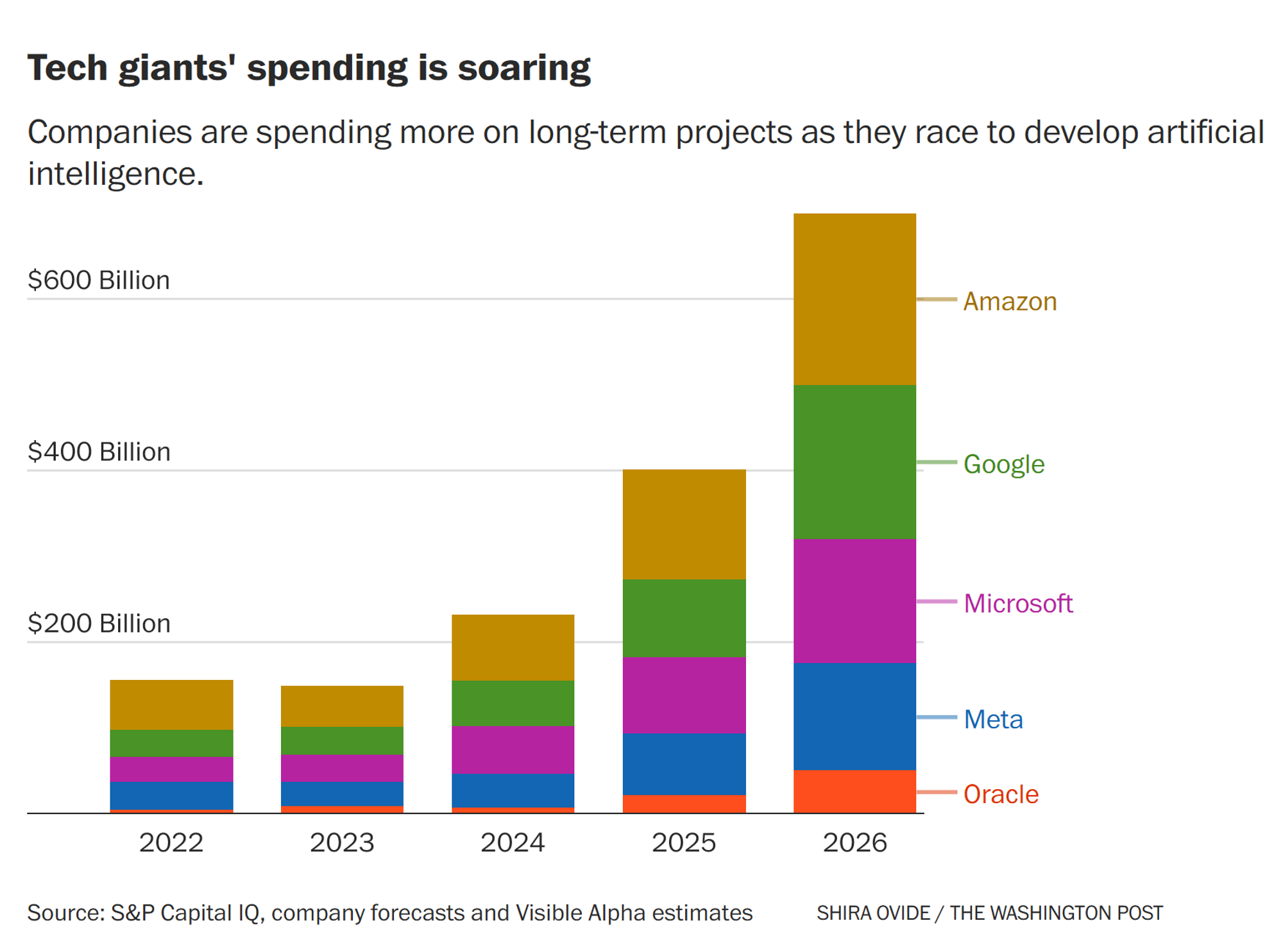
Tax advisor Joe Brusuelas said that the economic effects of AI are difficult to estimate, and its contribution to 2025's GDP may eventually require revision. Critics, he said, are focusing too narrowly on specific details, while broader economic drivers remain uncertain. Everyone is "trying to peer through the fog to understand what is driving growth," Brusuelas added.

Permalink to story:

 
Oh. We are building lots of data centers, but we aren't able to turn many of them on. I'll take the OT for building them but I know that none of those facilities are making any money. All these investors saw eliminating jobs with AI as some magic thing that would create an infinite money glitch. The problem is my 401k and IRA are dependent on those investors making money so the bankers handing out loans are getting rich in commissions while stealing my retirement money.
 
Oh. We are building lots of data centers, but we aren't able to turn many of them on. I'll take the OT for building them but I know that none of those facilities are making any money. All these investors saw eliminating jobs with AI as some magic thing that would create an infinite money glitch. The problem is my 401k and IRA are dependent on those investors making money so the bankers handing out loans are getting rich in commissions while stealing my retirement money.
the crash is goona hit hard...
 
AI predictive type text takes me more time to type something out than it helps, from all its screw ups. If they can't get something 'that simple' right... (compared to what they're trying to do)

AI will revolutionize large parts of the world one day, but it isn't going be this year, next year, or the year after that as they all like to claim. "We gonna replace 80% white collar jobs with AI by 2027!!". Their spending going exponential in just 3 years is insane. Its hard to fathom that they're betting so hard and completely on this farce.

I figure their thinking is "Competitor company spending bajillions for AI. If they succeed we're sunk. We better spend bajillions on AI too. If we all fail together, no one will have the advantage so thats fine. Screw the worlds economy that we're going to sink in the process when we fail. Little people peasants dont matter"
 
So we've spent the last two years watching tech bros cosplay as prophets of a new industrial revolution, and the actual GDP contribution is somewhere between "rounding error" and "maybe 0.2%." The funniest part is that the most concrete economic impact so far is apparently... making Taiwan richer. The AI boom is predominantly a massive transfer of American investment capital to Asian semiconductor manufacturers. Bold strategy.
 
Corporate exec: "AI isn't a magic productivity engine"
Also... corporate exec, six months ago: raises prices, cuts staff, tells shareholders it's because of AI transformation
 
If AI replaces much of the current workforce, how will governments then finance themselves? Seems to be 2 options... either increase income taxes on those still remaining in the workforce or tax AI. If it becomes a tax on AI, it will end up like other corporate taxes. Ultimately paid by the final consumer, who will get it 3 ways: deep, wide and frequently.
 
Oh. We are building lots of data centers, but we aren't able to turn many of them on. I'll take the OT for building them but I know that none of those facilities are making any money.
LOL, what? Data Centers are raking in cash like before before. Amazon's AWS, for instance, is THE primary profit driver for the company now, raking in some $130B in revenues last year with a massive 35% operating margin. Google Cloud Platform pulled in some $70B, and Microsoft's Azure more than $80B, with a 68% gross margin.
 
Most of what is being spent is going overseas and the rest is circular. It's the illusion of success, just like the illusion of artificial intelligence. Lots of money moving around, so people assume the economy is cleaning up when it couldn't be further from the truth.
 
nVidia is brooding the largest company crash in the history when its AI products demand collapses. Trillions of dollars will vanish.

 
If AI replaces much of the current workforce, how will governments then finance themselves?
History gives us the answer. When automated looms replaced the Luddites, the looms didn't run themselves. Instead, one worker ran multiple looms and the price of stockings dropped dramatically, meaning you didn't have to be extremely wealthy to own more than 1 or two pairs of socks. Ultimately people wound up buying far more woven goods, and the industry employed even more people than it did before.
 
nVidia is brooding the largest company crash in the history when its AI products demand collapses. Trillions of dollars will vanish.
Put your money where your mouth is, short their stock now, and get rich quick.

Yeah ... I didn't think so.
 
LOL, what? Data Centers are raking in cash like before before. Amazon's AWS, for instance, is THE primary profit driver for the company now, raking in some $130B in revenues last year with a massive 35% operating margin. Google Cloud Platform pulled in some $70B, and Microsoft's Azure more than $80B, with a 68% gross margin.
No they aren't, almost 80% of new construction is not generating any revenue at all.
 
No they aren't, almost 80% of new construction is not generating any revenue at all.
Eh? By definition, new centers under construction aren't in operation yet, and thus generating zero revenue. Datacenters that are actually in operation, however, are generating record profits.

Above, I've given you the actual 2025 financial results from the three largest data center operators in the US. If you wish to dispute that, you'd need to provide something other than smoke and mirrors.
 
]
Eh? By definition, new centers under construction aren't in operation yet, and thus generating zero revenue. Datacenters that are actually in operation, however, are generating record profits.

Above, I've given you the actual 2025 financial results from the three largest data center operators in the US. If you wish to dispute that, you'd need to provide something other than smoke and mirrors.

U'm under NDA where I can't talk about this as much as I would like to, but most new data centers are not operational. We call them dark data centers and even the CEO of Goldman Sachs is saying AI is a bad investment. And you can believe me we much we you want to, but these data centers are not coming online after we build them.
 
]


U'm under NDA where I can't talk about this as much as I would like to, but most new data centers are not operational. We call them dark data centers and even the CEO of Goldman Sachs is saying AI is a bad investment. And you can believe me we much we you want to, but these data centers are not coming online after we build them.
waiting on power deals? is my guess
 
waiting on power deals? is my guess
And water deals. Many of the permits are being revoked before they actually come online. Things like Infrassound are a big concern for these things and they're running out of places to build them. So you are having big, noisy data centers right next to very wealthy neighborhoods and these wealthy individuals do not like the impact in their property value. They actually paid a lot for a nice home and don't want to live next to a noisy, industrial center
 
History gives us the answer. When automated looms replaced the Luddites, the looms didn't run themselves. Instead, one worker ran multiple looms and the price of stockings dropped dramatically, meaning you didn't have to be extremely wealthy to own more than 1 or two pairs of socks. Ultimately people wound up buying far more woven goods, and the industry employed even more people than it did before.
Luckily, with AI at the forefront, you will now be able to buy DOZENS of pairs of socks! A big
WIN for AI and all the techbros with investments in sock companies!
 
Wrong. It did have an impact. Remember all the jobs that got axed because AI stepped in and didn't ask for a salary.
More unemployed people obviously have an impact on the economy
 
Oh. We are building lots of data centers, but we aren't able to turn many of them on. I'll take the OT for building them but I know that none of those facilities are making any money. All these investors saw eliminating jobs with AI as some magic thing that would create an infinite money glitch. The problem is my 401k and IRA are dependent on those investors making money so the bankers handing out loans are getting rich in commissions while stealing my retirement money.
Privatising profits and socialising losses has been common practice since the advent of the stock market.
 
"Experts" publish a couple of such reports every week.
Usually one claims AI is a bubble that will go bust soon, and another claims AI will take some huge percentage of jobs within a year or two. Obviously both can't be true at the same time.
Meanwhile, AI saves me between 1 and 1.5 hours per day. I don't know how (or if) the economic impact of that can be measured, but it's very obviously not "basically zero".
 
Luckily, with AI at the forefront, you will now be able to buy DOZENS of pairs of socks! A big
WIN for AI and all the techbros with investments in sock companies!
You missed the point. Before the worker-displacing technology of the industrial revolution, the average person worked 12+ hours a day to be afford to afford no more than 1 or 2 sets of clothing, a diet that consisted of unflavored boiled grain, morning and evening, and a home that consisted of a one-room hand-made hut. Today, a middle-class family lives in most ways better than a lord of four centuries ago.

It's impossible to predict all the ways that AI will improve our standard of living. But some predictions are easy -- in 25 years, the average person will afford better healthcare than the billionaires of today have, with a team of medical specialists monitoring your vital signs and blood chemistry 24x7, able to instantly diagnose illnesses and conditions before you're aware of them yourself. A decade after that, young children will regard with disbelieving awe being taught that we once allowed people to drive their own vehicles, killing a million people each and every year, and maiming millions more.

Just two of the two hundred thousand ways AI will improve life, to the point that, one day a future "scoffer" can mock our current standard of living, just as you mock those 16th century peasants, happy that they don't have to choose between a pair of socks and going hungry.
 
Back