
Looking ahead: Live translation is shaping up to be one of the most practical (and competitive) uses of generative AI, with real-life implications for how people communicate across languages. A new update suggests Google may be pulling ahead of Apple: while Apple recently rolled out live, in-ear speech translation with its latest major OS release, Google's approach scales far wider, supporting significantly more languages and headphone models.

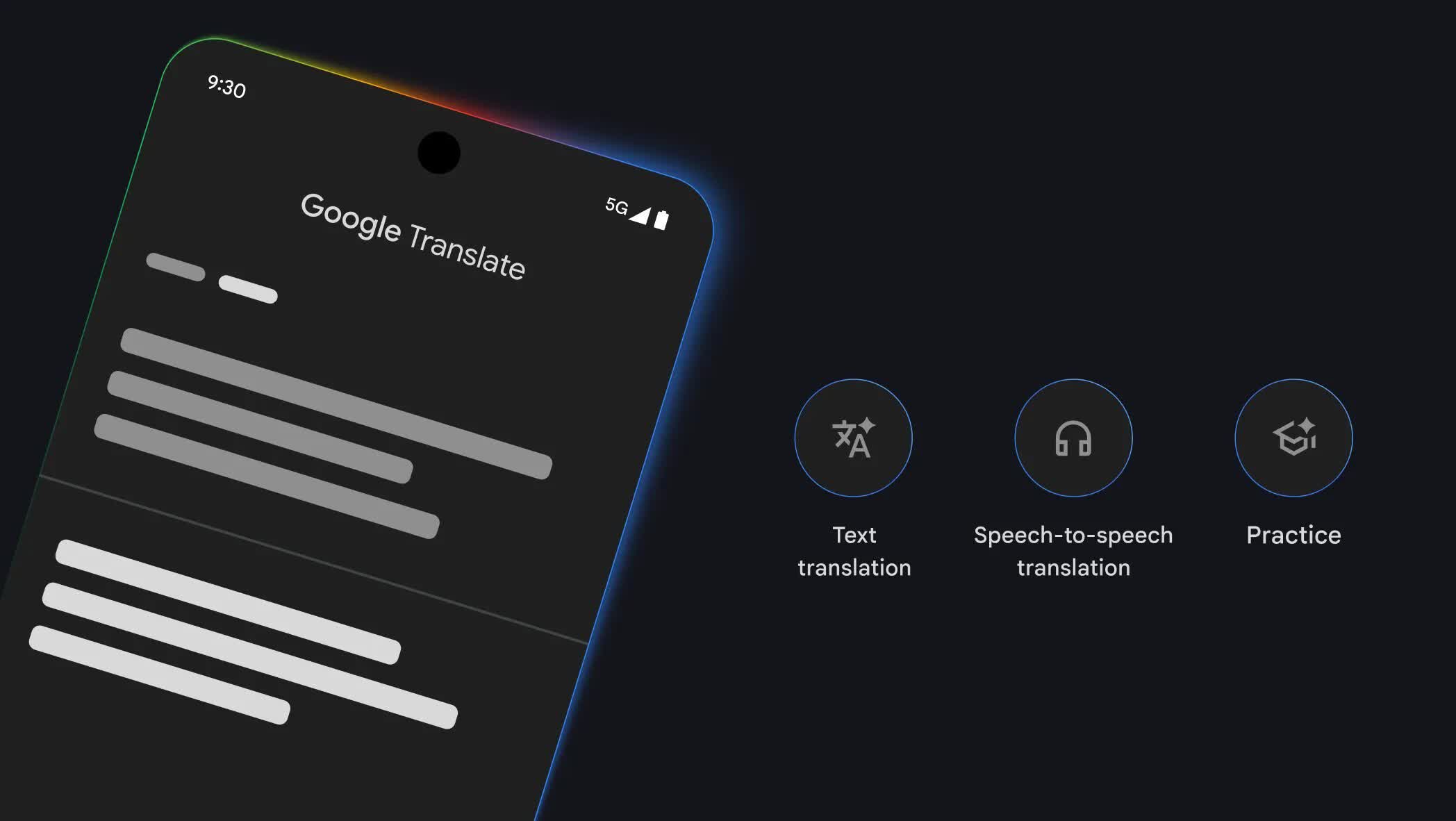
Starting today, Android device owners can begin testing live speech translation in the Google Translate app, which now relies on Gemini. The AI makes text translations sound more natural and nuanced than before.
Users can receive live translations of conversations, speeches, TV shows, and movies by opening the Google Translate app and syncing their device with any pair of headphones. Gemini attempts to preserve the speaker's tone, emphasis, and cadence. Both live and text translations can also localize idioms instead of translating them literally.
The beta is currently available on Android devices in the US, Mexico, and India. It supports over 70 languages, including English, Spanish, German, French, Russian, Ukrainian, Chinese, Japanese, Korean, standard Arabic, Palestinian Arabic, Hindi, Urdu, Zulu, and many more. Support for iOS and more countries is coming next year.
Meanwhile, Gemini-powered text translations are now available in the US and India and support 20 languages, including Spanish, Hindi, Chinese, Japanese, and German. Users can try them on the Android and iOS apps, as well as on the web.
Google's live translation closely resembles a feature Apple introduced with iOS 26 in June. Users with iPhones that support Apple Intelligence can receive live translations of text and verbal conversations. However, live audio translations support only a few AirPods models and only in Mandarin Chinese, English, French, German, Italian, Japanese, Korean, Portuguese, and European Spanish.
The difference in functionality likely reflects Google's aggressive investment in Gemini, which is quickly catching up to ChatGPT's user base. OpenAI recently pivoted its feature roadmap to focus on countering Google's progress. By comparison, Apple Intelligence is a latecomer to the AI battle and still relies on external models such as GPT. Google Translate's maturity compared to Apple's rival also helps explain Gemini's broader language support.
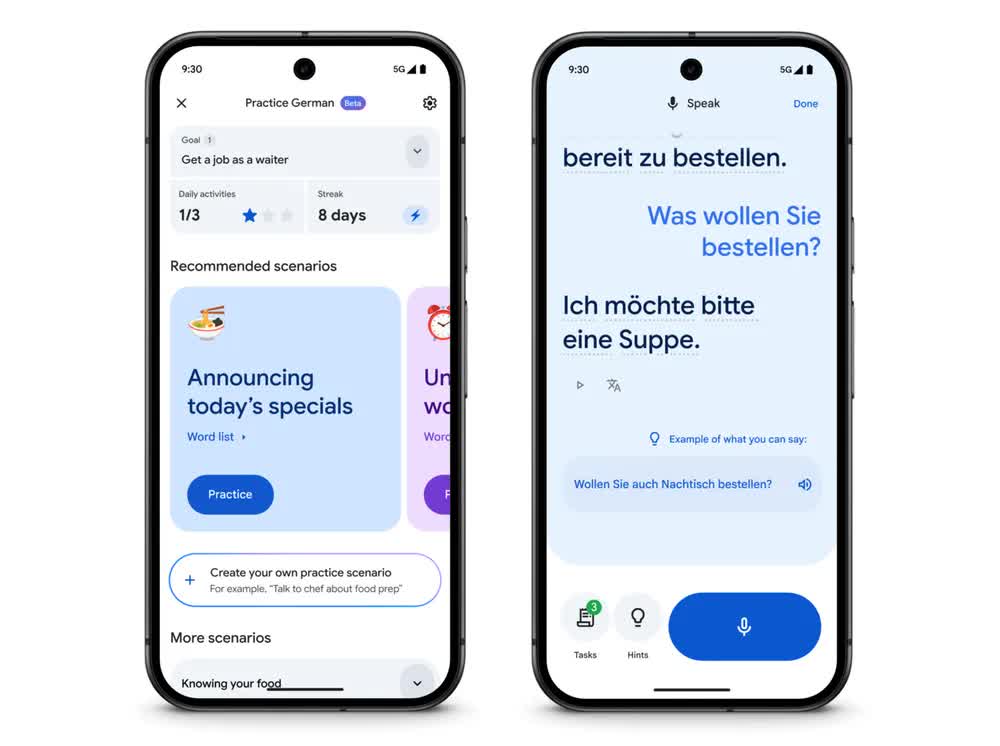
Google has also updated the Translate app's language learning tools. Resembling Duolingo, the courses now offer improved feedback and allow users to track daily progress. Support has also expanded to almost 20 new countries, including Germany, India, Sweden, and Taiwan.
New courses for English speakers include German and Portuguese. Meanwhile, English courses are now available for Bengali, Mandarin, Dutch, German, Hindi, Italian, Romanian, and Swedish speakers.
Google is turning any headphones into real-time translation earbuds


