In context: Despite being one of the world's most technologically advanced nations, South Korea remains one of only a few countries, alongside China and North Korea, where Google Maps cannot provide comprehensive navigation and real-time travel directions. The issue centers on whether Google should be allowed to export detailed South Korean mapping data to its servers overseas.
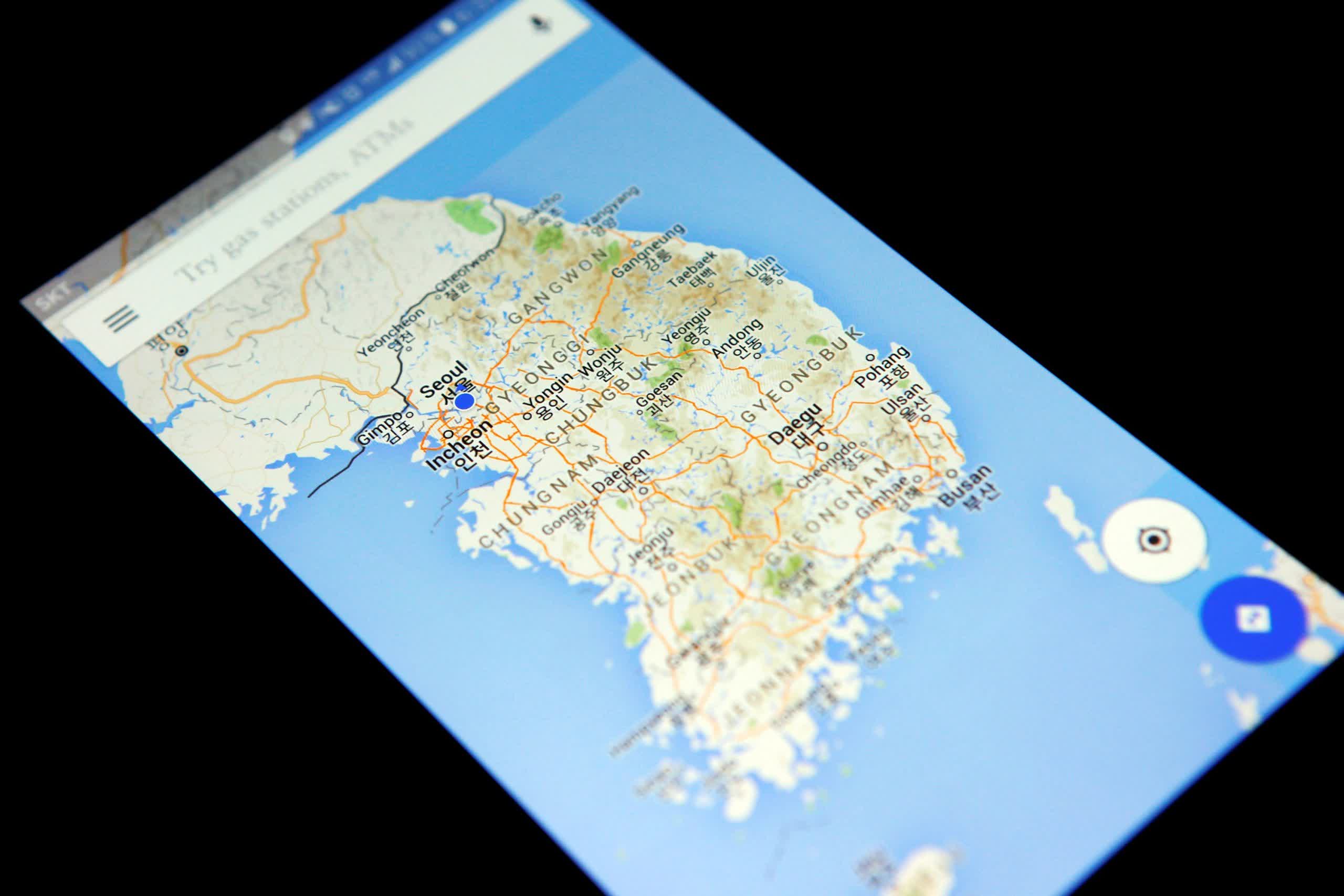
A government committee made up of South Korean officials from defense, foreign affairs, transport, and intelligence has again postponed a decision, citing the need for additional review of national security risks and the broader industry impact. The review period was extended for a second time in 2025, pushing any final verdict to October.
Google's request specifically seeks permission to export high-precision maps at a scale of 1:5,000, which would allow the identification of individual buildings, alleys, and terrain features, with 1 centimeter on the map representing 50 meters in reality. The government has consistently argued that such data could reveal the locations of sensitive sites, including military bases and critical infrastructure, which remains a major concern given ongoing tensions on the Korean Peninsula.
South Korea's mapping data is managed by local portal giants Naver and Kakao, whose platforms dominate the digital sector. These companies provide comprehensive map, search, and payment services, but all mapping data is stored on domestic servers.
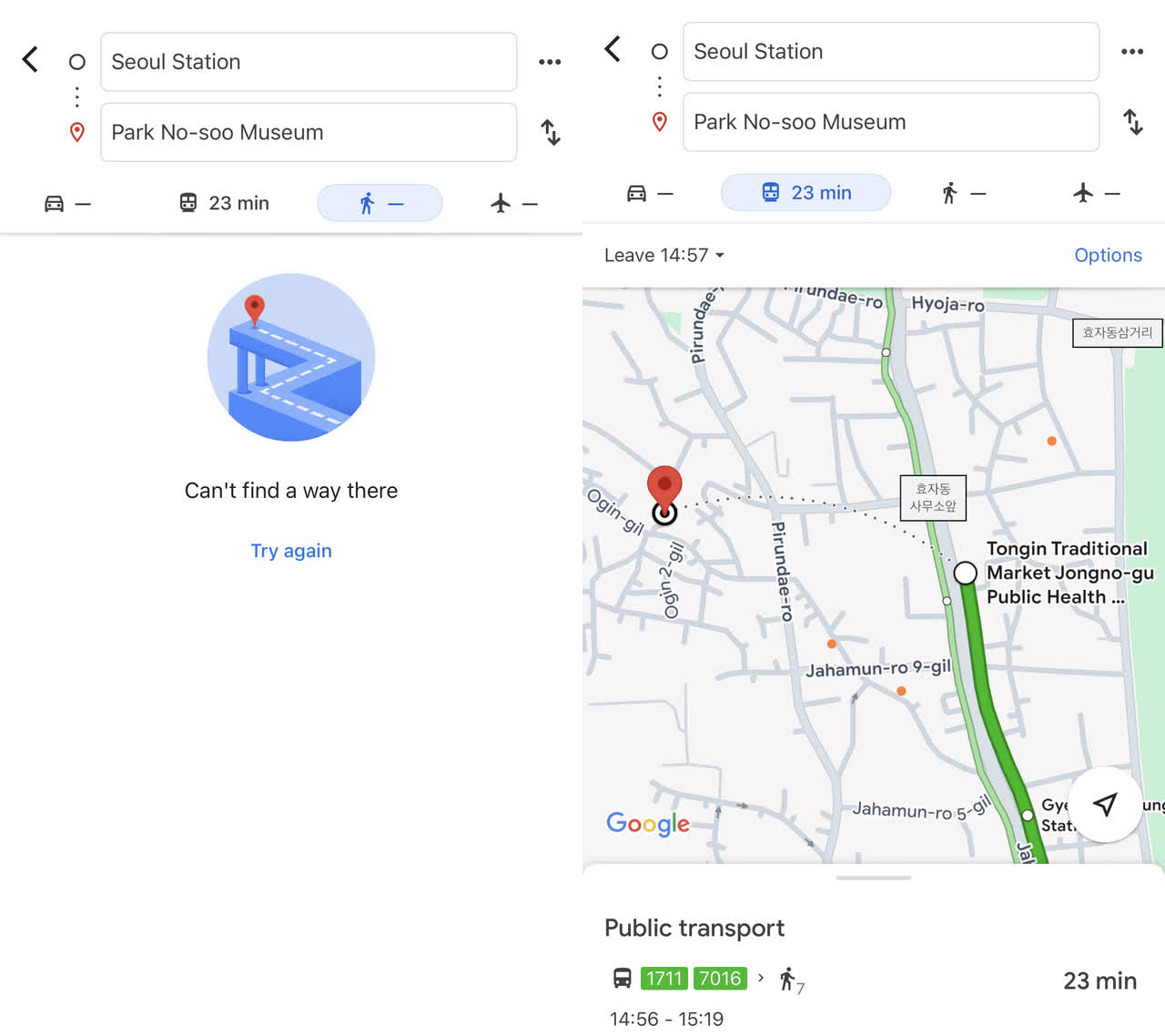
In South Korea, Google Maps lacks walking directions (left). While it can display public transit routes with live updates, the walking portions appear only as rough dotted lines, without detailed turn-by-turn instructions (right). Source: The Korea Herald
This limitation means Google can only show low-detail Korean maps at a 1:25,000 scale, preventing users from getting real-time directions. Naver and Kakao have responded to Google's campaign by upgrading their apps, expanding multilingual support, and adding features such as step-by-step navigation guides for foreigners and deeper integration with local businesses.
The lack of global-standard mapping tools has had an impact on tourism. According to figures from the Korea Tourism Organization, complaints about app-related navigation issues rose 71 percent last year, with Google Maps accounting for 30 percent of the grievances.
Tourists routinely report difficulties finding destinations, switching between apps, and coping with language limitations. Tech advocates claim the restrictions also stifle innovation among Korean startups, making it harder to develop travel and location-based services with international reach.

Tourists visiting South Korea often struggle to find their destinations due to limited real-time mapping applications.
Opposition to Google's request remains strong among South Korean industry groups, with 90 percent of companies in the digital mapping sector expressing opposition due to fears of market consolidation by foreign firms.
"The government must listen to industry concerns," Kim Seok-jong, chair of the Korean Association of Spatial Information, Surveying and Mapping, told The Guardian, warning of potential industry devastation if Google gains control of the domestic mapping market.
The controversy has also been a part of ongoing trade negotiations between South Korea and the United States. Washington has described the mapping restrictions as a "non-tariff barrier," advocating for relaxed rules on cross-border data flows as part of broader economic discussions.
Amid the delay, the government has offered alternatives to Google, including operating domestic data centers, an approach already taken by local competitors, but Google maintains this would not meet its technical requirements for global server integration.
Google Maps faces roadblocks in South Korea as detailed navigation remains restricted


