Google's AI told people Flock cameras were full of gold. They weren't.

Skye Jacobs

Posts: 2,195   +62
Staff
Facepalm: For a short while, Google's AI Overviews handed the internet a financial case for vandalizing Flock's AI-powered license plate cameras, and it wasn't based on anything real. Google has since walked the answer back, but the incident is a clean example of how quickly a widely used AI tool can turn a joke into something that looks like fact.
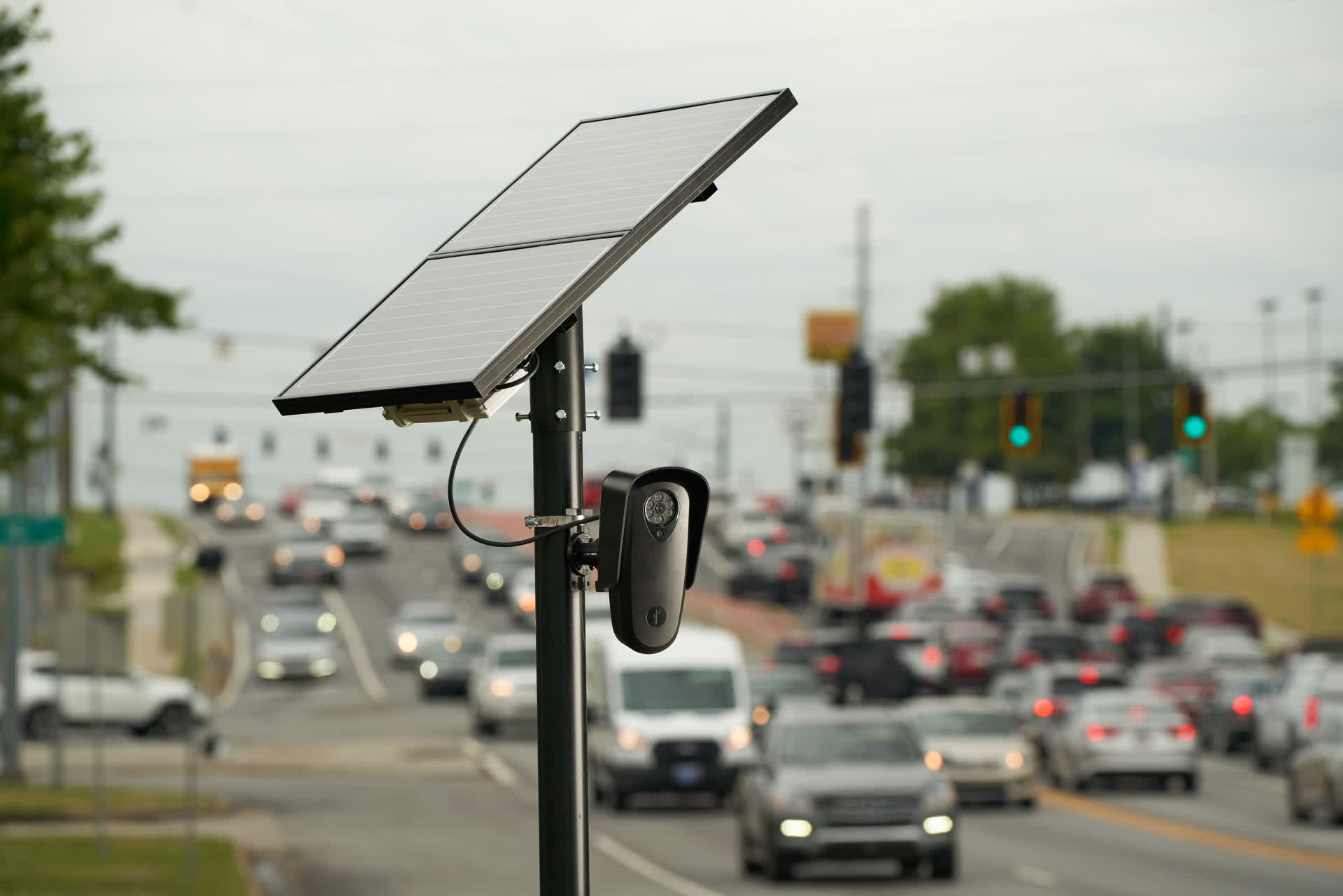
The story starts with a meme: privacy advocates joking online that Flock's surveillance cameras are secretly loaded with valuable metals, worth cracking open for scrap. AI Overviews took the joke literally, and for a while, told anyone who asked exactly that.

As originally reported by Futurism, anyone searching "how much gold does a Flock camera have" saw a confident answer: a "Flock safety camera contains about 1 to 5 grams of gold used in its internal circuit boards and wiring," plus between two and 23 pounds of copper.

Taken literally, that put roughly $650 worth of gold, and an implausible amount of copper, inside a device that weighs just three pounds. The figures didn't match what engineers would expect from this kind of compact electronics, and of course weren't backed by teardown data or materials analysis.
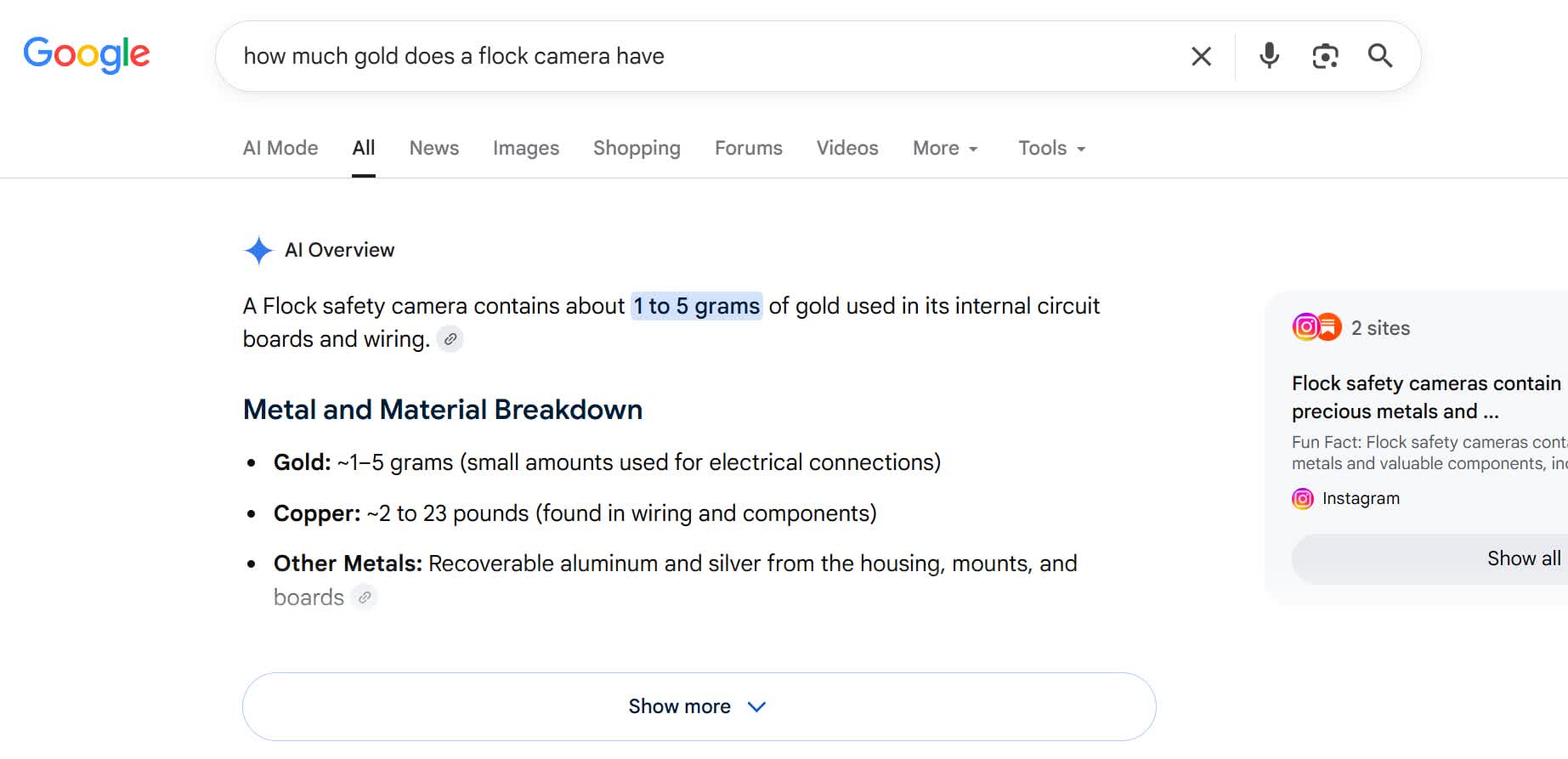
Image credit: Futurism

After the discrepancy was reported, Google appears to have updated the answer. The AI answer now pushes back directly, telling searchers that claims of a single unit holding pounds of recoverable copper are false since the whole housing weighs about three pounds, and that any gold present is only in trace amounts typical of small consumer electronics.

Some users saw this new language, too: "A Flock safety camera only contains trace amounts of gold in its standard electronic circuit boards, similar to most common small electronics. Rumors claiming the cameras are packed with large amounts of valuable precious metals – like ounces or grams of recoverable gold – come from internet memes and AI hallucinations, not facts."

Flock's cameras sit at the center of a growing AI surveillance network. The units use cameras and machine learning models to capture license plate images, translate them into machine-readable text, and feed that data into searchable databases used by police and private customers.

The process is automated end to end: the system scans passing vehicles, runs the plates through recognition software, and surfaces hits in seconds. Those capabilities – continuous data capture, AI-based identification, and fast search across large datasets – have made Flock a focal point in debates over how far automated monitoring should go, especially as reports emerge of officers using the system for unauthorized checks on romantic partners.

The technology has also become a lightning rod because it reflects where modern security tools are headed: networked cameras, automated recognition, and large, queryable datasets about everyday movement.

Online, the backlash has spawned an ecosystem of memes and videos celebrating the destruction or sabotage of the cameras. One recurring joke casts Flock's units as high-tech piñatas, packed with gold, copper, and other metals rich enough to make vandalism pay. The premise is simple: cut down the hardware, crack it open, strip out the "valuable" components, and cash in at the scrapyard.

The underlying economics don't hold up. Like most electronics, the cameras contain small amounts of precious and base metals in their boards, connectors, and wiring, but the quantities are tiny, and extracting them takes time, tools, and know-how.

Without experience breaking down circuit boards, the realistic payoff is closer to pocket change than a serious cash haul. The meme glosses over that reality.

Google's earlier AI Overview answer lent the meme a veneer of credibility, repeating it almost verbatim and backing it with two weak sources. The first was an anonymous Substack post from an account called do.not.obey.do.not.comply, claiming the "rough scrap value of these metals per camera is estimated to be $150 to $500."

The post itself admitted the figures came from "estimates based on scrap-value discussions," not testing, teardown documentation, or formal analysis.

The second was an AI-generated Instagram post urging people to rip apart Flock cameras for scrap. The account mostly posts about growing weed, plant cloning, and hydroponics, with no apparent expertise in hardware engineering.

For people using AI systems, the episode is a reminder of how easily a summarization tool can turn casual speculation into what looks like a technical statement. The model scans available content, finds material that fits the question, and stitches it into a clean, confident-sounding answer.

In this case, nothing suggests it checked whether the numbers made sense for a three-pound device, or weighed the credibility of anonymous and AI-generated sources. The output sounded certain even though the underlying data was flimsy.

The episode also exposes how prone AI models still are at missing context. The scrap-value narrative around Flock is part humor, part protest against AI-driven surveillance, exaggerating the hardware's value to make a point about the cameras themselves. Google's system didn't get the joke. It treated the posts as straightforward claims and repeated them as facts.

Permalink to story:

 
They are full of gold in a sense. They're a goldmine for data collection and unwarranted surveillance, both of which are highly profitable. Nobody's buying Flock devices unless they were sold Flock devices by people who are paid to sell Flock devices. Can you guess why people get paid to sell Flock cameras? Because they make money.
 
Flock and Axon need civilian oversight. Immediately.
Flock and Axon are made up of civilians lol. They also just sell the products. They don't own the data that gets recorded nor do they decide whether to share the data. That's up to the customer (often cities, shopping centers, colleges, and hospitals). Your assertion is misdirected.
 
Fortunately in the non-dystopian world Flock cameras are illegal as they violate privacy laws... Only in the United States of Dystopia do companies get to do whatever they like.
 
They are full of gold in a sense. They're a goldmine for data collection and unwarranted surveillance, both of which are highly profitable. Nobody's buying Flock devices unless they were sold Flock devices by people who are paid to sell Flock devices. Can you guess why people get paid to sell Flock cameras? Because they make money.

But why are data collection and surveillance highly profitable? The same can be said for AI. There's literally no way that all that computing power is necessary to provide basic AI services to the average citizen.

None of this makes any sense.
 
Flock and Axon are made up of civilians lol. They also just sell the products. They don't own the data that gets recorded nor do they decide whether to share the data. That's up to the customer (often cities, shopping centers, colleges, and hospitals). Your assertion is misdirected.

What he meant is open and transparent public oversight. And the personal data of Flock and Axon managers should be readily available to the public.
 
Everyone is missing the point, its comical.

This story has merit, just not for the reason some people think.

People deliberately flooded the internet with nonsense about Flock cameras being full of gold, and Google’s AI repeated it.

So the grand discovery here is...feed an AI enough garbage and sometimes it repeats garbage. WOW, Stunning.

Google deserves criticism for poor verification, but this proves absolutely nothing about Flock itself.

The funniest part is watching people intentionally create misinformation to prove AI can spread misinformation.

Mission accomplished, geniuses.
 
Flock and Axon are made up of civilians lol. They also just sell the products. They don't own the data that gets recorded nor do they decide whether to share the data. That's up to the customer (often cities, shopping centers, colleges, and hospitals). Your assertion is misdirected.
I was referring to police use of the data needs oversight. I sure you could have worked that out?
 
Fortunately in the non-dystopian world Flock cameras are illegal as they violate privacy laws... Only in the United States of Dystopia do companies get to do whatever they like.
You have exactly zero privacy on a public street, nor any legal expectation of such. Meanwhile, an increasingly-fascist Europe is arresting people for silently praying in public, or for Internet posts noting that men actually cannot magically transform themselves into women.

Surprise, surprise!!!!! POS AI gives POS answer.
A perusal of your posts reveals an accuracy track record well below that of AI. What should we glean from that?
 
I was referring to police use of the data needs oversight. I sure you could have worked that out?
Pluto responded to what you actually wrote, not what you apparently meant in your head. If your point is simply that police use of Flock data needs oversight, that’s completely reasonable...access controls, auditing, retention rules, and accountability absolutely matter.

But “you should have worked that out” is a pretty weak escape hatch when someone responds accurately to the words you chose.

And the constant need to tack on a little insult or condescending jab doesn’t strengthen your argument...it just says more about the mentality you’re bringing to the discussion.

People aren’t mind readers. Precision helps. So does basic civility.
 
Now there are people posting that they have 64 gigs of ram in them.
Really? ON MY WAY!
I hope it's DDR4 because my PC cannot use any other type.
Will a screwdrives suffice to open the thing or do I need to blow it up?
I wonder if it's one big stick or more smaller ones because I'd like to fill all 4 slots and 4 x 64GB would rock!

joke tag just to make sure
 
Of course we're being told that they're not full of gold; that AI was mistaken. This serves two useful purposes: It stops the removal of the cameras and it slows the mainswell against AI by influencing us to believe there's nothing - really - to worry about. After all, the big search engines would never get access to the collected data; what would they gain from it?

Who should we believe, people with a vested interest in protecting a surveillance system or ... Where are the reports from those who have actually - for research purposes, only - disassembled a representative sample of the cameras?
 
No, they do not contain large amounts of gold.
The copper, on the other hand, is somewhat more accurate. Just understand that the majority of that copper is not "inside" the camera. It makes up the electrical wiring connecting the camera to the power supply...
 
Back