Google's TurboQuant compression tech cuts LLM memory use by 6x with no accuracy loss

DragonSlayer101

Posts: 978   +14
Staff
The big picture: Google has developed three AI compression algorithms – TurboQuant, PolarQuant, and Quantized Johnson-Lindenstrauss – designed to significantly reduce the memory footprint of large language models without degrading performance or output quality. All three use vector quantization, a data optimization technique that could help AI companies reduce hardware costs as memory prices reach record highs.

The biggest memory burden for LLMs is the key-value cache, which stores conversational context as users interact with AI chatbots. The cache grows as conversations lengthen, increasing both memory usage and power consumption. TurboQuant addresses this issue by reducing model size with "zero accuracy loss," improving vector search efficiency, and alleviating key-value cache bottlenecks.
It achieves this by using PolarQuant, a high-compression method that randomly rotates data vectors to simplify their geometry, making it easier to apply a standard, high-quality quantizer to map large datasets of continuous values. If it performs as advertised, it could significantly boost on-device AI processing on consumer smartphones and laptops by enabling them to retain more context and support longer chatbot conversations.

To minimize errors in the output, TurboQuant uses 1 bit of compression to apply the Quantized Johnson-Lindenstrauss algorithm, which acts as a mathematical error-correction mechanism, reducing bias and improving accuracy. The algorithm employs a specialized estimator that balances high-precision queries with low-precision, simplified data to calculate the "attention score," which determines which parts of the input are most relevant and which can be ignored.
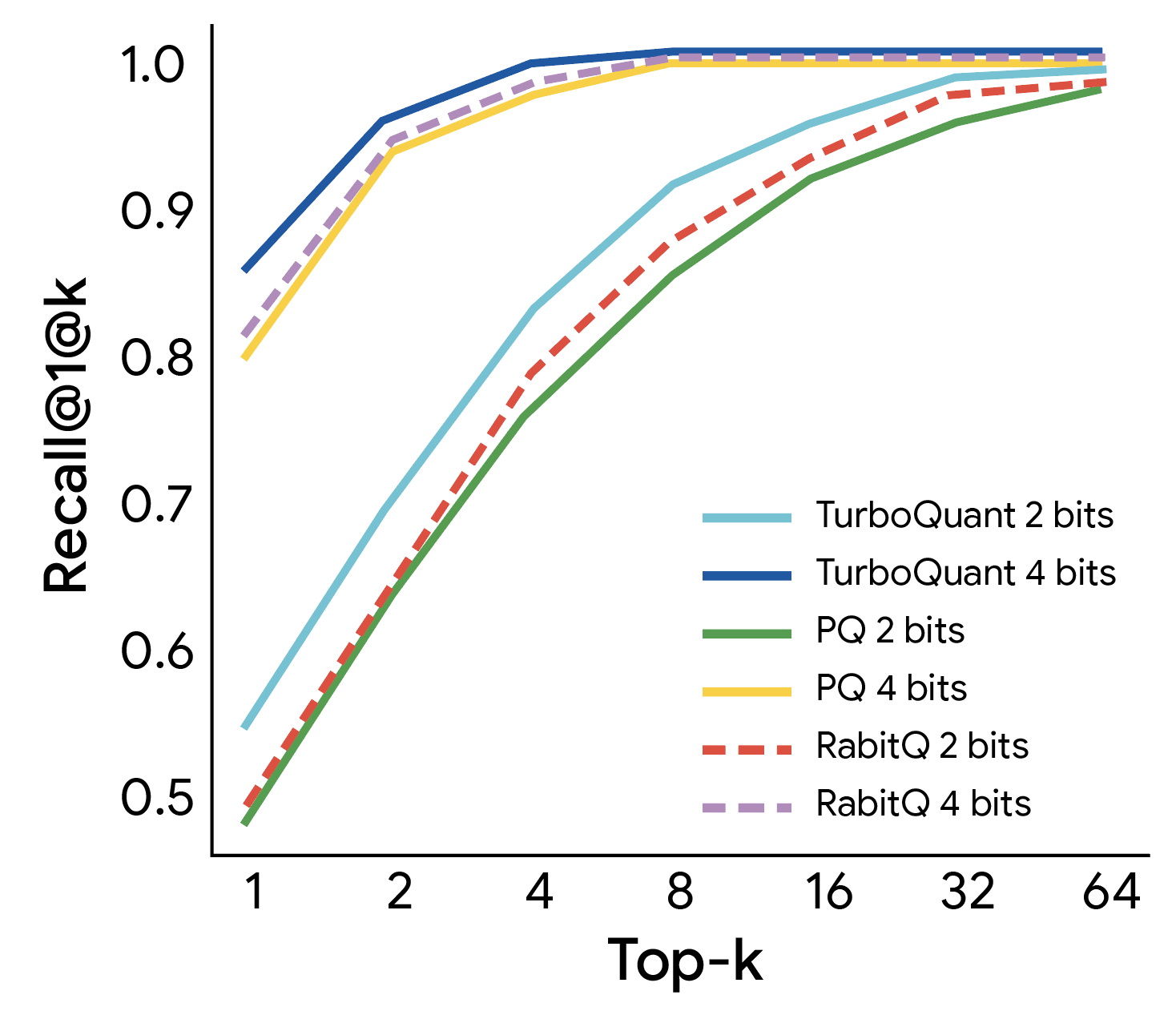
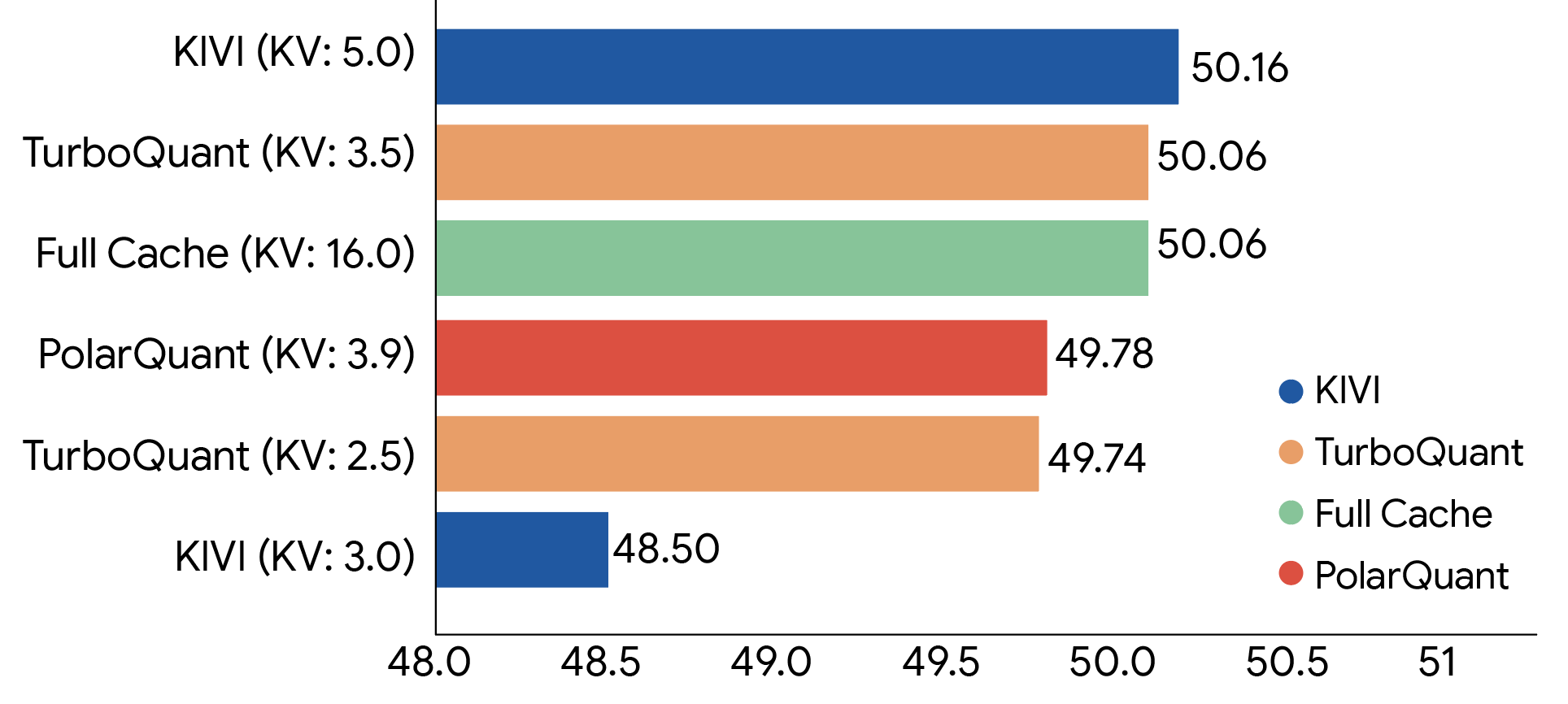
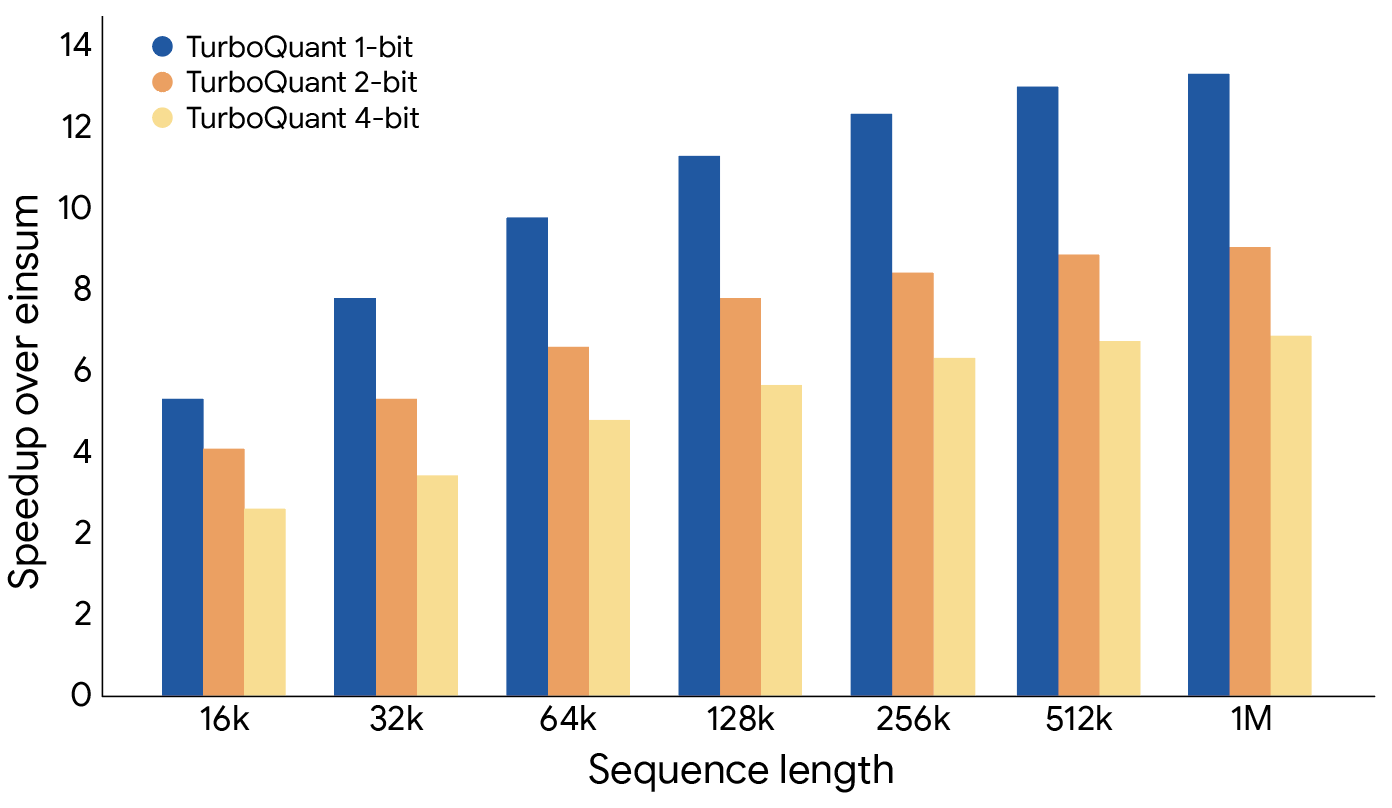
Google evaluated all three algorithms across a range of standard long-context benchmarks, including LongBench, Needle in a Haystack, ZeroSCROLLS, RULER, and L-Eval, using the open-source Gemma and Mistral LLMs. The results show that TurboQuant achieves strong performance in both dot product distortion and recall while reducing the key-value memory footprint by at least 6×.

Google's AI engineers believe the new algorithms can not only reduce the voracious memory demands of multimodal LLMs like Gemini, but also deliver the efficiency and accuracy required for mission-critical applications. However, the benefits of efficient online vector quantization extend beyond addressing the key-value cache bottleneck, enabling improved web search results with minimal memory usage, near-zero latency, and high accuracy.
The new AI algorithms offer a ray of hope for the global consumer electronics industry, which has seen input costs rise sharply in recent months due to the AI boom, a trend that has triggered a global memory shortage and pushed DRAM prices to record highs. If TurboQuant delivers on its promise, it could reduce the high-bandwidth memory requirements for AI data centers, potentially helping stabilize consumer electronics prices in the near future.

Permalink to story:

 
I've been wondering why AI developers haven't been working on efficiency. It seems like the development philosophy has been to just throw as much data and hardware at it as possible. I guess hardware has become so expensive that it is finally worth while to focus on optimization.

And I guess 30x frame Gen is right around the corner.
 
I've been wondering why AI developers haven't been working on efficiency. It seems like the development philosophy has been to just throw as much data and hardware at it as possible. I guess hardware has become so expensive that it is finally worth while to focus on optimization.

And I guess 30x frame Gen is right around the corner.
Tech markets have always moved in cycles—prices go up when demand spikes, then efficiency and supply catch up. That’s exactly what’s happening here. Everyone got used to unusually dirt-cheap hardware, especially RAM and storage. It’s just how the market lifecycle works and this too will self-correct eventually.
 
The sledgehammer to crack a nut being used by these LLMs to spoof some form of 'intelligence' will always be their limiting factor. All they are doing now is fiddling with the dials slightly as they hit the buffers on this dead end piece of barn-door engineering.
 
Tech markets have always moved in cycles—prices go up when demand spikes, then efficiency and supply catch up. That’s exactly what’s happening here. Everyone got used to unusually dirt-cheap hardware, especially RAM and storage. It’s just how the market lifecycle works and this too will self-correct eventually.
I've been an active part of the tech world for over 30 years. What we are seeing currently has never happened before and seeing 400-500x price increases over just a few months has also never happened before.

We didn't get used to "unusually cheap hardware.". SKHynx flat out said they don't believe in the long term sustainability of AI hardware sales and will not be making investments to expand capacity. And can you blame them? If you think memory was cheap before, imagine how cheap it would be if there were multiple fabs around the world that were being even more under utilize while they are paying off billions on loans to build it.

This whole "AI is great, it's going to take over the world" is strictly an American thing. While AI is useful to some extent, the rest of the world isn't buying it. They're most just willing to to take our money while we flood their markets with it and they're using dollar to buy silver and gold. I don't know if you have been watching the markets lately, but the cracks have been showing for a long time and the Iran conflict is just the straw the broke the camels back.
 
I've been an active part of the tech world for over 30 years. What we are seeing currently has never happened before and seeing 400-500x price increases over just a few months has also never happened before.

We didn't get used to "unusually cheap hardware.". SKHynx flat out said they don't believe in the long term sustainability of AI hardware sales and will not be making investments to expand capacity. And can you blame them? If you think memory was cheap before, imagine how cheap it would be if there were multiple fabs around the world that were being even more under utilize while they are paying off billions on loans to build it.

This whole "AI is great, it's going to take over the world" is strictly an American thing. While AI is useful to some extent, the rest of the world isn't buying it. They're most just willing to to take our money while we flood their markets with it and they're using dollar to buy silver and gold. I don't know if you have been watching the markets lately, but the cracks have been showing for a long time and the Iran conflict is just the straw the broke the camels back.
Hard drive shortage of 2011
Crypto GPU shortages of 2013/14
Red Lung 2020

If you havent seen this before, you were asleep for the last 15 years. And yes, you got used to some very cheap hardware in 2023/2024. 8TB SSDs for only $540. 64GB of RAM for $140. These are very cheap prices.
 
I've been an active part of the tech world for over 30 years. What we are seeing currently has never happened before and seeing 400-500x price increases over just a few months has also never happened before.

We didn't get used to "unusually cheap hardware.". SKHynx flat out said they don't believe in the long term sustainability of AI hardware sales and will not be making investments to expand capacity. And can you blame them? If you think memory was cheap before, imagine how cheap it would be if there were multiple fabs around the world that were being even more under utilize while they are paying off billions on loans to build it.

This whole "AI is great, it's going to take over the world" is strictly an American thing. While AI is useful to some extent, the rest of the world isn't buying it. They're most just willing to to take our money while we flood their markets with it and they're using dollar to buy silver and gold. I don't know if you have been watching the markets lately, but the cracks have been showing for a long time and the Iran conflict is just the straw the broke the camels back.
You seem to have missed my point entirely.

What I said is factual: markets are cyclical. Prices spike when demand outpaces supply, then correct as things rebalance. That’s exactly what’s happening here.

Yes, the scale is not typical—but that doesn’t make it unprecedented in *mechanism*. A demand shock (AI) hit constrained supply, so prices overshot.

And your SKHynx point actually supports this. If they’re hesitant to expand because they don’t think demand is sustainable, that’s textbook cyclical behavior—avoiding overbuilding at the top.

Also, RAM and storage *were* unusually cheap for a long stretch, which is why this reversal feels even more extreme than it might otherwise.

Everything else you brought up—global sentiment, geopolitics, whether AI is overhyped—is completely beside the point I’m making. None of that changes how supply/demand cycles work.

That’s all I was saying.
 
You seem to have missed my point entirely.

What I said is factual: markets are cyclical. Prices spike when demand outpaces supply, then correct as things rebalance. That’s exactly what’s happening here.

Yes, the scale is not typical—but that doesn’t make it unprecedented in *mechanism*. A demand shock (AI) hit constrained supply, so prices overshot.

And your SKHynx point actually supports this. If they’re hesitant to expand because they don’t think demand is sustainable, that’s textbook cyclical behavior—avoiding overbuilding at the top.

Also, RAM and storage *were* unusually cheap for a long stretch, which is why this reversal feels even more extreme than it might otherwise.

Everything else you brought up—global sentiment, geopolitics, whether AI is overhyped—is completely beside the point I’m making. None of that changes how supply/demand cycles work.

That’s all I was saying

I don't know why thought that was necessary to say. I was explaining the nuance of why supply was low and demand was high. Demand is artificially high, manufacturers know it and they aren't going to risk their bottom line to play our American fake money game. They're gonna take our money until we crash our own economy and then they're going to go back to selling stuff at normal prices again.
 
I don't know why thought that was necessary to say. I was explaining the nuance of why supply was low and demand was high. Demand is artificially high, manufacturers know it and they aren't going to risk their bottom line to play our American fake money game. They're gonna take our money until we crash our own economy and then they're going to go back to selling stuff at normal prices again.
Err? A misunderstanding perhaps. I interpreted it as a rebuttal and focusing on a point I wasn’t trying to make. We may just not be on the same page here. No worries. Have a great weekend :)
 
We didn't get used to cheap prices, and it wasn't only cheap, it was more like what should be normal prices, hardware should become cheaper as tech progresses.
But thanks to Artificial Idiocy and RAM manufacturers price fixing again, any chance of tech being affordable again has probably been ruined.
 
Back