GPUs are so bulky now that Asus is using gyroscopes to detect sagging

Daniel Sims

Posts: 2,460   +74
Staff
In context: Over the past few years, brackets to support large graphics cards have joined the growing list of components that custom PC builders might shop for. As high-end GPUs and their cooling solutions continue to grow larger, methods to detect and prevent sagging are becoming increasingly sophisticated.
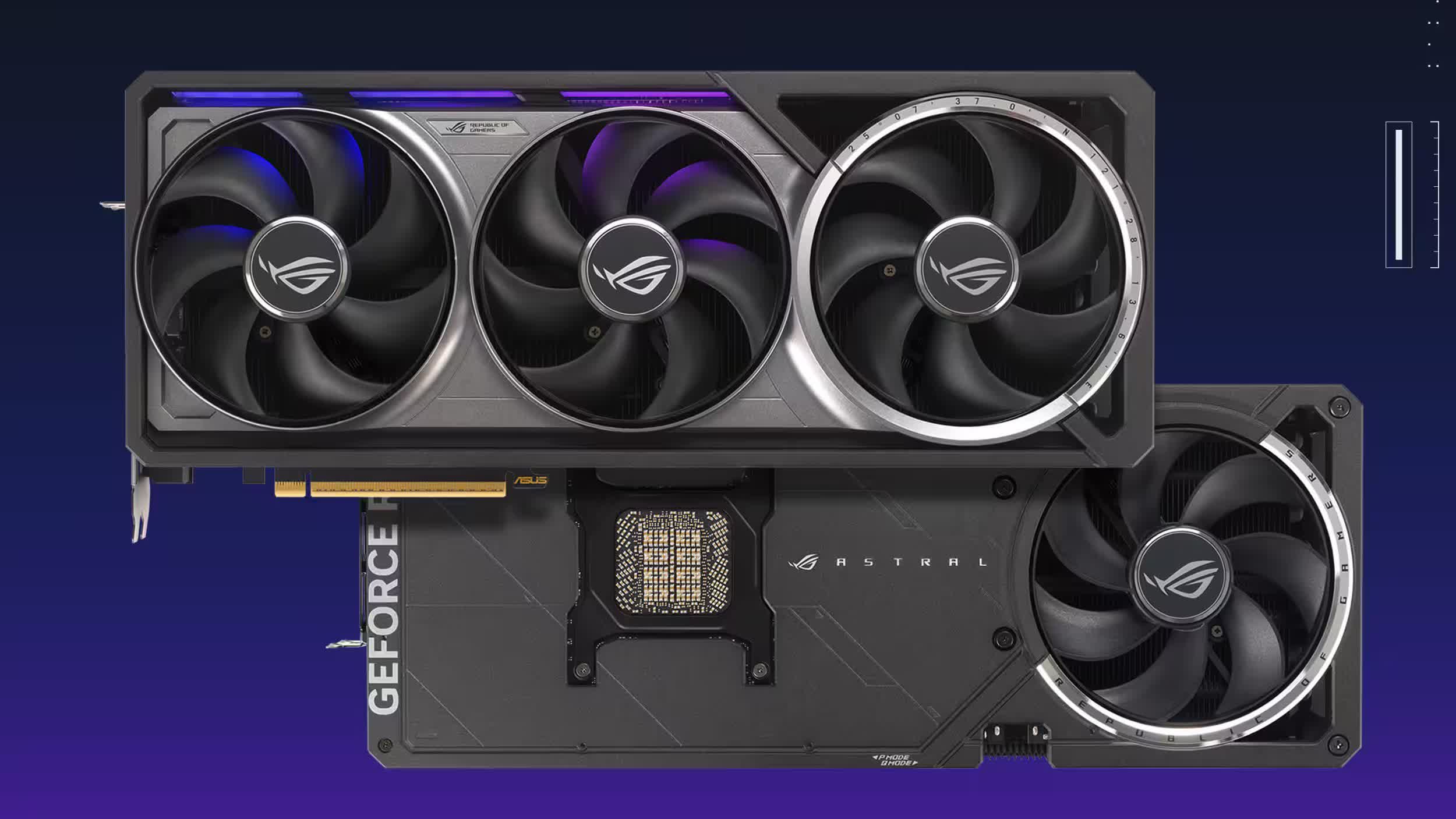
Asus graphics card owners recently discovered that the company has quietly introduced software capable of detecting GPU droop. An investigation into the feature's workings uncovered new hardware dedicated to user safety.

Asus' GPU Tweak monitoring software seemingly received a new function called "Equipment Installation Check" around the time Nvidia released its RTX 50 series graphics cards in January. Clicking it on the right side of the window produces a precise calculation of the graphics card's horizontal angle, with a warning if it drops too low.
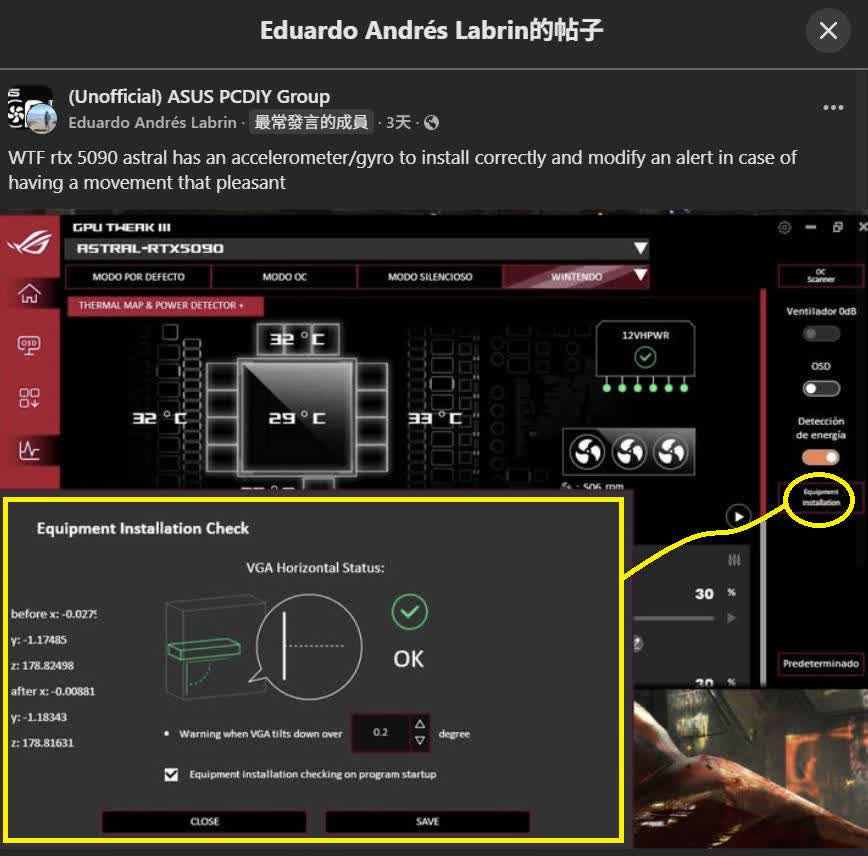
The feature helps users detect GPU sag, also known as GPU droop, which has become a growing concern. As more graphics cards employ enormous coolers, gravity can slowly pull them downward over time, potentially damaging the PCIe connection. In 2023, Gigabyte users started complaining that their PCBs were cracking due to sag.

While novel, the solution is not entirely uncalled for. The card weighs 6.6 pounds, so customers who can afford its $3,300 price tag can likely afford an extra bit of caution.

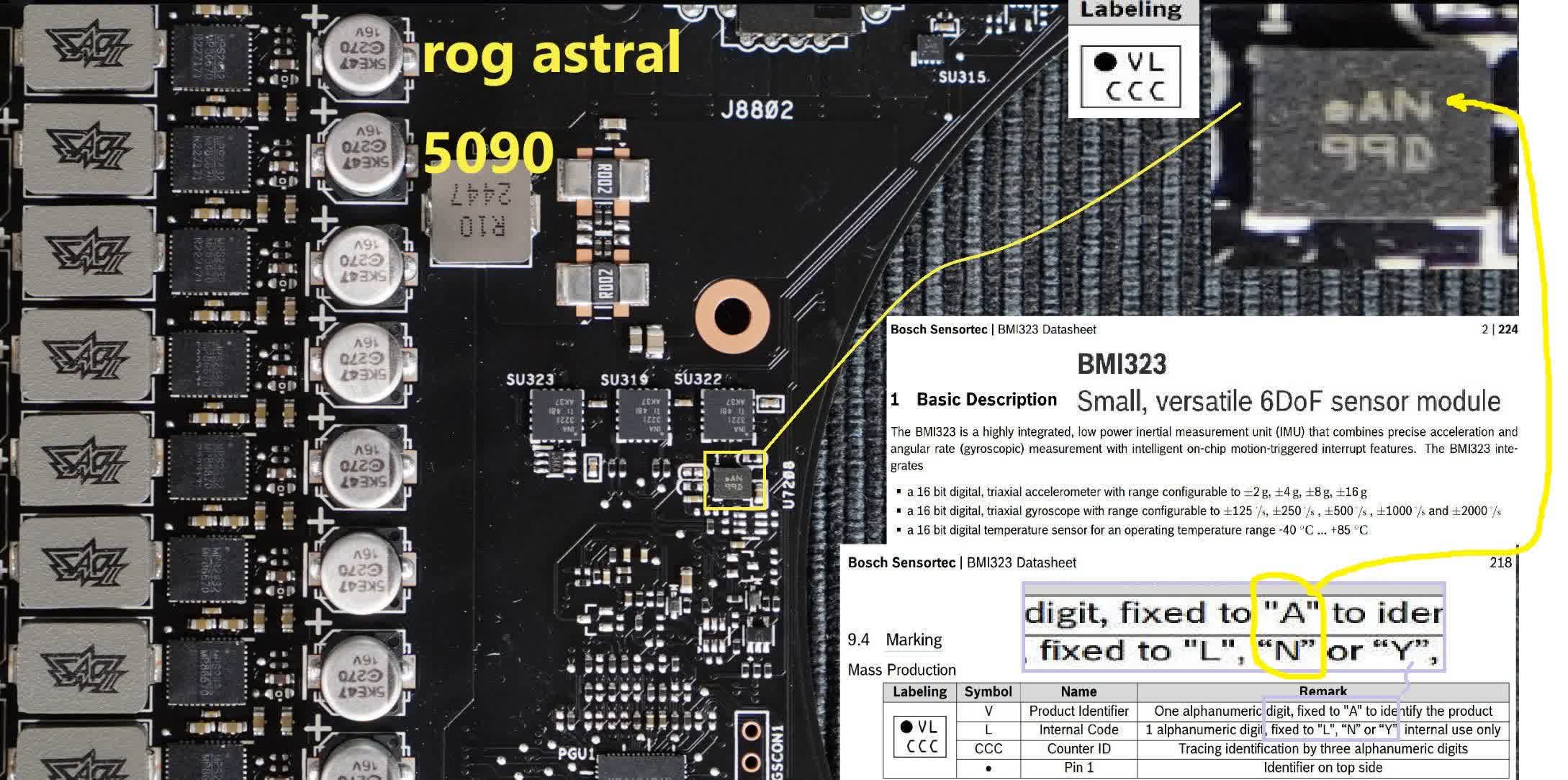
After investigating Asus' monitoring app, Uniko's Hardware discovered that the ROG Astral RTX 5090 includes a Bosch BMI323 IMU, which uses a gyroscopic accelerometer to measure the GPU's angle. While novel, the solution isn't entirely uncalled for. The card weighs 6.6 pounds, so customers who can afford its $3,300 price tag can likely afford an extra bit of caution.

GPU brackets or braces, which typically screw into an adjacent expansion slot below the graphics card (and often include RGB lighting, of course), are fairly standard nowadays. Like many other high-end GPUs, the Asus Astral RTX 5090 ships with one. However, manufacturers have also devised other unique solutions.
In 2022, vendor 51RISC released an RTX 4090 featuring two spirit levels on its exposed side. EVGA's 3090 Ti also came with a free leash that attaches to the chassis roof to stabilize the GPU.

Graphics cards have grown in size primarily because, as the effects of Moore's Law slow down, achieving meaningful performance uplifts requires more wattage, more heat, and larger cooling apparatuses. Although the power draw of Asus's ROG Astral RTX 5090 is slightly lower than that of the company's TUF 4090, the newer GPU expands from three to four slots and weighs almost twice as much.

Permalink to story:

 
I have the ASUS ROG Strix GeForce RTX 4090 24GB GDDR6X WHITE OC Edition and I can definitely vouch for the need for an anti-sag bracket...

My motherboard (Asus Sage TRX50) only allows for x16 in certain slots, and I also have an Asus Hypercard (allows for 4 x 4TB SSDs in one PCIe slot) so I needed to install it in a non-reinforced PCIe slot (why they aren't all reinforced in a $1000+ motherboard I don't know) and it was a PAIN to get the anti-sag bracket (included with my case, NOT my motherboard or GPU) installed properly.

I suspect that soon, vertically mounting GPUs will become far more common in the future.
 
Last edited:
I'm never going to knock any type of hardware (or software) for being able to check proactively for common usage problems and hopefully ward them off.

That said I would not be shocked if the internal justification for this extra cost was at least partly around potentially denying warranty claims when there was documentation of improper installation.
 
I always wonder what flagship graphics cards will be like in size and power consumption in say 6 years / 3 gens.
- We're already at 2kg and 600w for a 5090.
- Node shrinks and energy savings are reaching an end as we know them.
- Costs and/or retail prices for flagships are going sky high thanks to AI and manufacturing allocation (but let's not focus on this point).
And then again, while flagships will hit that inviability point first, give it a few more years and mid-ranges will follow.
I asked chatgpt and it gave me a ton of very smart factors that sound very nice but maybe a bit far out.
What can be done about it or how will it be?
How will motherboard and case design adapt to it?
So interesting!
I'd like an article about it!
 
Last edited:
If you asking me, I don't like it...

why not adapting a GPS too so they know where the GPU is located?

hey, put a cam and mic too so you know everything about the owner ... this a Great Idea!
 
I think it’s time we bring back standardized chassis mounting points for large expansion cards. This used to be common in PCs and is still found in many workstations and servers. Back in the ’90s, large add-on cards were fairly typical. While most didn’t have the massive triple-slot heatsinks we see today, some were even longer than the largest modern GPUs. As expansion cards shrank over time, the need for additional chassis support faded—but with the growing size and weight of today’s GPUs, I believe it's worth revisiting.
 
I always wonder what flagship graphics cards will be like in size and power consumption in say 6 years / 3 gens.
- We're already at 2kg and 600w for a 5090.
- Node shrinks and energy savings are reaching an end as we know them.
- Costs and/or retail prices for flagships are going sky high thanks to AI and manufacturing allocation (but let's not focus on this point).
And then again, while flagships will hit that inviability point first, give it a few more years and mid-ranges will follow.
I asked chatgpt and it gave me a ton of very smart factors that sound very nice but maybe a bit far out.
What can be done about it or how will it be?
How will motherboard and case design adapt to it?
So interesting!
I'd like an article about it!
The easiest case adaption is to position the motherboard horizontal (as MarkHughes points out), but it is somewhat surprising that the high end motherboards haven't added some additional support as part of what you get for $400+.

The power limit for GPUs is probably 1000W due to the wiring in most US homes. A standard circuit is 15 amps so 1650W. But you have to remember that multiple outlets and/or lights will be on that circuit and you will also need power for the CPU, monitor, and all that sweet RGB lighting. Even that could be pushing it depending on how power hungry CPUs (and possibly future NPUs) get, but 800W seems almost inevitable at this point.
 
I always wonder what flagship graphics cards will be like in size and power consumption in say 6 years / 3 gens.
- We're already at 2kg and 600w for a 5090.
- Node shrinks and energy savings are reaching an end as we know them.
- Costs and/or retail prices for flagships are going sky high thanks to AI and manufacturing allocation (but let's not focus on this point).
And then again, while flagships will hit that inviability point first, give it a few more years and mid-ranges will follow.
I asked chatgpt and it gave me a ton of very smart factors that sound very nice but maybe a bit far out.
What can be done about it or how will it be?
How will motherboard and case design adapt to it?
So interesting!
I'd like an article about it!
600 watts isn't unprecedented for total GPU power. Enthusiasts hit that back in the Crossfire and SLI days with triple and double dual cards. If you ran two titan z's you would have a 750 watt total gpu power draw between with cards maxed out. Triple gtx 280s would have been 680 watts in 2008.
 
The easiest case adaption is to position the motherboard horizontal (as MarkHughes points out), but it is somewhat surprising that the high end motherboards haven't added some additional support as part of what you get for $400+.

The power limit for GPUs is probably 1000W due to the wiring in most US homes. A standard circuit is 15 amps so 1650W. But you have to remember that multiple outlets and/or lights will be on that circuit and you will also need power for the CPU, monitor, and all that sweet RGB lighting. Even that could be pushing it depending on how power hungry CPUs (and possibly future NPUs) get, but 800W seems almost inevitable at this point.
Most modern motherboards have a reinforced GPU socket capable of handling 3-4 kilos without issues - when standing still. The biggest problems usually happens when you transport your computer. So the best recommendation is to actually remove your gpu during transport.

As for the gyorscope, it seems like Asus has the best 5090 card on the market now - with additional pin sensors, sag detection etc. They cost a friggin premium, but they are also the best out there.
 
Most modern motherboards have a reinforced GPU socket capable of handling 3-4 kilos without issues - when standing still. The biggest problems usually happens when you transport your computer. So the best recommendation is to actually remove your gpu during transport.

As for the gyorscope, it seems like Asus has the best 5090 card on the market now - with additional pin sensors, sag detection etc. They cost a friggin premium, but they are also the best out there.
Yeah... the problem is when you want/need to install the GPU in a different slot... wish every motherboard reinforced EVERY slot - but I guess that would be too costly for them...
 
600 watts isn't unprecedented for total GPU power. Enthusiasts hit that back in the Crossfire and SLI days with triple and double dual cards. If you ran two titan z's you would have a 750 watt total gpu power draw between with cards maxed out. Triple gtx 280s would have been 680 watts in 2008.
True but that power was split between multiple cards. Those 280s were only pulling ~228 per card. I've got a GTX 285 in my retro PC and it barely breaks 70c at full tilt with a 2 slot cooler.

Running a single card, the limitation is going to be moving heat out of ever shrinking transistors. The 5090 and 3090ti are pushing the limit of how much heat you can dissipate.
 
True but that power was split between multiple cards. Those 280s were only pulling ~228 per card. I've got a GTX 285 in my retro PC and it barely breaks 70c at full tilt with a 2 slot cooler.

Running a single card, the limitation is going to be moving heat out of ever shrinking transistors. The 5090 and 3090ti are pushing the limit of how much heat you can dissipate.
The Titan X drew about 200-250w back in the day (although it idled under 10w) - if you had 3 (which I did until flipping to a 2080Ti), you'd be close to 750w... I understand nowadays that people only use 1 card - cause AMD and Nvidia hated the idea of using 2 or more cards - God forbid we buy a cheaper 2nd card in order to upgrade instead of having to replace our existing card and buy a new one...
 
True but that power was split between multiple cards. Those 280s were only pulling ~228 per card. I've got a GTX 285 in my retro PC and it barely breaks 70c at full tilt with a 2 slot cooler.

Running a single card, the limitation is going to be moving heat out of ever shrinking transistors. The 5090 and 3090ti are pushing the limit of how much heat you can dissipate.
It is true that we're approaching the teoretical limit of current technology. We have been for a while, which is why Nvidia is scrambling to introduce software workarounds (DLSS, MFG etc) to be able to seemingly run prettier graphics "as fast as" before. I believe that a total re-design of how graphics is rendered will be crucial for the future. I liked what I saw from neural rendering - but it's still impossible to know how that will hold up once you introduce other factors than pure geometry.
 
Yeah... the problem is when you want/need to install the GPU in a different slot... wish every motherboard reinforced EVERY slot - but I guess that would be too costly for them...
It is purely about cost. Expansion cards are getting rare as well - Used to be sound cards, wifi cards etc. Now you get external dacs running on USB-C, wifi is usually already implemented on the motherboard and disk drive slots have multiplied on the motherboards as well (mine has 5 nvme slots for instance). What they could do, is to introduce "slot" on the end of the pci-e port, a reinforced socket, where a metal pin going from the graphics card would fit and be held in place. Make that a standard, which should be fairly cheap - and we'd have a much better quality mounting
 
Is your CPU cooler in the way? I've never had an issue putting the GPU in the main slot.
It fits fine - but if I put it there, I can’t put the HyperCard in… so I put the HyperCard in top slot and put the GPU underneath - works great for airflow and everything but… that second slot isn’t reinforced… bracket fixes the problem, but it’s a pain to install it - not to mention if I ever want to upgrade the 4090 (maybe 6090?), there’s no guarantee the bracket will still work…
 
Can someone please explain how this gyro on the add-in card is calibrated against any tilt the case itself may have? Any sagging of the board is likely to be in the realm of just a few millimeters. Lots of homes have not-so-level floors, so the case itself may be a few mm off of 100% level.

Spirit levels would make a heck of a lot more sense. And they don't require power to operate.
 
Can someone please explain how this gyro on the add-in card is calibrated against any tilt the case itself may have? Any sagging of the board is likely to be in the realm of just a few millimeters. Lots of homes have not-so-level floors, so the case itself may be a few mm off of 100% level.

Spirit levels would make a heck of a lot more sense. And they don't require power to operate.
I suspect it isn’t but… a simple solution would be for the card to calibrate itself upon initial hardware install… kind of like how digital scales need you to step on them and step off to calibrate “0”…
 
It fits fine - but if I put it there, I can’t put the HyperCard in… so I put the HyperCard in top slot and put the GPU underneath - works great for airflow and everything but… that second slot isn’t reinforced… bracket fixes the problem, but it’s a pain to install it - not to mention if I ever want to upgrade the 4090 (maybe 6090?), there’s no guarantee the bracket will still work…
I agree that reinforcing all of the 16x slots is reasonable expectation for higher end boards.

But I don't think you'll get much sympathy on needing another bracket for your new $2000+ GPU. LOL.
 
I agree that reinforcing all of the 16x slots is reasonable expectation for higher end boards.

But I don't think you'll get much sympathy on needing another bracket for your new $2000+ GPU. LOL.
lol, it’s a select crowd :)

But there ARE several people who own Threadrippers - and very few buy “cheap” GPUs when they’ve spent so much on the MB and CPU… alas, it seems like the 9000 series will be using the same socket, so this problem will persist…
 
Back