Intel confirms Core Ultra Series 3 "Panther Lake" CPUs will debut at CES on January 5th

DragonSlayer101

Posts: 981   +14
Staff
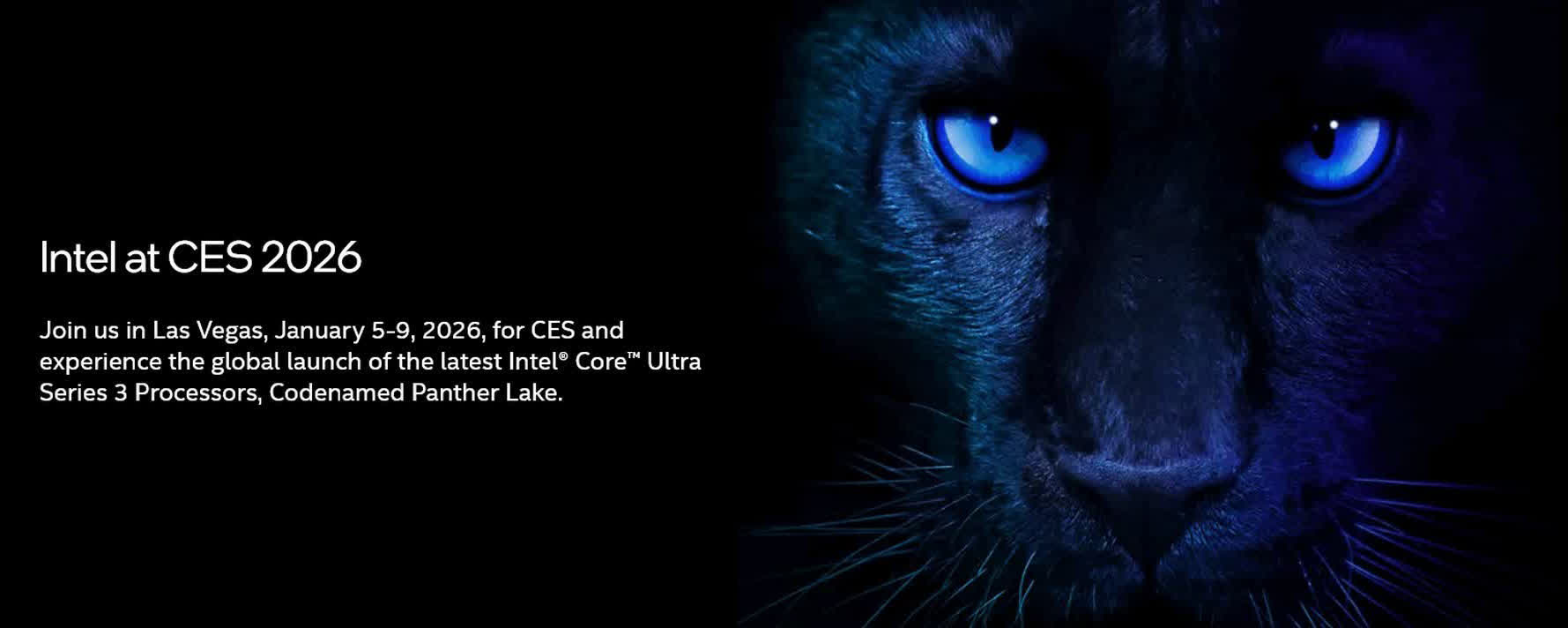
Forward-looking: Intel has confirmed that it will officially unveil its Core Ultra Series 3 "Panther Lake" CPU lineup at CES 2026 in Las Vegas on January 5. The next-generation chips will be manufactured using Intel's cutting-edge 18A process node and will introduce substantial upgrades over the company's current Arrow Lake and upcoming Lunar Lake processors.
Panther Lake processors will employ a five-tile architecture, comprising Cougar Cove performance cores, Darkmont and Skymont efficiency cores, an Xe3 Celestial integrated GPU, and a 5th-generation NPU for on-device AI acceleration. The lineup will introduce Intel's new Core Ultra X branding, with the flagship model designated as Core Ultra 9.

The series is expected to include approximately 14 SKUs, led by the 16-core Core Ultra X9 388H, which features four Cougar Cove performance cores, eight Darkmont efficiency cores, and four Skymont low-power E-cores, alongside a 12-core Xe3 integrated GPU. Preliminary specifications suggest a maximum clock speed of 5.1 GHz and a 25W TDP.
The entry-level Core Ultra 5 322 will feature a dual-core Celestial GPU and a six-core CPU, consisting of two performance cores and four low-power E-cores, with a maximum clock speed of 4.4 GHz. Alongside this model and the flagship Core Ultra X9, 12 additional SKUs are expected to power a wide range of laptops and handheld devices next year, some of which may debut at Intel's CES showcase.

Panther Lake represents a major release for Intel as the company continues to face stiff competition from AMD in both consumer and data center markets. The new chips are projected to deliver up to 50 percent faster CPU and GPU performance compared with Lunar Lake, while the integrated NPU reportedly offers up to 180 TOPS of AI performance.

At an official Panther Lake media event in May, Intel claimed that the new chips would provide Arrow Lake-level performance with Lunar Lake-level efficiency, although no official benchmarks were shared. Instead, the company demonstrated the chips' AI capabilities by running DaVinci Resolve on a Panther Lake laptop powered by an unspecified 16-core engineering sample.

While Intel did not disclose exact specifications for that engineering sample, unverified leaks suggested it included four performance cores, eight efficiency cores, and four low-power E-cores, with a 2.0 GHz base clock, 3.0 GHz boost clock, 1.6 MB of L1 cache, 24 MB of L2 cache, and 18 MB of L3 cache.

Permalink to story:

 
I hope that this is Intels redemption arc.
Time to proof that their nodes can compete with TSMC. If they can do that customers should be flocking towards them.
I should look up some recent benchmarks, but I think after a lot of patches Lunar Lake is pretty close to Skylake? (On mobile ATM makes reading charts a pain).
Skylake performance with Lunar Lake performance sounds good though, I don't trust AMD one bit to stay on the ball without competition.
 
Pretty confusing news item.
The next-generation chips will be manufactured using Intel's cutting-edge 18A process node and will introduce substantial upgrades over the company's current Arrow Lake and upcoming Lunar Lake processors.
Upgrade over upcoming processors 🤔

If core counts mentioned in article, Alder Lake (8P+16E) is pretty hard to be challenged with 4P+8E+4whateverE configuration...
 
Pretty confusing news item.

Upgrade over upcoming processors 🤔

If core counts mentioned in article, Alder Lake (8P+16E) is pretty hard to be challenged with 4P+8E+4whateverE configuration...

Panther Lake is spiritually the Lunar Lake successor, not Raptor Lake, Alder lake or Arrow Lake. Nova Lake H, HX is the successor to Arrow Lake. Lunar Lake was a one off that will not be replaced with its integrated memory, but clearly Panther Lake is basically a higher performing upgrade to Lunar Lake with 2x the E cores, and LPE cores as well as a much stronger iGPU based on a hybrid of Xe2 and Xe3.

If Panther Lake has good gains in efficiency and performance over Lunar Lake, I would get that over Strix or the miserable Gorgon update. Zen 6 mobile won't be out until 2027.
 
Well I just got the 285K. I won't be upgrading again for a long time to come. Maybe a decade. I guess by then, AI will have completely taken over - but at least I'll be retired.
 
Kind of expecting good things from this. I have Lunar Lake based laptop now and it has really good battery life. Actually can do intense work with the machine for more than a day without having to charge it.

But, it is limited to 32Gb which is problematic when wanting to run Windows on container and still trying to run couple instances of Rider in the main OS.

And, it is just a little bit too slow. Not much.

If they can provide 64Gb configuration and even a little more performance without affecting the battery life, it could be great.
 
Panther Lake is spiritually the Lunar Lake successor, not Raptor Lake, Alder lake or Arrow Lake. Nova Lake H, HX is the successor to Arrow Lake. Lunar Lake was a one off that will not be replaced with its integrated memory, but clearly Panther Lake is basically a higher performing upgrade to Lunar Lake with 2x the E cores, and LPE cores as well as a much stronger iGPU based on a hybrid of Xe2 and Xe3.

If Panther Lake has good gains in efficiency and performance over Lunar Lake, I would get that over Strix or the miserable Gorgon update. Zen 6 mobile won't be out until 2027.
Yep but how CPU can be upgrade over something that does not even exist? Or perhaps I just understood something wrong. It's like this will upgrade current mobile CPU lineup but has nothing to do with Alder/Raptor Lake upgrades and therefore this should have nothing to do with Alder Lake. Except of course that it probably will have somewhat Alder Lake performance outside amount of cores.

AMD has not really putting effort on mobile segment since people will buy Intel anyway. Perhaps with Zen6 we will see some Real effort. Gorgon point really is pretty lame upgrade. However when it comes to CPU performance, Panther lake at current core count still has difficulty against Gorgon point so what AMD needs more is better GPU. Perhaps they "save" it for Zen6.
 
I've bought nothing but AMD laptops since 2022. I have an AMD Advantage with the 6800m and wife has an HP with an AMD APU. I think the thing that everyone misses is that the higher up they are in performance, the fewer they sell on an exponential curve. Wife's laptop I wouldn't touch with a barge pole, but it does everything she needs it for and then some. Intel is still king in laptop because of this and corporate buying. It will take a long time for AMD to cut into this.

Having said that, I'm not sure how Intel will get back on their feet making mass market laptops on their cutting edge node. Intel needs higher margin sales, not lower margins.
 
This is a make or break moment for Intel in my opinion. It is not just the chip that Intel is trying to prove, but also its foundry quality. I think they are doing better now only because TSMC is fully booked out and going with a US fab is probably better to avoid getting hit with tariffs. The other reason is likely also to not let TSMC hold them hostage.
 
This is a make or break moment for Intel in my opinion. It is not just the chip that Intel is trying to prove, but also its foundry quality. I think they are doing better now only because TSMC is fully booked out and going with a US fab is probably better to avoid getting hit with tariffs. The other reason is likely also to not let TSMC hold them hostage.

This "make or break moment" narrative is a little dramatic. Intel isn’t suddenly surviving only because TSMC is booked out. Intel has been investing heavily in the foundry business for years, including building new fabs, acquiring talent, and building processes meant to compete long term.

And the tariff angle is getting old at this point. It hasn’t significantly hurt any major chip buyers except the incredibly paranoid. Companies are diversifying manufacturing because it makes strategic sense, supply chain stability, geographic redundancy, government incentives, and competitive pricing, not just fear of some tariff apocalypse.

Intel might not be back on top yet, but this isn’t some last chance Hail Mary. It’s a long term business strategy that gives chipmakers more options and keeps the industry from bottlenecking around a single foundry.....like TSMC.

If anything, competition at the top is healthy. It drives pricing down, technology forward, and prevents exactly the kind of “held hostage” scenario you’re worried about.
 
This "make or break moment" narrative is a little dramatic. Intel isn’t suddenly surviving only because TSMC is booked out. Intel has been investing heavily in the foundry business for years, including building new fabs, acquiring talent, and building processes meant to compete long term.

And the tariff angle is getting old at this point. It hasn’t significantly hurt any major chip buyers except the incredibly paranoid. Companies are diversifying manufacturing because it makes strategic sense, supply chain stability, geographic redundancy, government incentives, and competitive pricing, not just fear of some tariff apocalypse.

Intel might not be back on top yet, but this isn’t some last chance Hail Mary. It’s a long term business strategy that gives chipmakers more options and keeps the industry from bottlenecking around a single foundry.....like TSMC.

If anything, competition at the top is healthy. It drives pricing down, technology forward, and prevents exactly the kind of “held hostage” scenario you’re worried about.
I agree with a lot of what you said, but have to state that the "go big or go home" foundry strategy left with Pat. The board that got rid of him didn't all of the sudden change their mind. And Tan wasn't just waving idle threats when he said that if 18A and 14A don't land external sales, they're pulling the plug on leading edge. The Nvidia angle reeks of desperation as well. Nvidia making GPU's for them and hitching Xenon to Nvida will be interesting to see. Foundry space doesn't matter internally if you don't have a decent design to make. Jury's still out on that, and it's a bit disconcerting that the tech press looks at every Intel announcement as more proof that Intel is back. There problem hasn't really been about products that didn't run fast, their problem was when they did, they needed 220v to power them and could heat your home at the same time.
 
I don’t expect people on this site are going to be impressed. People here don’t care about NPU, Gpu, or efficiency cores integrated in their CPU. Gaming performance is what the people want. These are not a recipe for gaming. They aren’t going to win by continuing to follow their same losing recipe. Spending your silicon budget on features that don’t help gaming doesn’t make sense unless it’s a low power laptop.
 
Back