Intel next-gen desktop CPUs to feature 12-52 cores across Core Ultra 3, 5, 7, and 9 SKUs

Skye Jacobs

Posts: 2,010   +58
Staff
Highly anticipated: Intel is preparing to make a dramatic leap in desktop computing performance with its upcoming Nova Lake-S processors, aiming to significantly increase core counts for both consumers and professionals. This next-generation lineup, expected to launch in 2026, is designed to push the boundaries of multi-threaded performance, power efficiency, and platform connectivity.

At the heart of Intel's strategy is a flagship model expected to feature an unprecedented 52 cores. This high-end chip combines 16 high-performance "Coyote Cove" cores, 32 efficient "Arctic Wolf" cores, and four additional low-power island cores. These low-power cores are located in a separate part of the chip and are optimized to handle background tasks with minimal energy consumption – an approach similar to that introduced with Meteor Lake.

The Core Ultra 9 version, featuring this maximum core configuration, is expected to ship with a base power rating of 150W. The expanded core layout is complemented by a large L3 cache – reportedly up to 144MB in the top-tier model – which should benefit demanding workloads such as gaming and data-heavy applications.

Intel is also rolling out generational upgrades across the rest of its desktop lineup. The Core Ultra 7 SKUs are expected to feature 14 performance cores, 24 efficient cores, and the same four low-power island cores, bringing the total to 42 cores. These chips are also projected to retain a 150W base power envelope at the high end.
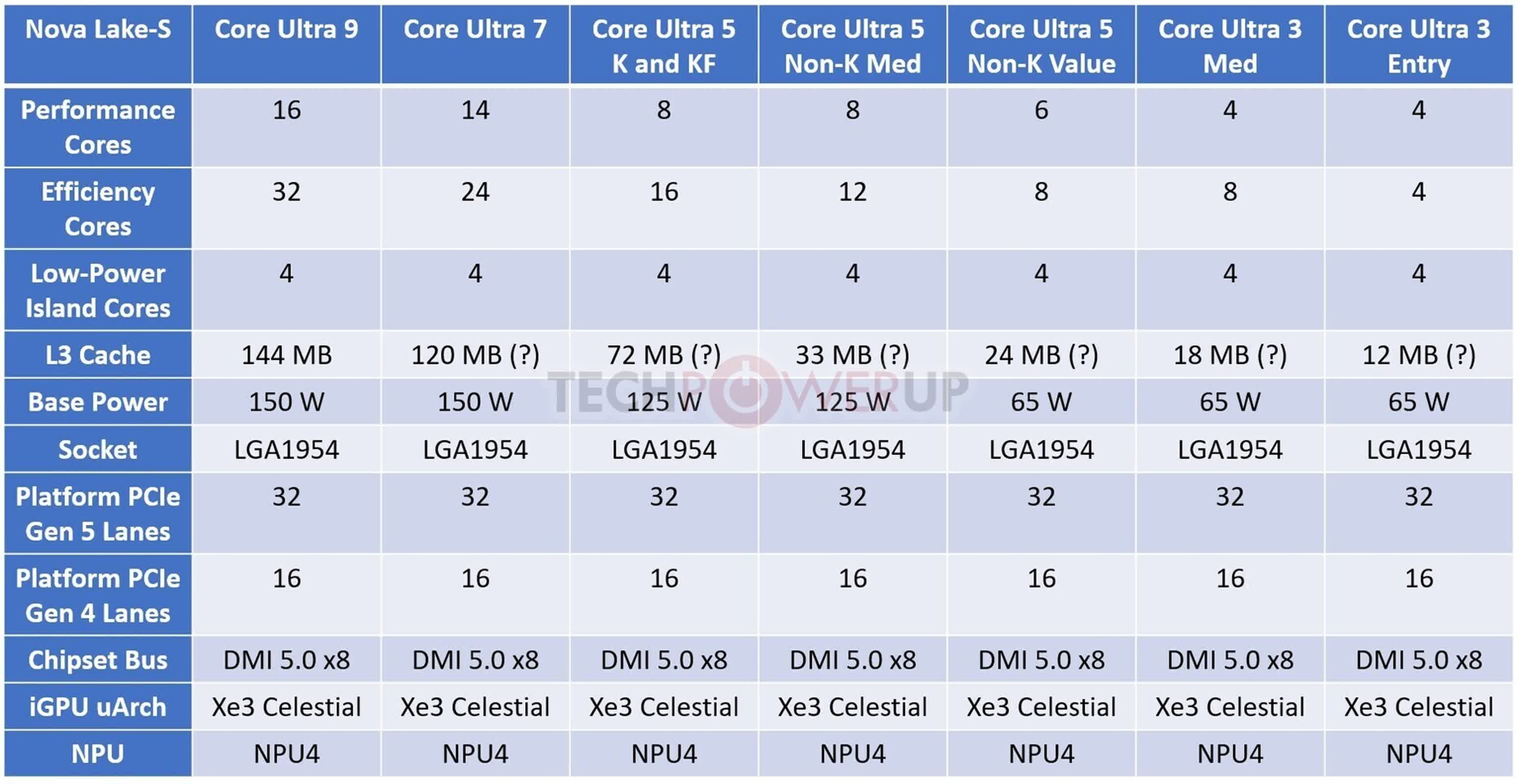
In the mid-range segment, the Core Ultra 5 processors will come in three distinct configurations, with core counts ranging from 18 to 28. These models will feature varying combinations of performance and efficiency cores. At the entry level, Core Ultra 3 processors are expected to launch with 12- and 16-core variants, targeting compact or budget-friendly systems and operating at a more modest 65W base power.

Beyond core counts, platform connectivity is also set for a major upgrade. Intel plans to equip Nova Lake-S motherboards with up to 32 PCI Express 5.0 lanes and 16 PCIe 4.0 lanes, providing ample bandwidth for modern GPUs and high-speed storage devices.

For the main chipset connection, Intel will adopt DMI 5.0, offering speeds comparable to PCIe 5.0 x8 on flagship boards. Lower-tier boards will feature slightly reduced – but still substantial – bandwidth.

Another key improvement is the integrated graphics solution. Nova Lake-S chips will incorporate the next-generation Xe3 "Celestial" GPU architecture, promising noticeable generational gains over current desktop offerings. While the desktop variants will include a more modest version of this iGPU compared to their mobile counterparts, users can still expect solid entry-level gaming and strong everyday performance.

Every Nova Lake-S processor will also include a dedicated neural processing unit, in line with Microsoft's requirements for running Copilot+ AI features locally.

Intel is expected to manufacture Nova Lake-S using advanced process technologies, including TSMC's 2nm node for select components, as it continues refining its multi-tile design approach. Early indications point to a consumer launch in the second half of 2026, marking one of Intel's most ambitious overhauls of its desktop CPU lineup in years.

Image credit: TechPowerUp

Permalink to story:

 
Because they’ve forgotten how to innovate. Too many years of sitting on their rear ends while AMD wallowed in the shadows while drinking their own Kool-Aid.
Well, their major is are with their FABs since they make their chips themselves. They're perfectly capable of designing good chips, but as the 13 and 14 gens showed, their node couldn't handle the clock speeds they were pushing and damaged their chips. Their #1 issue is their nodes and their FABs and TSMC just doesn't have the capacity to make APPLE, AMD, NVIDIA and Intel chips. If they tried then prices would spiral out of control.

I know everyone is hating on Intel right now, but we all need to hope that Intel gets their FABs together or the CPU market is going to start looking like the GPU market.
 
Well, their major is are with their FABs since they make their chips themselves. They're perfectly capable of designing good chips, but as the 13 and 14 gens showed, their node couldn't handle the clock speeds they were pushing and damaged their chips. Their #1 issue is their nodes and their FABs and TSMC just doesn't have the capacity to make APPLE, AMD, NVIDIA and Intel chips. If they tried then prices would spiral out of control.

I know everyone is hating on Intel right now, but we all need to hope that Intel gets their FABs together or the CPU market is going to start looking like the GPU market.

There was almost NO difference from 12th gen to 14th gen from an architecture standpoint. If it was a node problem, then you would see consistent power and IPC improvements, as well as signs of operational changes/improvements.

If anything, Intel stagnated long before that, but their consistent foundry improvements (along with AMD's monumental blundering), covered up their lack of actual innovation and progress. Don't forget, Intel nodes have been a disaster for a long long time. 14nm was way late to the party, 10nm was a thousandfold worse (14nm +++++++ anyone?), nodes renamed rather than improved, 20A canceled, and now, Intel is talking about taking the ax to 14A before it even launches.

You should read up on how Intel engineering and the other divisions were all stabbing each other in the back to the point where problems were only addressed when they got too big to ignore.

Say what you want about Pat, he saw this and was fixing it when the board got impatient. It still looks like Tan was brought in to part the company out to vulture capital groups rather than fix anything. I haven't seen Tan give ANY statements about fixing or improving anything. If anything, Tan is the axe man: "Everyone has 6 months to fix their problems after staff reductions. And group that isn't profitable will be closed or sold".

Intel is doomed.

P.S. It's not about hating Intel, Think about this point I forgot, their biggest goal for the company was to put AMD out of business and get back their monopoly on x86. The made MOST of their decisions basied on this. As a result, they tied all of their manufacturing and chip generations to their own fabs and nodes. Intel did not get a new architecture generation until a new node was ready until the 14nm chips were ported to 10nm. and then those stagnated. Don't forget, paying manufactures not to us AMD chips, loafiing while thought AMD was toast, propeatary design tools preventing them from making chips for others.

This isn't hate, it's Intel's poor decisions coming back to bite time. And right now, their chips are space heaters, slow, and way behind. Intel will come back only when they have a better procuct.

P.P.S. More is not better.
 
Last edited:
AMD should be asking itself why Intel can integrate its newest GPU into its SOC so quickly, rather than lagging a generation or two behind.
 
There was almost NO difference from 12th gen to 14th gen from an architecture standpoint. If it was a node problem, then you would see consistent power and IPC improvements, as well as signs of operational changes/improvements.

If anything, Intel stagnated long before that, but their consistent foundry improvements (along with AMD's monumental blundering), covered up their lack of actual innovation and progress. Don't forget, Intel nodes have been a disaster for a long long time. 14nm was way late to the party, 10nm was a thousandfold worse (14nm +++++++ anyone?), nodes renamed rather than improved, 20A canceled, and now, Intel is talking about taking the ax to 14A before it even launches.

You should read up on how Intel engineering and the other divisions were all stabbing each other in the back to the point where problems were only addressed when they got too big to ignore.

Say what you want about Pat, he saw this and was fixing it when the board got impatient. It still looks like Tan was brought in to part the company out to vulture capital groups rather than fix anything. I haven't seen Tan give ANY statements about fixing or improving anything. If anything, Tan is the axe man: "Everyone has 6 months to fix their problems after staff reductions. And group that isn't profitable will be closed or sold".

Intel is doomed.

P.S. It's not about hating Intel, Think about this point I forgot, their biggest goal for the company was to put AMD out of business and get back their monopoly on x86. The made MOST of their decisions basied on this. As a result, they tied all of their manufacturing and chip generations to their own fabs and nodes. Intel did not get a new architecture generation until a new node was ready until the 14nm chips were ported to 10nm. and then those stagnated. Don't forget, paying manufactures not to us AMD chips, loafiing while thought AMD was toast, propeatary design tools preventing them from making chips for others.

This isn't hate, it's Intel's poor decisions coming back to bite time. And right now, their chips are space heaters, slow, and way behind. Intel will come back only when they have a better procuct.

P.P.S. More is not better.
Under Pat Intel floundered, got stuck on alder lake, and canceled multiple nodes. There's no evidence that he was fixing any of Intel's systemic problems.

Don't forget Pat was in charge during the netburst and bribery fiascos. Anyone who thought he was gonna save Intel has a screw loose.
 
Under Pat Intel floundered, got stuck on alder lake, and canceled multiple nodes. There's no evidence that he was fixing any of Intel's systemic problems.

Don't forget Pat was in charge during the netburst and bribery fiascos. Anyone who thought he was gonna save Intel has a screw loose.

Making chips is not like making a pizza. As I said, read about some of the stories about how Intel was run. Marketing would ask if a new chip could do X. The chip guys would reply "sure it can, and it will be ready in 6 months" knowing damn well it was a lie, but they got their bonus. The whole damn company was every man for himself with zero ethics. All of the problems you mentioned were set in stone long before Pat got there, and he still had a way to go, but was heading in the right direction. He knew their CPU business was on it's heels, and wanted to sell foundry to other customers to bring in revenue and buy time to fix the CPU side. Tan is just chopping up the company into bite size pieces and has ZERO plans to increase revenue. Gutting the foundry side and saying "perform and sell or else" is not going to have customers beating on Intel's door.

I don't see how they get out of this with Tan getting rid of engineers in both design and foundry. Sometimes, you have to spend your way out of a jam. or, bite the bullet maximize what you've got until you can get the fix out. Nothing Tan had done says FIX.
 
I don't see how they get out of this with Tan getting rid of engineers in both design and foundry. Sometimes, you have to spend your way out of a jam. or, bite the bullet maximize what you've got until you can get the fix out. Nothing Tan had done says FIX.
*brings out the bugle and begins to play Taps*

I’m afraid that this is the beginning of the end for Intel. Honestly, the first nail in the coffin was when Apple went their own way with their M-Series of chips. Then we had another nail when their 13th and 14th gen chips began to fail. Now this? Another nail is being hammered in as we speak.
 
I hope they heavily focused on heating this time around.
They have bigger issues, like being incredibly behind on performance where it counts :)

Laptops is pretty much the only place where they are still "competitive" even though they are still playing dirty to get better designs.

DYI is dead for Intel and server is bleeding so much that I expect them to go below 50% market share next year. AMD just passed the 36% mark recently and it's gaining fast.
 
I'm struggling to think what workload I might have that requires 48 cores, but only 16 of them to be performance-oriented.

Or how many applications, designed to take advantage of parallel processing, anticipate that some cores/threads will randomly have different performance characteristics than others?
 
I'm struggling to think what workload I might have that requires 48 cores, but only 16 of them to be performance-oriented.

Or how many applications, designed to take advantage of parallel processing, anticipate that some cores/threads will randomly have different performance characteristics than others?
Hence my statement a few posts back about thread scheduling being a nightmare.

OK sure, Windows does have a lot of background processes or services but not enough of them that a chip would need 32 cores to handle them. Most of them (I'd say about half) would be doing nothing.

Performance cores are what a majority of us need more of and 16 of them aren't enough and what's bad is that there's no Hyperthreading which makes things even worse.
 
I'm struggling to think what workload I might have that requires 48 cores, but only 16 of them to be performance-oriented.

Or how many applications, designed to take advantage of parallel processing, anticipate that some cores/threads will randomly have different performance characteristics than others?
Easy answer: Synchetic benchmarks. Since Core 2 Duo, Intel has done many CPUs that focus on benchmark performance. For example Core 2 lineup looked good on benchmarks where background processes were minimal and L2 cache was enough. In reality when running real world software, L2 cache was way too small. Then we have these Hybrid CPUs, no-one uses them on default settings for anything else than benchmarks.

This 16P and 32 Crap cores thing will probably look good on synthetic benchmarks. Outside them Thread director will mess things up.
 
Easy answer: Synchetic benchmarks. Since Core 2 Duo, Intel has done many CPUs that focus on benchmark performance. For example Core 2 lineup looked good on benchmarks where background processes were minimal and L2 cache was enough. In reality when running real world software, L2 cache was way too small. Then we have these Hybrid CPUs, no-one uses them on default settings for anything else than benchmarks.

This 16P and 32 Crap cores thing will probably look good on synthetic benchmarks. Outside them Thread director will mess things up.
Oh, so this is all a part of some kind of d*ck measuring contest. I get it.

LOL
 
Exactly. Intel cannot compete on architecture or manufacturing process anymore. Solution? More cores is better and morons will surely buy Intel because it has more cores ;)
Ah yes, just like the old days when they were pushing GHz, GHz, GHz. Meanwhile you had AMD where their chips were running at slower clock speeds but were technically faster due to higher IPC. But try to tell the average person that.
 
Just slapping E cores on products to buff the overall core counts, like look at us with our 16 Core i3!
Current Skymont E-cores are a strong as Raptor Cove P cores and can hit 4.6GHz. It's laughable to still think they are pleb grade cores that are much slower. Nova Lake's E cores will see another lift in performance compared to Skymont. For people that aren't game obsessed, everything from i5 to 19 will be a productivity monster. Bring it on.
 
Back