Is AI really behind layoffs, or just a convenient excuse for companies?

midian182

Posts: 11,624   +175
Staff member
A hot potato: It's taken a while, but many companies are now blaming artificial intelligence as the reason for their job cuts, whether directly or indirectly. But is the technology really always to blame? Some critics argue that AI has become a convenient scapegoat for firms laying off workers – much like return-to-office mandates, which some say amount to quiet firing in disguise.
When ChatGPT first started to spread across the world, companies using generative AI tools were very cautious when discussing the potential for job losses. Some firms avoided the topic altogether, while others insisted that the technology wasn't a factor in their announced cuts.

Things have changed recently, with companies freely admitting that their layoffs are the result of AI adoption. Several large organizations, including Accenture, Salesforce, Klarna, Microsoft, and Duolingo, have said they are reducing staff numbers as AI helps streamline operations, reduce costs, and increase efficiency.

But Fabian Stephany, Assistant Professor of AI & Work at the Oxford Internet Institute, told CNBC that companies are "scapegoating" the technology.

"I'm really skeptical whether the layoffs that we see currently are really due to true efficiency gains. It's rather really a projection into AI in the sense of 'We can use AI to make good excuses,'" Stephany told the publication.

Many firms are still looking to reduce worker numbers after they overhired during the pandemic. Critics say a popular method of culling staff has been to introduce return-to-office mandates. With many people unable or unwilling to go back to the office for three or more days per week, they simply quit, doing their employers' dirty work for them without costing the companies any severance pay.

Blaming AI for layoffs also has its advantages. Multibillion- and trillion-dollar companies can not only push the narrative that the changes must be made in order to stay competitive, but doing so also makes them appear more cutting-edge, tech-savvy, and efficient in the eyes of potential investors.
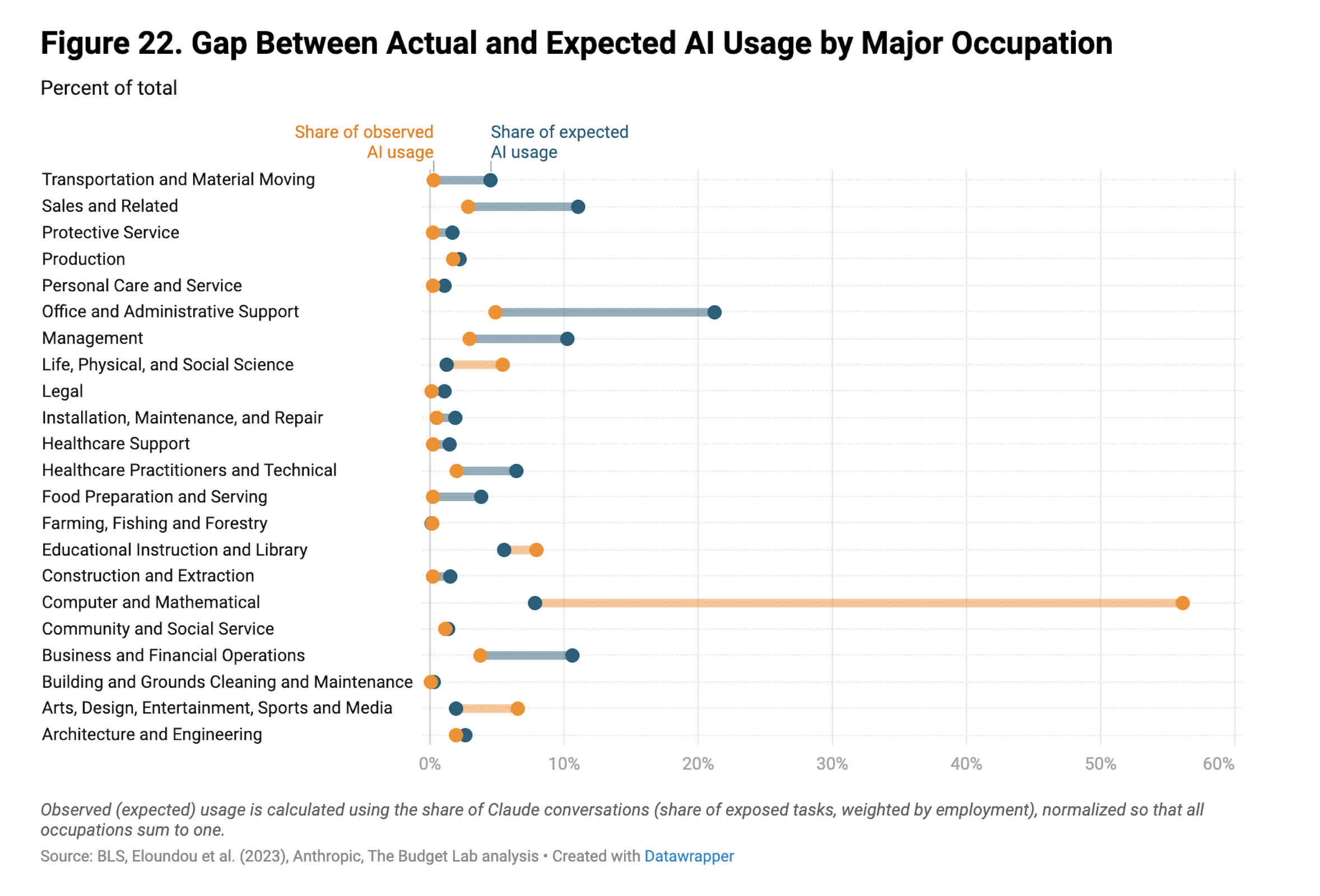
Interestingly, a study by the Yale Budget Lab a few weeks ago showed there is little evidence that AI has displaced workers more severely than earlier innovations such as computers or the internet. Meanwhile, Goldman Sachs Research has estimated that AI could ultimately displace 6 to 7 percent of the US workforce, though it concluded the effect would likely be temporary.

Permalink to story:

 
If the current generation of AI really did replace a worker, then that job was already not worth it. AI is a great tool, but it requires people to manage it. I use AI daily, and there is no way that anything that I have seen would prove it could replace a real person in a real life job.

Sure, it is pretty good at coding, but it still needs people to have the ideas and manage the code development process. I have tried those automated AI pipelines, and they only work on the most simple and cookie cutter of applications.

The only place I have seen AI have some real world application to replace an actual human is "call centers" or "help chats". Those things were already out-sourced to 3rd world countries or had some kind of automation already. The are the lowest form of usefulness, always have been. So replacing with AI is not really a win or loss.
 
Most of the workers let go over "AI" have been either HR, "leadership", or marketing/sales positions. Most of these positions were not only vastly over hired in the work from home era, but many of these were funded by DEI/BRIDGE investments by the likes of Blackrock/Vanguard and USAID. Well, USAID got shutdown, and Blackrock/vanguard have been slowing down funding because none of their investments are paying out. So all the demand for these positions has dried up.

On top of that, these jobs were mostly useless. We used to call them "email jockeys". All they do is attend meetings and send emails. They dont produce anything of value, they dont make money. This is the fat that gets cut in any recession (which we are in, regardless if the system wants to admit it). Difference is that AI can easily send emails and collect statistics easily. So rather then slow layoffs and restructuring, they can gut entire divisions with ease.

Now we're seeing the overcorrection, since AI work cannot be trusted, and companies ar enow looking for people to "oversee" their AI. Give it a couple more easy and these corporations will be rehiring those positions under new names.
 
There was a crazy hiring spree after covid, when people jumped to online consumption. Those people weren't really needed, and when stuff got normalized they are still not needed. But saying AI is the reason for firing people is just a great advertisement for AI. Let's wait till corporation will believe this AI crap and start to fire the important people. This bubble will burst so quickly it will be worse than 2008.
 
FFS. Companies aren’t “quiet firing” or “scapegoating” AI—they’re making strategic decisions. That’s literally their job.

Employees don’t have to like it or agree. Nobody owes you a job. You’re not entitled to a paycheck. Frankly, it’s not your job. It never was. It’s the company’s job and they can do with it as they please. And that’s how it should be. If you want to own the job and get full control, go start your own business. It’s how the world works, children.

RTO is not “sneaky.” It’s companies reasserting structure as they see fit—and they are entitled to do that. If someone quits over it, that’s not trickery—it’s called agency. If my company strategically used that to cut away dead-weight employees, than I’m the company hero buddy—you were the unnecessary resource.

Blaming every layoff on AI like it’s some kind of cartoon villain? Grow up. That’s not analysis, it’s projection—like a kid inventing reasons why their “mean step-parent” grounded them.

If this kind of stuff shocks you, the real world’s going to eat you alive. And from a survival-of-the-fittest perspective, maybe it should.
 
FFS. Companies aren’t “quiet firing” or “scapegoating” AI—they’re making strategic decisions. That’s literally their job.

Employees don’t have to like it or agree. Nobody owes you a job. You’re not entitled to a paycheck. Frankly, it’s not your job. It never was. It’s the company’s job and they can do with it as they please. And that’s how it should be. If you want to own the job and get full control, go start your own business. It’s how the world works, children.

RTO is not “sneaky.” It’s companies reasserting structure as they see fit—and they are entitled to do that. If someone quits over it, that’s not trickery—it’s called agency. If my company strategically used that to cut away dead-weight employees, than I’m the company hero buddy—you were the unnecessary resource.

Blaming every layoff on AI like it’s some kind of cartoon villain? Grow up. That’s not analysis, it’s projection—like a kid inventing reasons why their “mean step-parent” grounded them.

If this kind of stuff shocks you, the real world’s going to eat you alive. And from a survival-of-the-fittest perspective, maybe it should.

Your only right to an extent. While yes, companies are free to do whatever they want when they want, many of the companies have a public face to them. In addition, even b2b operations have to manage their image and their track record in whatever business their in. While employees are indeed "at will" and at the mercy of the employer, so too, the employer is at the mercy of the whims and decisions of their customers.

Any business that is totally cavalier with their employees probably isn't terribly successful. Behemoths or the "only game in town:" not withstanding. . As a practical matter.
 
Neither I, nor anyone around me or anyone I've discussed this with knows a person "replaced by AI".

Recent cuts are merely a normalization following the over-hiring spree during the Covid hysteria. Despite the cuts, the US tech sector now has 700K to 900K more jobs compared to 2021, which is a huge net positive.

The are two main reasons for the ridiculous AI job cuts narrative - adversaries spreading AI hysteria via troll/bot farms in an attempt to impede progress and create social tension, and the fact the market still reacts positively to claims like "we're replacing highly paid employees with 100x cheaper AI's".
 
FFS. Companies aren’t “quiet firing” or “scapegoating” AI—they’re making strategic decisions. That’s literally their job.

Employees don’t have to like it or agree. Nobody owes you a job. You’re not entitled to a paycheck. Frankly, it’s not your job. It never was. It’s the company’s job and they can do with it as they please. And that’s how it should be. If you want to own the job and get full control, go start your own business. It’s how the world works, children.

RTO is not “sneaky.” It’s companies reasserting structure as they see fit—and they are entitled to do that. If someone quits over it, that’s not trickery—it’s called agency. If my company strategically used that to cut away dead-weight employees, than I’m the company hero buddy—you were the unnecessary resource.

Blaming every layoff on AI like it’s some kind of cartoon villain? Grow up. That’s not analysis, it’s projection—like a kid inventing reasons why their “mean step-parent” grounded them.

If this kind of stuff shocks you, the real world’s going to eat you alive. And from a survival-of-the-fittest perspective, maybe it should.
businesses make money when people have money to spend. Private equity and banks have stopped issuing money for AI data centers. While it might make sense for 1 business to replace staff with AI agents, if every business does that then you end up with massive amounts of unemployeed people that can't afford food or housing and forget about disposable income that our economy runs on.

Frankly, it's my opinion that these lay offs are the result of a failed economic system where people making 100k+ a year can barely afford food. Between me and my wife, we would have been considered wealthy just 5 years ago. Between utilities, food and insurance we'd be broke every month if we were living on only 1 income and we're basically broke now
 
Feels like the return to office strategy and the AI excuse are just two different skins for the same speedrun: shrink payroll without admitting a mismanagement bonus round happened in 2021. If AI were actually this efficient most of these companies would not still need four layers of vice presidents to approve a sticky note.
 
businesses make money when people have money to spend. Private equity and banks have stopped issuing money for AI data centers. While it might make sense for 1 business to replace staff with AI agents, if every business does that then you end up with massive amounts of unemployeed people that can't afford food or housing and forget about disposable income that our economy runs on.

Frankly, it's my opinion that these lay offs are the result of a failed economic system where people making 100k+ a year can barely afford food. Between me and my wife, we would have been considered wealthy just 5 years ago. Between utilities, food and insurance we'd be broke every month if we were living on only 1 income and we're basically broke now

Ding.

You essentially just highlighted the result of 50 years of national economic mismanagement. Tax cuts and generous subsidies hid the problem for a few decades, but the bill is coming due and its more or less impossible to hide the fact that consumers simply can not keep the economy humming along any longer.

When this goes bust (and it will), it's going to be *much* worse then 2008 was. I honestly think there's going to be an outright depression by the end of this decade. And I doubt the current crop of politicians are capable of doing what is necessary to fix the longstanding economic problems we've been dealing with.
 
I was thinking about this lately, great to see it as an article, Techspot never disappoints, keep up the great work guys, and thank you.
 
Ding.

You essentially just highlighted the result of 50 years of national economic mismanagement. Tax cuts and generous subsidies hid the problem for a few decades, but the bill is coming due and its more or less impossible to hide the fact that consumers simply can not keep the economy humming along any longer.

When this goes bust (and it will), it's going to be *much* worse then 2008 was. I honestly think there's going to be an outright depression by the end of this decade. And I doubt the current crop of politicians are capable of doing what is necessary to fix the longstanding economic problems we've been dealing with.
It's going to be VERY bad when the bubble bursts.
 
And I doubt the current crop of politicians are capable of doing what is necessary to fix the longstanding economic problems we've been dealing with.
The last time that politicians fixed something was perhaps when Clinton worked bipartisanly with congress to balance the budget. It was all downhill from there.

Right now, it seems that at least some politicians are more interested in implementing an agenda rather than fixing anything, IMO.

And I agree. AI is a bubble that is going to make a massive bang when it bursts.
 
The last time that politicians fixed something was perhaps when Clinton worked bipartisanly with congress to balance the budget. It was all downhill from there.

Right now, it seems that at least some politicians are more interested in implementing an agenda rather than fixing anything, IMO.

And I agree. AI is a bubble that is going to make a massive bang when it bursts.
It's the end result of making "safe" districts; it leads directly to radicalization. And no, splitting safe districts evenly does *not* solve the underlying problem.

At this point: Since the House is incapable of making competitive districts that result in Representatives that serve the people (the theoretical job of the House of Representatives), I argue that instead Representatives should be appointed from the state population at random.

This fixes more or less all the problems: You eliminate gerrymandering, you get representation that more or less matches the states makeup, you eliminate career politicians, weaken party bosses, and so on. The only downside is the admission that the version of Democracy we've been sold doesn't work, but I think most people admit that fact already.
 
Back