Liquid gears could challenge 5,000 years of mechanical engineering

Skye Jacobs

Posts: 2,030   +59
Staff
Forward-looking: For thousands of years, mechanical gears have driven human invention – from ancient chariots to robotic arms. Now, for the first time, engineers have built a gear that doesn't rely on solid teeth or even physical contact. At New York University, a team of researchers has demonstrated that gears can function purely through fluid dynamics, creating a contactless mechanism capable of transmitting motion with remarkable precision and adaptability.
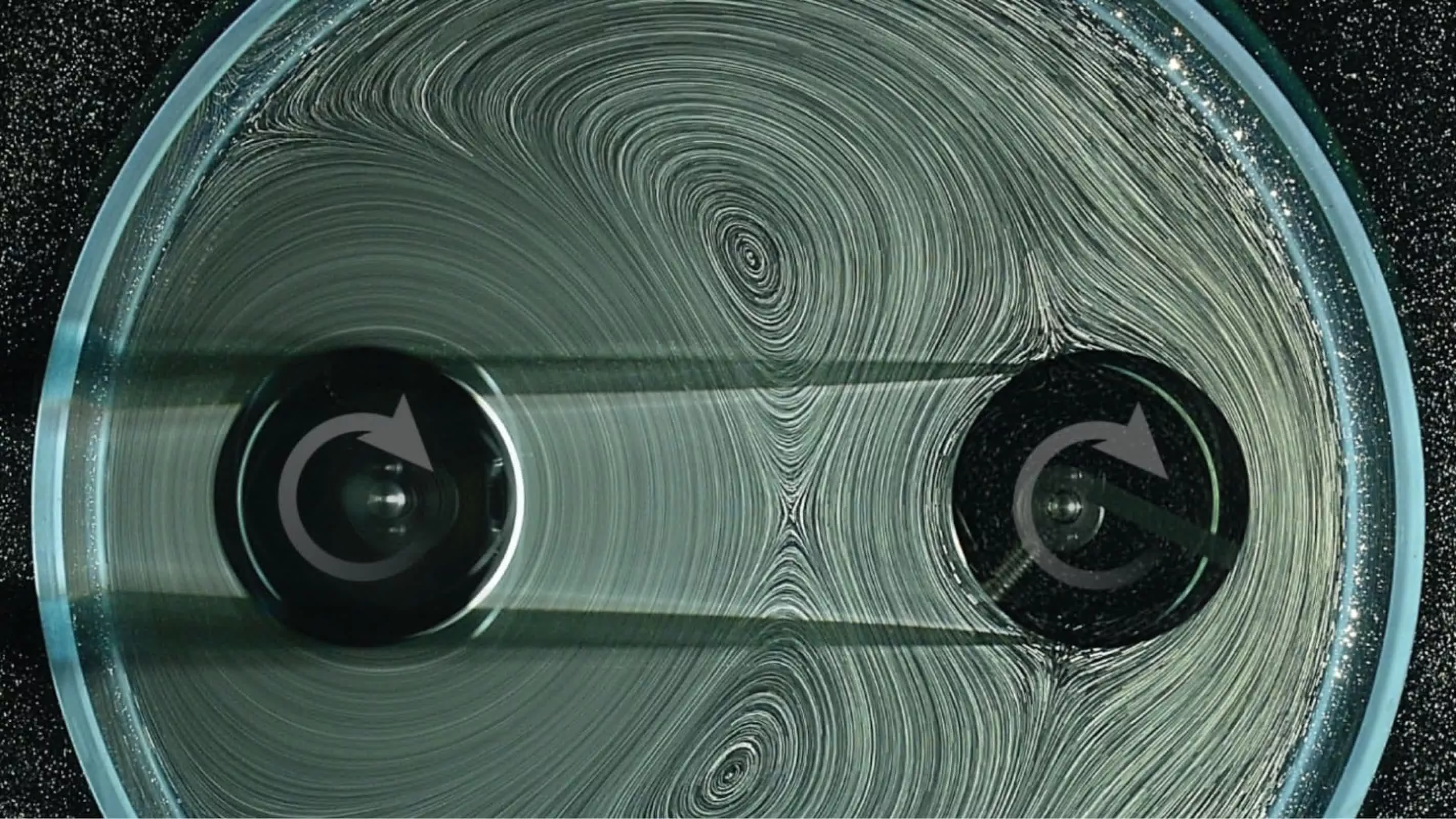
The study, published January 13 in Physical Review Letters, replaces the metal or plastic cogs of conventional gears with controlled flows of liquid. In their experiments, NYU physicists submerged two cylinders in a viscous water – glycerol mixture. When one cylinder rotated, the liquid currents it generated transmitted motion to the other – mimicking the performance of classical gears, but without any interlocking parts.

The results depended on the spacing between the cylinders. At short distances, swirling fluid formed micro-scale vortices that caused the second cylinder to spin in the opposite direction, replicating traditional gear behavior.

When the cylinders were spaced farther apart, the same flow looped around like an invisible belt, pulling both rotors in the same direction. The discovery demonstrated two distinct modes of motion transfer, both driven entirely by fluid flow.

NYU professor Jun Zhang, who led the project alongside mathematics professor Leif Ristroph, highlighted the broader significance of the finding: the ability to tune rotation speed and direction without solid contact offers a fundamental redesign of the gearbox itself.

Because the components never touch, the mechanism is immune to jamming and resistant to debris – problems that plague metal-based systems across industries. In traditional machinery, even a single grain of sand or a minor misalignment can halt an entire operation. In the fluid-driven system, the liquid simply flows past the obstruction.

Beyond durability, fluid gears offer a level of flexibility that mechanical versions cannot match. Adjusting flow speed or viscosity could instantly change a system's gear ratio, creating a self-adjusting drive mechanism ideal for soft robotics and adaptive structures. Instead of lubricating moving steel components to prevent wear, engineers might one day replace them entirely with carefully tuned liquids.

In soft robots, for example, fluid-driven gears could sit between a standard motor and a flexible joint, converting rigid rotary motion into smooth, controlled movement within a sealed limb. Designers could power silicone-based arms through a shared liquid circuit rather than installing separate gearboxes at every joint.

Because the parts do not touch, the system reduces hard pinch points and stress areas – a critical advantage for robots operating near people or delicate objects. The same principle could enable distributed actuation in pneumatic or hydraulic soft robots, where a network of fluid gears distributes flow and torque across different sections of the body. Engineers would still need to balance viscosity, pressure, and response time, but they would gain a new way to shape motion without adding rigid hardware.

Permalink to story:

 
vicky.png
 
Last edited:
How much torque would something like this have? Would the system need to be pressurized like hydraulics to have any meaningful use? I can’t see how liquid can rotate a 50 ton rock truck transmission without some serious pressure, unrealistic pressure.

EDIT: Also what turns the cylinders? I guess you could use magnets or electromagnetic forces but I think gears will be most efficient and practical long term. This could see use in nanobots.
 
Last edited:
We already have hydraulic couplings like torque converters as well as hydraulic systems that can produce linear and rotational motion, not really sure where the breakthrough is.
The breakthrough here would be making the fluid act like a gear via current, hypothetically drastically reducing the losses associated with fluid couplings.

That's a pretty big deal if sustainable.
How much torque would something like this have? Would the system need to be pressurized like hydraulics to have any meaningful use? I can’t see how liquid can rotate a 50 ton rock truck transmission without some serious pressure, unrealistic pressure.
It would likely need to be pressurized, but given that current 50 ton trucks use allison automatics with torque converters, it should be possible.

Regardless the article suggests that a lighter application that needs precise movement instead of brute strength is the suggested use case.
 
How much torque would something like this have? Would the system need to be pressurized like hydraulics to have any meaningful use? I can’t see how liquid can rotate a 50 ton rock truck transmission without some serious pressure, unrealistic pressure.

EDIT: Also what turns the cylinders? I guess you could use magnets or electromagnetic forces but I think gears will be most efficient and practical long term. This could see use in nanobots.
I think these are just engineering students looking for a PhD to further their career.
 
The fact that you can flip direction and gear ratio just by changing spacing or viscosity is wild. Somewhere a mechanical engineer is excited, and somewhere else a maintenance technician is thrilled they’ll never have to clean sand out of a gearbox again.
 
Already been done, even better than the torque converter, the viscous coupling used in all wheel drive units is another example that's been around for a long time.

Also as I read above, I noticed they don't mention efficiency. I'd imagine the torque transfer falls off a cliff in very short order.
 
We have been using fluid to transfer motion for centuries. For Pete's sake, rotating fluid is literally how a torque convert works in an automatic transmission. Look it up, it is very cool. The critical thing left out of this article is the fact that there is no meaningful torque transfer. The two cylinders effectively have no load on them. Connect them to some kind of load and it won't do squat. This whole thing is basically a bath tub exercise for kids. I don't know which is worse, the fact that this made news or I wasted my time writing a comment.
 
How much torque would something like this have? Would the system need to be pressurized like hydraulics to have any meaningful use? I can’t see how liquid can rotate a 50 ton rock truck transmission without some serious pressure, unrealistic pressure.

EDIT: Also what turns the cylinders? I guess you could use magnets or electromagnetic forces but I think gears will be most efficient and practical long term. This could see use in nanobots.

Zero torque. None. These are cool to look at, and useful in no way at all.
 
The fact that you can flip direction and gear ratio just by changing spacing or viscosity is wild. Somewhere a mechanical engineer is excited, and somewhere else a maintenance technician is thrilled they’ll never have to clean sand out of a gearbox again.

No, we aren't excited at all. There's nothing new here and it's just another fluid simulation exercise. No torque = cannot replace real gears.
 
We have been using fluid to transfer motion for centuries. For Pete's sake, rotating fluid is literally how a torque convert works in an automatic transmission. Look it up, it is very cool. The critical thing left out of this article is the fact that there is no meaningful torque transfer. The two cylinders effectively have no load on them. Connect them to some kind of load and it won't do squat. This whole thing is basically a bath tub exercise for kids. I don't know which is worse, the fact that this made news or I wasted my time writing a comment.
Man I am so glad that people allergic to technological advancement are not the only ones in charge of the world. I imagine you'd be saying the same thing about the model T 100 years ago, or the TV 70 years ago. Why do we need these new fangled computers? We've been typing on typewriters for a century and they work perfectly fine! These need ELECTRICITY? Dead on arrival, useless technology!
 
I imagine that the greatest breakthrough is a clean mathematical expression of how all the variables work together. From there, engineering would either be straightforward or would invite further research.

My interest comes from possible insights into how 'soft-style' martial arts achieve force and motion with minimal lever-style muscular contractions. One of the insights that I explore is that our bones are not so much the hard frame for lever actions, but rather are solid guides for directing our soft tissues to stack on themselves to support a drooping stack of self-supporting flesh. The advantage is resilience and whole body flesh supporting the force of our motions. Again, our bones at their best are just guides that let our flesh stack and balance. Cohesively stacked and balanced whole body flesh is stronger than bone and can immediately transfer force. Tendons and cartilage are much stronger than bone.

The mechanics of movement in these fluid gears could be a model for soft-tissue connection and force transfer in internal martial arts. The literature of those arts indicates that there is more than a mechanical element and that intention and micro-movements guide the forces in the flesh, so these fluid gears certainly do not answer all questions. But, they eventually might. Setting such fluid gears into the desired motion involves a level of intention, of engineering.
 
This idea has been around for years. Energy efficiency was/is one problem as is the type of fluids used. There have been advances in fluid (in this case liquid) synthesis e.g. synthetic motor oils (still expensive compared to mineral oils). Mineral oils have also evolved. The case could be made (are they doing that here) that there are new synthetic liquids capable at a very small lab scale of doing the transmission of energy job. But out in the real world? Don't see it.
 
Like others, I'm wondering what the "breakthrough" is since we have known about fluid dynamics and viscous couplings for years, but I suspect the nuances that have the researchers excited are beyond the scope of the more mainstream-oriented puff piece this article was based on. A lot of people here know more than most laypeople so we have more questions than "wow, neat."

I'd be interested in seeing how this would work in conjunction with magnetorheological fluids where the viscosity can be controlled.
 
LOL that regularly happens to your car's oil in the gearbox or diff I presume.
Not necessarily - but I reckon this solution would require a certain amount of pressure to maintain functionality and would be much more susceptible to any and all changes to the liquid compared to traditional oil leak / shortage in your gearbox.
 
I can’t wait to replace the planetary reducers in our precision indexing servo tables/ feeding mechanisms with these units. /sarcasm off
 
Back