
What just happened? Despite the associated concerns, Meta is increasing its AI spending. After announcing financial results that were heavily impacted by a massive tax bill, the company said its AI infrastructure spending will continue to rise and capital expenditure in 2026 will be "notably larger" than in 2025.

Meta just reported $51.24 billion in quarterly revenue, up 26% YoY and beating both Wall Street's and its own expectations for Q3. But its earnings per share (EPS) of $1.05 was far below Wall Street's expected $6.70.
The drop in EPS was due to a one-time non-cash income tax charge of $15.93 billion. Without that expense, EPA would have been $7.25.
With companies facing more questions over the enormous amount of money being spent on AI, Meta admitted that its full-year total expenses would be between $116-118 billion, increasing the lower end of the estimate from the previous $114 million. Meanwhile, predicted capital expenditure for the year has increased from $66-72 billion to $70-72 billion.
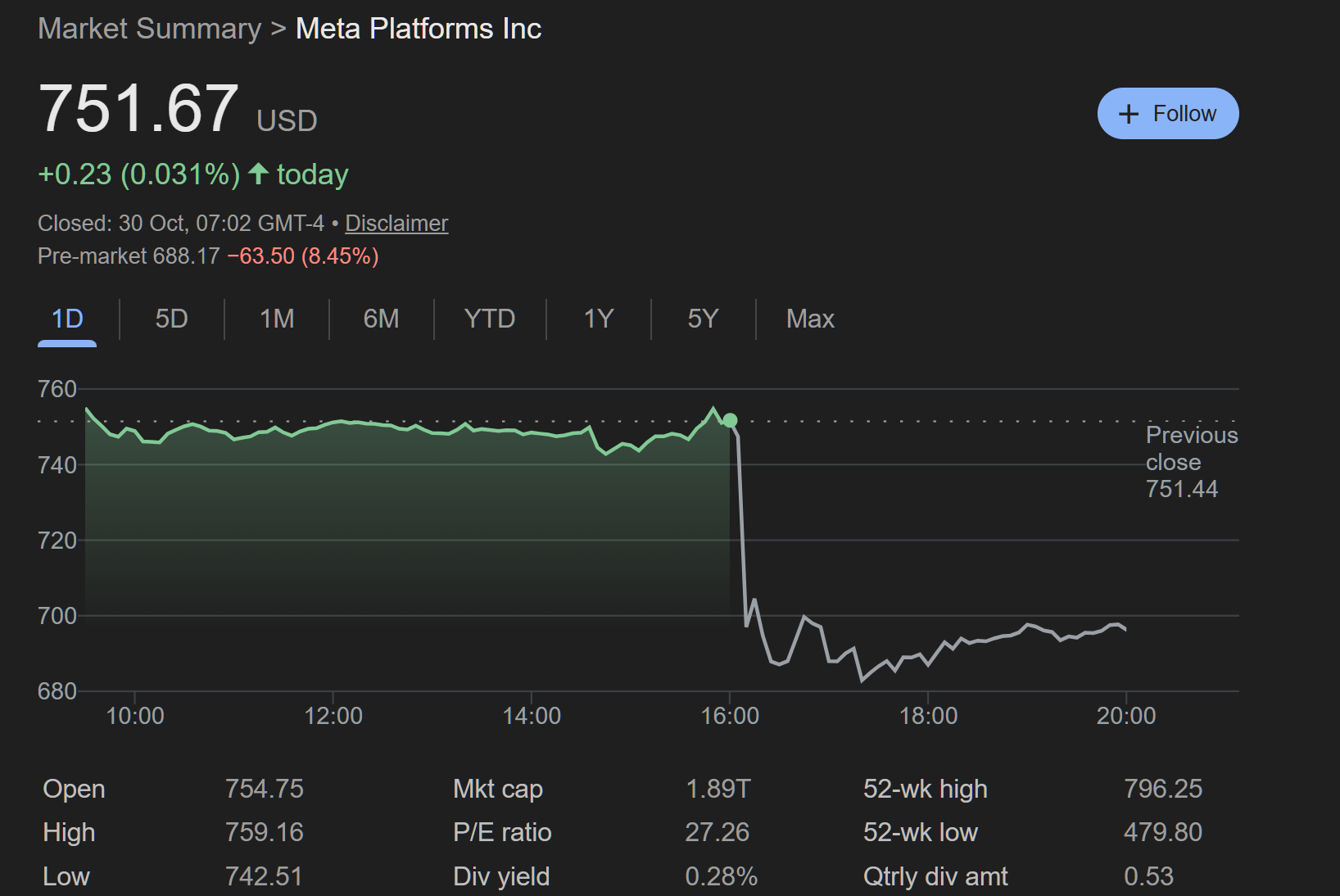
Meta's stock price has dropped 9% since its financial report
Chief financial officer Susan Li said in an earnings call that Meta needed to "invest aggressively" in 2026 to meet its computational needs. Li also said that total expenses are expected to grow at a significantly faster percentage next year, driven primarily by infrastructure costs.
The CFO also acknowledged that the millions it has spent on hiring AI talent will be the second-largest contributor to cost growth. In June, OpenAI boss Sam Altman said Meta tried to lure his employees into joining the firm using $100 million signing bonuses.
Investors are becoming increasingly concerned over the lack of near-term returns from the billions being spent on AI. Mark Zuckerberg tried to alleviate fears with the claim that larger investment in compute will "likely" be profitable, and that the research will lead to new capabilities that can be built into different products.
The Meta boss added that the infrastructure will be vital if AI superintelligence arrives soon. Zuckerberg said in July that AGI was "near," though he said the same thing in 2023.
Zuckerberg also said that in the very worst case, Meta will have pre-built capacity and absorb the depreciation costs.
"If it takes longer, then we'll use the extra compute to accelerate our core business, which continues to be able to profitably use much of the compute," Zuckerberg added.
There has been an increasing amount of talk about the AI boom being a bubble – Nvidia denies it, of course. With Microsoft and Alphabet joining Meta in ramping up AI spending, those fears are growing.
Meta this month announced that is laying off 600 people from its AI teams. Its shares dropped as much as 9% following its financial report.
Meta stock tumbles on massive tax charge and ballooning AI costs


