Micron starts sampling DDR5 RDIMMs with industry partners

Shawn Knight

Posts: 15,828   +202
Staff member
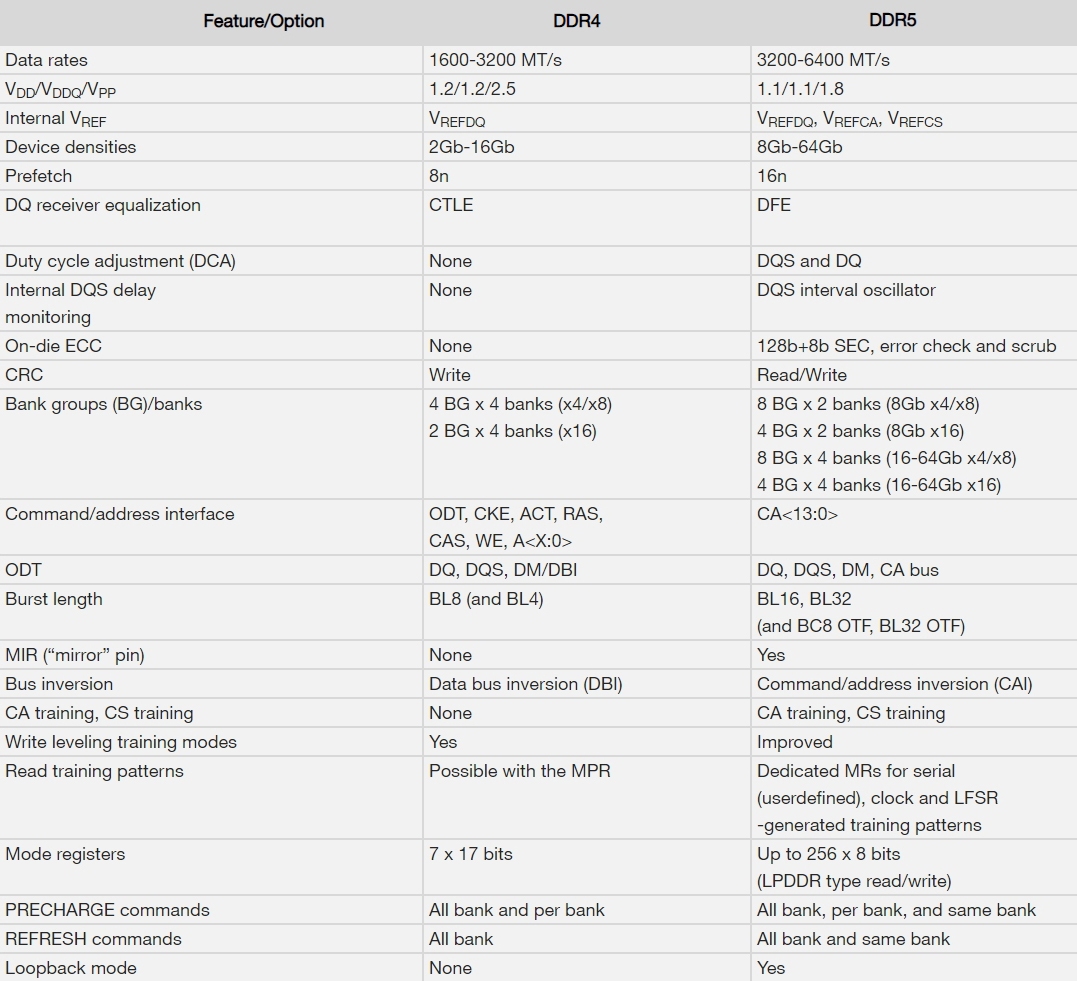
Forward-looking: Micron at CES this week announced it has begun sampling DDR5 registered DIMMS (RDIMM) based on its 1znm process technology. According to the memory maker, its new DDR5 – which doubles memory density while improving reliability – will deliver more than an 85 percent increase in memory performance among server workloads.
DDR5 also affords lower power requirements, making it more energy efficient at scale, and features enhancements like MIR (“mirror” pin) that improves DIMM signaling. There are also more options for PRECHARGE and REFRESH commands, we’re told.

Tom Eby, senior vice president and general manager of the Compute & Networking Business Unit at Micron, said, “Data center workloads will be increasingly challenged to extract value from the accelerating growth of data across virtually all applications.” Key to enabling these workloads, Eby added, is higher-performance, denser, higher-quality memory.
“Micron’s sampling of DDR5 RDIMMs represents a significant milestone, bringing the industry one step closer to unlocking the value in next-generation data-centric applications,” Eby said.

Keep in mind that all of this applies only to the server segment. There’s still no public timetable in place for the adoption of DDR5 in the desktop PC space as neither Intel nor AMD have announced components that support the standard. Still, it’s an important milestone and one that’ll eventually lead to desktop adoption when the time is right.

Masthead credit: RAM by FabrikaSimf

Permalink to story.

 
DDR5 is what I'm trying hard to wait for. Been wanting a cpu/platform upgrade for awhile, but wanna wait for ddr5 support. Another year more is about all I can probably muster and it doesn't sound like desktops will see ddr5 anywhere close to that time frame.
 
Yah, I'm waiting too. No benefit going from DDR3 to DDR4, so I may as well wait for DDR5.
Even the "just boot me speed" with Intel CPU IGPs is way faster going from DDR3 to DDR4.

SSDs are the biggest improvement, with very much accelerated boot and I/O times. That's even on the ancient DDR2 machine I'm using for the web. (DDR2 @ 800Mhz)

(That assumes performance improvement for the average user, not gaming, "speed freaks").
 
Last edited:
Even the "just boot me speed" with Intel CPU IGPs is way faster going from DDR3 to DDR4.

SSDs are the biggest improvement, with very much accelerated boot and I/O times. That's even on the ancient DDR2 machine I'm using for the web. (DDR2 @ 800Mhz)

(That assumes performance improvement for the average user, not gaming, "speed freaks").

I have an NVME SSD for booting...plenty fast enough (about 4 secs). I've read actual benchmarks of gaming with DDR3 and DDR4 and DDR3 still beats DDR4 in several games (several articles out there). DDR4 was just an excuse for Intel to make you buy an entirely new system. I bought my current system used 3 years ago from such a person for $200 CDN (about $145USD). i5 [email protected] (1.185V stock cooling), 16GB HyperX 1866, ASUS Z97 Pro Gamer...still very happy with it.
 
@Karl Hungus Well, it has been argued that as you increase clock speed, the latency times go up, offsetting some of the gains.

So, we don't know what that factor will be for even faster RAM.

("Hungus", really)?
 
Well, it has been argued that as you increase clock speed, the latency times go up, offsetting some of the gains.
Latency, in terms of clock cycles, is higher with DDR4 compared to DDR3, but since the chips themselves run at a much higher clock rate, the actual latency in terms of nanoseconds is about the same or slightly less (read more about it here).
 
DDR5 is what I'm trying hard to wait for. Been wanting a cpu/platform upgrade for awhile, but wanna wait for ddr5 support. Another year more is about all I can probably muster and it doesn't sound like desktops will see ddr5 anywhere close to that time frame.
Even if you get the first gen DDR5 capable hardware, the performance won't be any different since you have similar bandwidth and latency. This is always the case with early DDR transitions. You will probably have to wait 2-3 years before the pricing and speeds are make buying them worth it.
 
Back