Microsoft co-founder shows off the world's biggest plane

midian182

Posts: 11,693   +177
Staff member

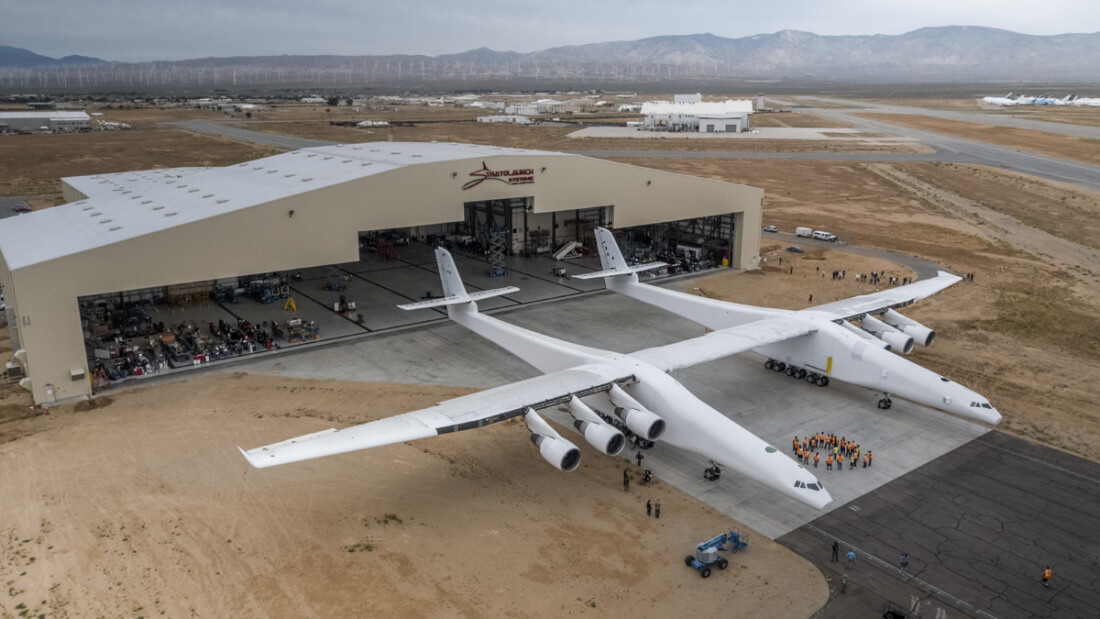
Paul Allen, the billionaire business magnate who co-founded Microsoft alongside Bill Gates, has unveiled the world’s biggest plane. His satellite launch company, Stratolaunch Systems, announced the 28-wheeled aircraft has now had its scaffolding removed, left the hanger, and is about to undergo fuel tests.

The double-fuselage plane weighs 500,000 pounds unfueled, but its total weight can go as high as 1.3 million pounds when fueled and carrying a rocket and payload.
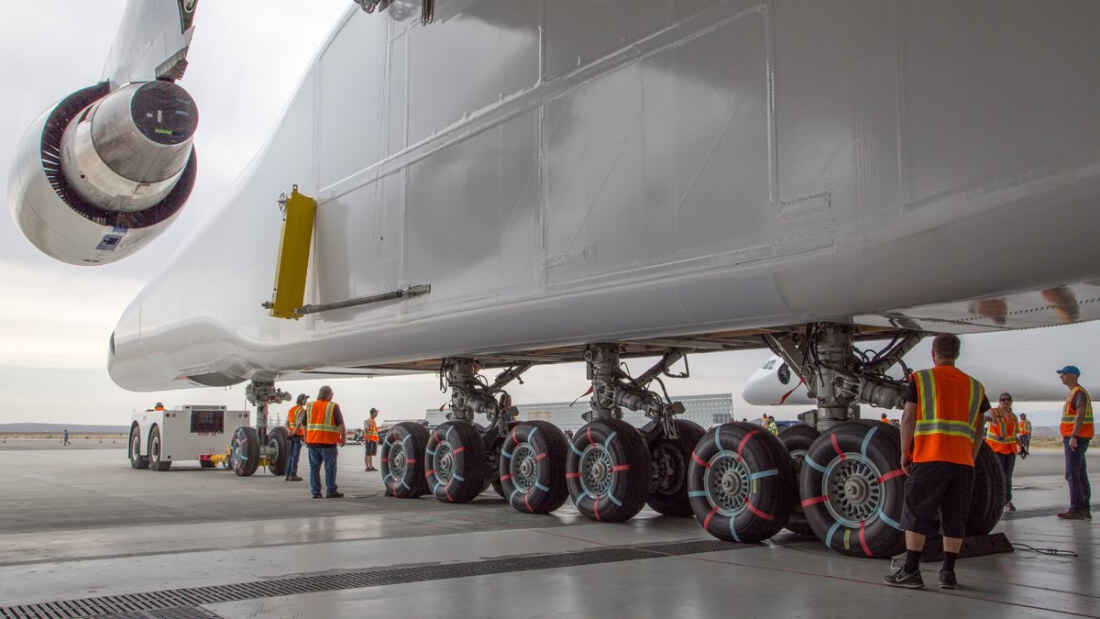
With six Boeing 747 engines and a 385-foot (117m) wingspan, the plane is so enormous it required special construction permits just for the scaffolding.

The aircraft, also named the Stratolaunch, is 238-feet (72m) long, has a tail height of 50 feet (15m), and boasts an operational range of 2,000 nautical miles. It’s larger than Howard Hughes’ “Spruce Goose,” which had a 320-foot (97.5m) wingspan. The plane was supposed to cost $300 million, but there’s no word on whether it exceeded its budget.

The Stratolaunch is designed for launching rocket-mounted satellites into space while in low-Earth orbit. Compared to sending satellites into space using traditional vertical rockets, this “air launch” method is cheaper and more effective.
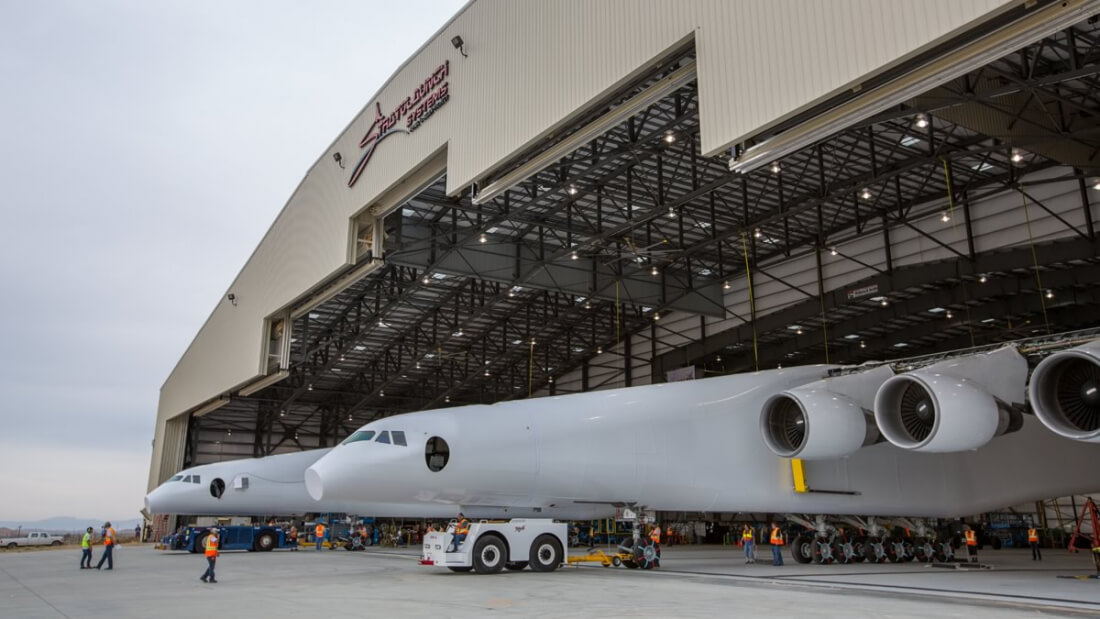
"Over the coming weeks and months, we'll be actively conducting ground and flightline testing at the Mojave Air and Space Port. This is a first-of-its-kind aircraft, so we're going to be diligent throughout testing and continue to prioritize the safety of our pilots, crew and staff," said Jean Floyd, Chief Executive Officer of Stratolaunch Systems.

This isn’t Allen’s first venture into space. His SpaceShipOne craft completed the first manned private spaceflight in 2004, winning the $10 million Ansari X Prize that same year.

The Stratolaunch's first demonstration satellite launch could arrive “as early as 2019.”

Permalink to story.

 
While it's size is impressive, even larger than the Hughes H-4 Hercules, also known as the Spruce Goose, a look at the aircraft causes me to wonder about the rigidity of the wing that spreads between the two fuselages. That will be the point of greatest stress and when carrying a fully loaded rocket payload it will be the obvious failure point. Such a failure would be unrecoverable and suggests that it only be flown in the most favorable weather. Any turbulence will put excessive stress on that failure point.
 
When you see something like this, your first thought might be, it will never get off the ground.
Then, when you find out Burt Rutan was the lead designer, you have to say, well, if he designed it,
it probably will work, and work well. He's designed some "interesting" aircraft over the years.
 
I wonder if the problem with such large aircraft is not in ensuring they can fly, but ensuring they can do so profitably, or at least break even. I expect modern composite materials would be a great aid here.
 
It's not like this is meant to carry people from Paris to Melbourne.... it's meant for launching satellites... And sending them this way, instead of via rockets that cost a ton and can't be re-used seems like a pretty intelligent idea.
 
While it's size is impressive, even larger than the Hughes H-4 Hercules, also known as the Spruce Goose, a look at the aircraft causes me to wonder about the rigidity of the wing that spreads between the two fuselages. That will be the point of greatest stress and when carrying a fully loaded rocket payload it will be the obvious failure point. Such a failure would be unrecoverable and suggests that it only be flown in the most favorable weather. Any turbulence will put excessive stress on that failure point.

While I agree with your analysis, I would like to think that Rutan and the other engineers on the project noted this and did the math to compensate. My guess is they will only fly in fare weather anyway, simply because they're launching rockets from underneath this thing.
 
Considering the alternative to using this method is a $100+ million rocket that can't be reused and can potentially explode destroying everything with it, this is a pretty solid alternative that is potentially better for the environment and could even make the process of putting junk in space more affordable.
 
I would feel better about the design, if the tail wings went all the way across for additional support. But then I'm not a certified engineer, so I'd better not present my ideas (especially if it's in Oregon).
 
While it's size is impressive, even larger than the Hughes H-4 Hercules, also known as the Spruce Goose, a look at the aircraft causes me to wonder about the rigidity of the wing that spreads between the two fuselages. That will be the point of greatest stress and when carrying a fully loaded rocket payload it will be the obvious failure point. Such a failure would be unrecoverable and suggests that it only be flown in the most favorable weather. Any turbulence will put excessive stress on that failure point.

I'm sure they accounted for all of those things. If not then I guess thats what tests are for.
 
I would feel better about the design, if the tail wings went all the way across for additional support. But then I'm not a certified engineer, so I'd better not present my ideas (especially if it's in Oregon).
Well, I am an engineer- not in this field though, but I agree with you. I don't know what the tolerance is for those engines, but any difference in thrust between the two groups of engines will create an added shearing force on that middle wingspan and an added risk- no doubt an additional tail wingspan can mitigate some of that risk.
 
Well, I am an engineer- not in this field though, but I agree with you. I don't know what the tolerance is for those engines, but any difference in thrust between the two groups of engines will create an added shearing force on that middle wingspan and an added risk- no doubt an additional tail wingspan can mitigate some of that risk.
Yeah, I'm sure the legions of engineers who came up with this had no idea what they were doing....
 
Yeah, I'm sure the legions of engineers who came up with this had no idea what they were doing....
Smart a55, huh?
BTW, "the legions of engineers" who designed the space shuttle Columbia also new what they were doing! If some Joe Schmo like me suggested something then that may have averted the disaster, I'm sure another clown would've been there to give that stupid response too.
 
Last edited:
Smart a55, huh?
BTW, "the legions of engineers" who designed the space shuttle Columbia also new what they were doing! If some Joe Schmo like me suggested something then that may have averted the disaster, I'm sure another clown would've been there to give that stupid response too.

Those legions of engineers had flagged the possibility of foam impact on shuttle tiles as a risk to the craft. They also flagged the O-rings as a risk to the Challenger boosters. The Bureaucrats ignored them. Engineers tend to be extremely conservative with their estimates of performance, MTBFs, and system risks - because the ones who are liberal with those numbers don't tend to stay employed as engineers for very long.
 
While it's size is impressive, even larger than the Hughes H-4 Hercules, also known as the Spruce Goose, a look at the aircraft causes me to wonder about the rigidity of the wing that spreads between the two fuselages. That will be the point of greatest stress and when carrying a fully loaded rocket payload it will be the obvious failure point. Such a failure would be unrecoverable and suggests that it only be flown in the most favorable weather. Any turbulence will put excessive stress on that failure point.
I'm sure the engineers who designed the aircraft know that, but thanks for the armchair quarterback analysis.
 
I'm sure the engineers who designed the aircraft know that, but thanks for the armchair quarterback analysis.

HAHAHAHA ..... and how many years have you been a structural engineer, owned a private/commercial license???
 
Yeah, I'm sure the legions of engineers who came up with this had no idea what they were doing....
Smart a55, huh?
BTW, "the legions of engineers" who designed the space shuttle Columbia also new what they were doing! If some Joe Schmo like me suggested something then that may have averted the disaster, I'm sure another clown would've been there to give that stupid response too.
You don't get to call people clowns when you misspell the word "knew". Engineer my a55.

https://www.techspot.com/news/69537-federal-judge-sides-oregon-man-accused-illegally-using.html
 
Back