Nuclear-electric rocket propulsion could cut Mars round-trips down to a few months

zohaibahd

Posts: 976   +19
Staff
Forward-looking: Scientists have long envisioned nuclear electric propulsion as a transformative technology for unlocking the potential of solar system exploration. Now, two companies making steady progress on the critical components of this technology have joined forces, potentially accelerating the timeline for turning that vision into reality.
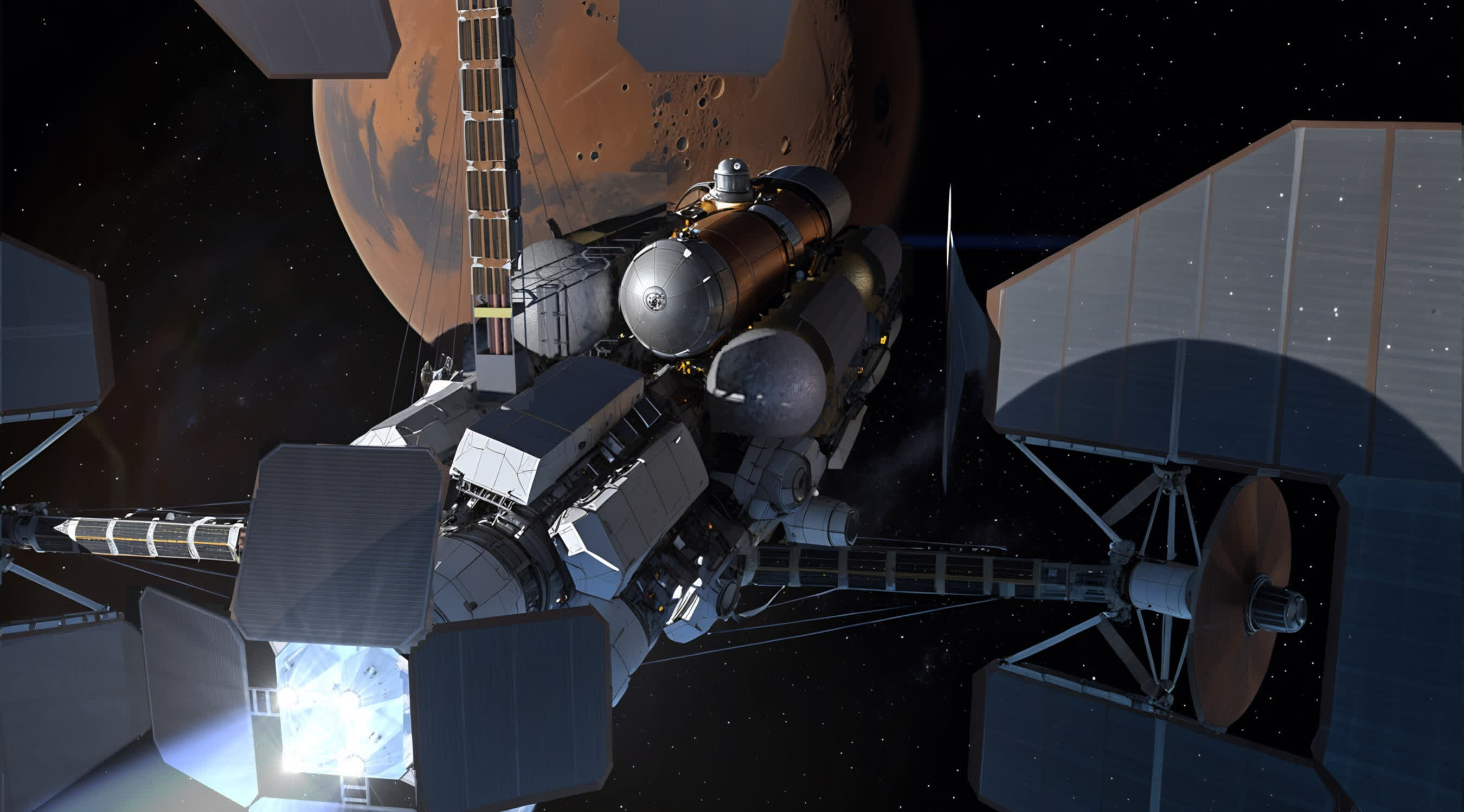
Ad Astra Rocket Company has spent over two decades developing the Variable Specific Impulse Magnetoplasma Rocket (VASIMR), a highly efficient electric propulsion system. VASIMR operates by using powerful electromagnetic fields to ionize and accelerate a propellant, creating a high-speed plasma exhaust.

This system offers exceptional fuel efficiency compared to traditional chemical rockets. However, this advantage comes with a significant tradeoff – low thrust levels. Achieving the engine's maximum thrust and efficiency requires an enormous amount of electrical power – over 100 kilowatts, to be exact. The VASIMR VX-200 prototype, for example, consumed 200 kilowatts of input power.

This power requirement is staggeringly high, and unfortunately, there is currently no practical way to generate such immense energy using existing space power systems, such as solar arrays or radioisotope thermoelectric generators.
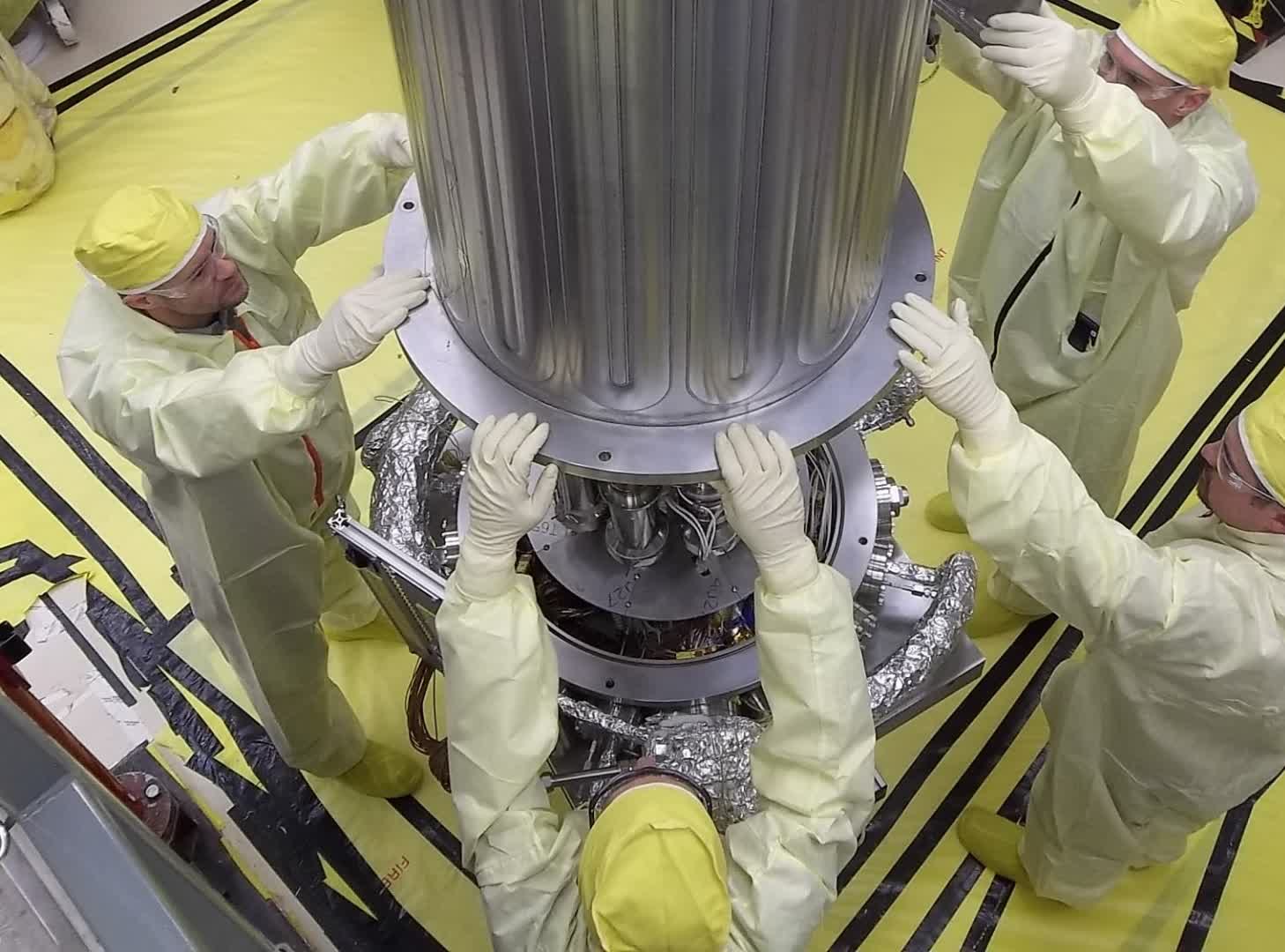
This is where Space Nuclear Power Corporation (commonly known as SpaceNukes) comes into play with its Kilopower nuclear fission reactor project. The startup has been steadily advancing nuclear reactors designed for space applications and successfully demonstrated a 1-kilowatt system on the ground in 2018. The Kilopower reactor is capable of generating up to 10 kilowatts of electrical output continuously for at least a decade.

Under a new partnership, the two companies will collaborate to integrate SpaceNukes' nuclear technology with Ad Astra's propulsion system, potentially achieving an optimal balance of efficiency and thrust.

VASIMR is highly scalable with larger power outputs, and Ad Astra emphasizes that its fundamental physics make it "propellant-agnostic," meaning it can operate using a variety of cost-effective propellants.

By combining high-power nuclear reactors with high-efficiency plasma engines, the two companies aim to develop a propulsion system that could significantly reduce transit times for future robotic and human exploration missions. SpaceNukes has suggested that round-trip journeys to Mars could take just a few months instead of the current timeline of over a year.

While the partnership is still in the early stages of planning, with concrete timelines yet to be finalized, the goal is to conduct an orbital demonstration by the late 2020s and move toward commercialization in the 2030s. Many challenges remain, but if successful, this collaboration could revolutionize deep space exploration.

Permalink to story:

 
More nonsense about going to Mars. We're not sending people to Mars, period. How hard is that to understand?

It doesn't matter how fast we can travel in space, it doesn't change the fact that Mars is an uninhabitable planet. It has low gravity, strong winds that create dust storms, high levels of radiation that is harmful to humans, a thin atmosphere with very little oxygen, an average temperature of -55C (-67F), and no magnetic field. Almost like the planet doesn't want us there.

If people like Elon Musk want to fool the masses into thinking we'll be colonizing Mars within our lifetime then they should be the first ones to go there. (Obviously they won't.)

Again, we're not going to Mars. Not in the next 20 years, not in the next 50 years. So get over it.
 
More nonsense about going to Mars. We're not sending people to Mars, period. How hard is that to understand?

It doesn't matter how fast we can travel in space, it doesn't change the fact that Mars is an uninhabitable planet. It has low gravity, strong winds that create dust storms, high levels of radiation that is harmful to humans, a thin atmosphere with very little oxygen, an average temperature of -55C (-67F), and no magnetic field. Almost like the planet doesn't want us there.

If people like Elon Musk want to fool the masses into thinking we'll be colonizing Mars within our lifetime then they should be the first ones to go there. (Obviously they won't.)

Again, we're not going to Mars. Not in the next 20 years, not in the next 50 years. So get over it.

Just because Mars is a harsh environment does not mean that at least some people will want to attempt to set up a colony there; naysayers like yourself are not going to stop them. SpaceX is actively building & testing their gigantic Starship rocket specifically to enable journeys to Mars, and setting up the infrastructure to mass produces said rockets. They would not be developing such an ambitious rocket & facilities if they did not have serious plans to land people on Mars within the next ten years. I mean their current Falcon 9 rocket is both profitable & makes everyone else's space operations look like a joke, SpaceX could easily rest on their laurels for a while, but has chosen not to.
 
More nonsense about going to Mars. We're not sending people to Mars, period. How hard is that to understand?

It doesn't matter how fast we can travel in space, it doesn't change the fact that Mars is an uninhabitable planet. It has low gravity, strong winds that create dust storms, high levels of radiation that is harmful to humans, a thin atmosphere with very little oxygen, an average temperature of -55C (-67F), and no magnetic field. Almost like the planet doesn't want us there.

If people like Elon Musk want to fool the masses into thinking we'll be colonizing Mars within our lifetime then they should be the first ones to go there. (Obviously they won't.)

Again, we're not going to Mars. Not in the next 20 years, not in the next 50 years. So get over it.
We landed on the moon and could feasibly build a small colony on it. The only thing that's more difficult about Mars than the moon is distance.
 
Sorry to burst everyone who is eager to go to mars bubble, nobody is going their, there has never been a moon landing never will be, all the fake bs made up and all the suckers who fell for it will never see anything like it happen. They just wasting money and time and deviating from what is the real problems the world faces
 
The VASIMIR engines don't increase acceleration or velocity, don't decrease travel time, orbital escape or insertion time, don't do anything that more typical engines already do. The entire article is a sales pitch. Heating up water and blowing it out the back is far, far more realistic and fully functional. A "plasma" doesn't add velocity. Fake nuclear fission doesn't add velocity. There's no impetus to motion in either event.

But that doesn't even matter because these other people are also mostly correct:

More nonsense about going to Mars. We're not sending people to Mars, period. How hard is that to understand?

It doesn't matter how fast we can travel in space, it doesn't change the fact that Mars is an uninhabitable planet. It has low gravity, strong winds that create dust storms, high levels of radiation that is harmful to humans, a thin atmosphere with very little oxygen, an average temperature of -55C (-67F), and no magnetic field. Almost like the planet doesn't want us there.

If people like Elon Musk want to fool the masses into thinking we'll be colonizing Mars within our lifetime then they should be the first ones to go there. (Obviously they won't.)

Again, we're not going to Mars. Not in the next 20 years, not in the next 50 years. So get over it.

Correct, wholesale.

Sorry to burst everyone who is eager to go to mars bubble, nobody is going their, there has never been a moon landing never will be, all the fake bs made up and all the suckers who fell for it will never see anything like it happen. They just wasting money and time and deviating from what is the real problems the world faces

Also correct, wholesale.

Just because Mars is a harsh environment does not mean that at least some people will want to attempt to set up a colony there; naysayers like yourself are not going to stop them.

Incorrect, wholesale. It doesn't matter what people will attempt - the radius of Mars and its charge field will never, ever float an oxygen atmosphere. Venus won't either. A planet must be within a very tiny percentage (.5-1%) the radius of Earth to float oxygen, period. Mars can never have an atmosphere and only pressurized cannister colonies could possibly work at all - which they will always eventually fail.

Earth isn't just the sweet spot in terms of charge balance and orbit, a planet HAS to be the same size and density as Earth to float oxygen at all. On Mars, any oxygen introduced wouldn't float. It would stay within 2" or so of the surface and nobody could breathe any of it. Dome colonies? Nope. Tents? Nope. Habitable by people? Nope.

It's physics, not fiction. It's also precisely why Venus will also not ever work. It's simply too small.
 
We're not sending people to Mars, period. How hard is that to understand? Not in the next 20 years, not in the next 50 years. So get over it.
You speak for all humanity now? Out here in the real world, plans are a bit different:

SpaceX will start launching Starships to Mars in 2026, Elon Musk says
September 8, 2024...'These will be uncrewed to test the reliability of landing intact on Mars. If those landings go well, then the first crewed flights to Mars will be 2028...
 
The VASIMIR engines don't increase acceleration or velocity, don't decrease travel time, orbital escape or insertion time, don't do anything that more typical engines already do. The entire article is a sales pitch.... A "plasma" doesn't add velocity. Fake nuclear fission doesn't add velocity. There's no impetus to motion in either event.
Wrong on all counts. The concept you're missing entirely here is something called "specific impulse", or Isp, which controls utterly the performance of rocket engines. Current chemical rockets have an Isp of about 250 to 450 seconds. Vasimir has been tested at 5000s -- albeit with some significant engineering issues remaining.

a planet HAS to be the same size and density as Earth to float oxygen at all. On Mars, any oxygen introduced wouldn't float. It would stay within 2" or so of the surface and nobody could breathe any of it. It's physics.
It's not physics. It's something you read in a comic book somewhere. Gases don't work like this.
 
Wrong on all counts. The concept you're missing entirely here is something called "specific impulse", or Isp, which controls utterly the performance of rocket engines. Current chemical rockets have an Isp of about 250 to 450 seconds. Vasimir has been tested at 5000s -- albeit with some significant engineering issues remaining.


It's not physics. It's something you read in a comic book somewhere. Gases don't work like this.
I hope you realize that you're arguing with someone who follows another person (who's name is not worth remembering, IMO) that specifically states everyone is wrong about the value of PI and that PI = 4.

Not to mention that the post fails to consider that Water is heavier requiring more fuel to launch it into space.
 
I hope you realize that you're arguing with someone who follows another person (who's name is not worth remembering, IMO) that specifically states everyone is wrong about the value of PI and that PI = 4.
Oof ... point taken.

Not to mention that the post fails to consider that Water is heavier requiring more fuel to launch it into space.
To clarify, the propellant for these magnetothrust systems is generally xenon -- far more massive than the hydrogen and oxygen than water disassociates into. But the efficiency gains come because the ions are expelled at far higher velocities. In a basic reaction mass calculation the mass term drops out -- only the exit velocity matters
 
Just another "could" article
It's nothing new. Science has known about various different possible propulsion methods including NEP that would get a spacecraft to Mars faster. ION propulsion is another method.

Honestly, the only "could" about it is to make the engine.
 
Oof ... point taken.
I gave up on Jared long ago.
To clarify, the propellant for these magnetothrust systems is generally xenon -- far more massive than the hydrogen and oxygen than water disassociates into. But the efficiency gains come because the ions are expelled at far higher velocities. In a basic reaction mass calculation the mass term drops out -- only the exit velocity matters
No disputes there, from me anyway. ;)
 
My god... First, the one talking about atmosphere on Mars... Pressurized colonies is the only method we could try to colonize Mars with humans... EVEN if it would be possible to terraform Mars that would take millenia to complete.

Second, we don't need to colonize Mars, but an outpost could be really valuable, and it don't even need to have full time humans there. It could act as a depot for resources for manned and non manned missions to getting even further in space, like an fueling outpost and for other materials. Again there's no need to have humans around the clock in a Mars outpost for it to be extremely valuable. Also, even if it's just an outpost comparable in size to the habitable space in the current ISS, you still would have miles and miles of ground to stockpile cargo, fuel, tanks, and so on and so on... So not every installation need to be pressurized to be valuable.

And to end it... It's propulsion technology... It can be useful in any space transportation scenario.

ps.: even a small outpost outside earth have lots of potential - there's lots of scientific research projects that's made in ISS, as I said it can be used as a hop for further travels, it can be used for fabrication of advanced materials that it's not feasible to do on earth gravity, we could have robot factories on Mars for products that could use "local" materials, and so on and so on...

With efficient and economic viable interplanetary transportation systems we could have an interplannetary logistics, that could in turn let us extend human activity over our planetary system, and over the centuries that could allow for the spread of space outposts, out of earth factories, the possibilities are endless.

Our current civilization became spread all over the planet not in the time span of a century, it took many technology advances and many centuries. Expanding civilization to another locations in our solar system would take centuries too.

So we can't think about such technology advances like this one in a short haul, it may not be useful in the next decades, but it can be an important milestone.

Not every advance about space exploration is about colonizing anywhere or about right now.
 
Last edited:
I hope you realize that you're arguing with someone who follows another person (who's name is not worth remembering, IMO) that specifically states everyone is wrong about the value of PI and that PI = 4.

Not to mention that the post fails to consider that Water is heavier requiring more fuel to launch it into space.
Imagine not even knowing what Pi is in 2024.

Literally every motion equation requires Pi to be "4". It's only 3.14xxx once you remove time/motion from the squared circle. NASA knows this, everyone in physics knows this, and yet here you are simpin' for Big Dumb.
 
Imagine not even knowing what Pi is in 2024.

Literally every motion equation requires Pi to be "4". It's only 3.14xxx once you remove time/motion from the squared circle. NASA knows this, everyone in physics knows this, and yet here you are simpin' for Big Dumb.
I don't have to not know. It is being demonstrated for me by posts like this one I quoted.

If it is 4, as you say, then how about posting a mathematical proof?
 
It's a total waste of resources for a useless purpose, as if we didn't already have enough problems here on earth
 
It's a total waste of resources for a useless purpose, as if we didn't already have enough problems here on earth
It's like I say with spending on arts and stuff like that. Why spend the money on that when we have so many other problems. Too much government waste!
 
The video is 6 years old, I'm sure the technology has advanced. I'm more interested in one of these for my house!

There are a lot of very smart people around the world working on space propulsion. It's amazing there are randos on the web that think they're smarter than multiple, global teams of scientists. If we cease to endeavor to achieve the impossible, how will we advance?
 
Probably need every type of propulsion . Solar sails , laser on moon to provide energy, ion drive

But really should just go to an antimatter ramjet to collect mass to propel , plus at that speed will need a force feed ramjet to protect from interstellar dust :)

Or a quantum state changer ( QSC ) , so your rocket can be all places at once to you decide where you want to be. Quite simple really, normally most quantum efforts are at nanoscale, but they are getting effects with bigger particles. Now a rocket ship is quite big vs a photon, or hydrogen atom and the chance of a quantum effect of you teleporting somewhere else is exceedingly small. However in my patented QSC,it creates infinite possibilities, so chance don't matter

as an side note, someone release a paper saying basically impossible for monkeys bashing a typewriter to write a Shakespeare play given infinite time- vaguely glanced at it,thought was a silly out , even with stupendous amount of monkeys bashing away, they time taken would not be within the effective life of the universe by huge order of magnitudes
 
as an side note, someone release a paper saying basically impossible for monkeys bashing a typewriter to write a Shakespeare play given infinite time- vaguely glanced at it,thought was a silly out , even with stupendous amount of monkeys bashing away, they time taken would not be within the effective life of the universe by huge order of magnitudes
Incorrect. The ratio between "infinite time" and "the age of the universe" is, well, infinite itself. Furthermore, our hypothetical monkeys could actually perform the feat in finite time ... if one assumes an infinite array of them.
 
Back