Nvidia GeForce RTX 50 prices finally edging toward MSRP across US retailers

Daniel Sims

Posts: 2,466   +74
Staff
The big picture: Nvidia's RTX 50 series and AMD's Radeon RX 9000 series graphics cards have generally sold for hundreds of dollars over MSRP since their launch in the first quarter of this year. While that largely remains the case, a careful search through online retailers in the US shows that customers looking for Team Green's GPUs still have reason to be optimistic.

Those willing to spend time browsing Amazon, Newegg, and Micro Center can now find some RTX 50 series graphics cards priced at or within $30 of MSRP. While most listings remain heavily inflated, the GPU market may finally be showing signs of stability.

Gigabyte is currently bundling pre-order copies of Borderlands 4 with the RTX 5070 at its $549 MSRP and the 5070 Ti at $780 – just $30 above its $749 list price. The 5070 Ti ranks among the best-performing graphics cards in recent cost-per-frame comparisons at MSRP, but until now, that price point has been more illusion than reality.
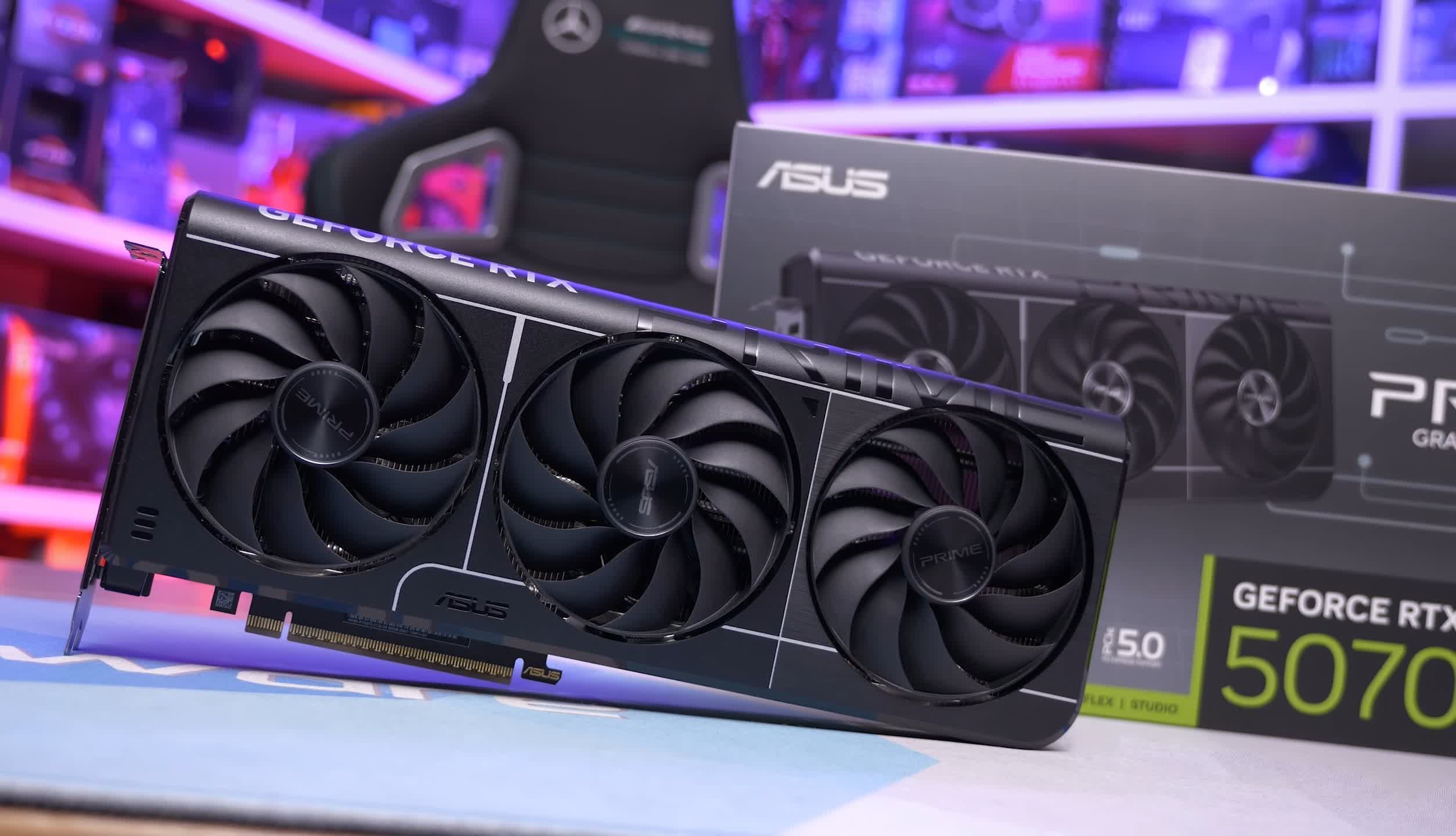
PNY is also selling the RTX 5070 and 5070 Ti at similar prices, but its most compelling offer may be the RTX 5080 at its $1,000 MSRP. This is notable because prior analysis identified the 5080 and 5090 as the biggest casualties of inflated pricing, often listed at least 50 percent above MSRP. Asus has a comparable offer at $1,100, signaling a possible shift toward normalization.

On the AMD side, MSRPs for the Radeon RX 9000 series remain largely theoretical. The RX 9070 XT would likely rank among 2025's best GPUs if it were actually available at its $600 MSRP. Our analysis shows it outperforms the $750 RTX 5070 Ti in most games, and recent software updates have further improved its performance. Unfortunately, most listings still price Team Red's upper-midrange card closer to $800, even months after launch. A few 16GB 9060 XT models, however, can be found within $50 of the $349 MSRP.

Although eager buyers might be tempted to grab these recent "deals," anyone who can wait a few months should consider doing so. Holiday promotions could offer better discounts, and if leaks from the Chiphell forums prove accurate, significant price cuts for the RTX 50 series may be imminent.

Looking ahead, Nvidia is expected to launch an RTX 50 Super lineup in late 2025 or early 2026. While these cards likely won't deliver dramatic performance gains, they are rumored to include substantial VRAM upgrades, providing extra headroom for high-resolution gaming and ray tracing.

Permalink to story:

 
Good to see. Hopefully the "front loaded" buying that occurred this year due to tariffs mean lower than average sales in the back half of the year, prompting promotions and discounts for the holiday shopping season as well.

I'm not even interested in the new cards necessarily, but they need to drop in price to put pressure on the used card market which is just a trainwreck of over valued cards and "I know what I got" attitudes from sellers.
 
If you think this is interesting just wait until you see what happens next as consumer spending power continues to plummet and massive machine learning deployments continue failing to deliver return on investment.
 
I noticed this trend a few weeks ago and have since been wondering how much I care about 24GB of VRAM.

Both rumor and logic predict minimal performance improvement in the Supers*, so the question is whether games will expand past 16GB VRAM in the next 4 years.

*e.g., 5080 already uses the full die, meaning no more cores, leaving slight OC and faster VRAM for ~3% gains. 5070 TIS can't improve much if the 5080S is the same. Etc.
 
I noticed this trend a few weeks ago and have since been wondering how much I care about 24GB of VRAM.

Both rumor and logic predict minimal performance improvement in the Supers*, so the question is whether games will expand past 16GB VRAM in the next 4 years.

*e.g., 5080 already uses the full die, meaning no more cores, leaving slight OC and faster VRAM for ~3% gains. 5070 TIS can't improve much if the 5080S is the same. Etc.
You're still gonna have 95% of PC gamers and consoles on 16GB or less for the next 5 years. Know what's gonna happen when the super series drops? Very few of the regular people who already bout a 5070 or 5080 will upgrade, the previous regular series will drop in price and people will buy those instead. The super series will sit on shelves until the 60 series comes on and they get a price drop.

Until nVidia starts making open source drivers or at least makes proper Linux drivers then buying them is off the table for me anyway.
 
You're still gonna have 95% of PC gamers and consoles on 16GB or less for the next 5 years. Know what's gonna happen when the super series drops? Very few of the regular people who already bout a 5070 or 5080 will upgrade, the previous regular series will drop in price and people will buy those instead. The super series will sit on shelves until the 60 series comes on and they get a price drop.

Until nVidia starts making open source drivers or at least makes proper Linux drivers then buying them is off the table for me anyway.
Nvidia did a good job of selling through the previous card inventory at minimal discounts before launching the 50 cards, so I wouldn't count on big discounts (beyond reaching MSRP) this go round.

Given that previous strategy, it could be a while until the Supers are actually available to buy unless Nvidia wants a Christmas rush on new cards.
 
Nvidia did a good job of selling through the previous card inventory at minimal discounts before launching the 50 cards, so I wouldn't count on big discounts (beyond reaching MSRP) this go round.

Given that previous strategy, it could be a while until the Supers are actually available to buy unless Nvidia wants a Christmas rush on new cards.

- The previous cards launched into not only a dearth of new cards to buy and poor launch supply, but also a period of economic upswing when people still felt like they had plenty of spending money in their pockets.

I think the American consumer is getting more and more stingy as inflation isn't backing off, prices aren't falling, lay-offs are increasing and the general national sentiment is turning sour again (although that can sometimes actually drive "spending for fun/pleasure" as people try to escape their economic realities).

IMO everyone is pro-recession so long as they aren't the ones that take a bath when the recession hits.
 
- The previous cards launched into not only a dearth of new cards to buy and poor launch supply, but also a period of economic upswing when people still felt like they had plenty of spending money in their pockets.

I think the American consumer is getting more and more stingy as inflation isn't backing off, prices aren't falling, lay-offs are increasing and the general national sentiment is turning sour again (although that can sometimes actually drive "spending for fun/pleasure" as people try to escape their economic realities).

IMO everyone is pro-recession so long as they aren't the ones that take a bath when the recession hits.
I agree a repeat is unlikely to have the same premium over MSRP fly with consumers, but I would be surprised to see more than $50 off MSRP on the non-Supers before they are gone.

Still, I think a lot of people would (maybe begrudgingly) buy the non-Supers at MSRP. The 5080 at $999 is within the realm of sanity for a top tier card (since covid). The 4080S sold pretty well. It was the additional because-we-can $300-600 that turned people off. Same with the other tiers as well.

I mean it's not like the supers or the 60s will be cheaper. The 60s will be at least 15% faster with the node shrink but it may be 2 years before those are widely available at MSRP. I don't want to wait that long with a hobbled 10GB card.
 
Sad times when months after launch hitting instead of doing well under MSRP is something considered to look forward to (especially when the prices are very high to begin with). NVIDIA has done great at setting a new normal that everyone seems far too willing to accept. I have considered buying anything current gen or new for a while now.
 
I'm not even interested in the new cards necessarily, but they need to drop in price to put pressure on the used card market which is just a trainwreck of over valued cards and "I know what I got" attitudes from sellers.

I've noticed that the used video card market has gone completely insane. In my country you see people selling used 3060s and 8GB 4060s in marketplaces for the same price as a brand new 5060 from reputable retail stores. In *70 and *80 series cards you see people asking even higher prices, I.e. used 4070 Super more expensive than a brand new 5070.
 
Na man, PC gaming is dead and so is Nvidia. Nobody here is buying video cards. Literally 1-30 sold a year in the biggest stores. People dont wanna buy them with these insane new prices. Our fun hobby is dead. I dont see things improving by them lowering the prices a little. To make things worse, the cable issue is becoming more and more popular so people wanna avoid Nvidia cards.

For the record, video cards used to sell a truckload every second in like 2010-2017. Nvidia sure killed the joy of building a computer, well done! At least console sales are going thru the roof, 400 bucks and you can play anything. No scalpers, no bs. Buy, plug and play.
 
Na man, PC gaming is dead and so is Nvidia. Nobody here is buying video cards. Literally 1-30 sold a year in the biggest stores. People dont wanna buy them with these insane new prices. Our fun hobby is dead. I dont see things improving by them lowering the prices a little.
Sorry to burst your cope bubble, but none of that is true.

PC gaming is still alive and well - even with fewer people upgrading their cards right now. Magically, existing GPUs still function. Owned games are still fun. New games are still sold. And yes WAY more than 30 GPUs/year are being sold. Like millions more.

Yes, GPUs are more expensive (like everything) and that means lower demand and longer upgrade cycles, but we are a loooong way from our hobby being dead.
 
Back