Nvidia's new monitoring software shows where AI GPUs are running worldwide

Skye Jacobs

Posts: 2,012   +59
Staff
First look: Nvidia has rolled out a new GPU fleet management platform aimed at giving data center operators real-time visibility into sprawling AI infrastructure. The system pulls telemetry from globally distributed deployments into Nvidia's NGC cloud platform, surfacing everything from hardware health and energy efficiency to the physical location of GPUs currently in operation.

The software relies on a customer-managed agent installed within each environment. That agent collects detailed system data and sends it to a centralized dashboard hosted on NGC. From there, operators can examine performance at multiple layers: a global view of all deployed hardware, compute zones corresponding to individual on-premises or cloud sites, and granular, node-by-node breakdowns.

The resulting data not only provides inventory and usage summaries but can pinpoint where each GPU is physically operating – functionality that may discourage smuggling or unauthorized exports of restricted AI processors.

Nvidia emphasizes that the software is strictly a monitoring layer. It has no ability to disable GPUs or remotely alter their behavior, a design choice meant to head off concerns about backdoors or manufacturer-controlled kill switches. In practical terms, Nvidia can see if its chips appear in regions where they are not permitted, but it lacks any technical mechanism to deactivate them. The company says the platform is open source, installed and managed by customers, and fully auditable.
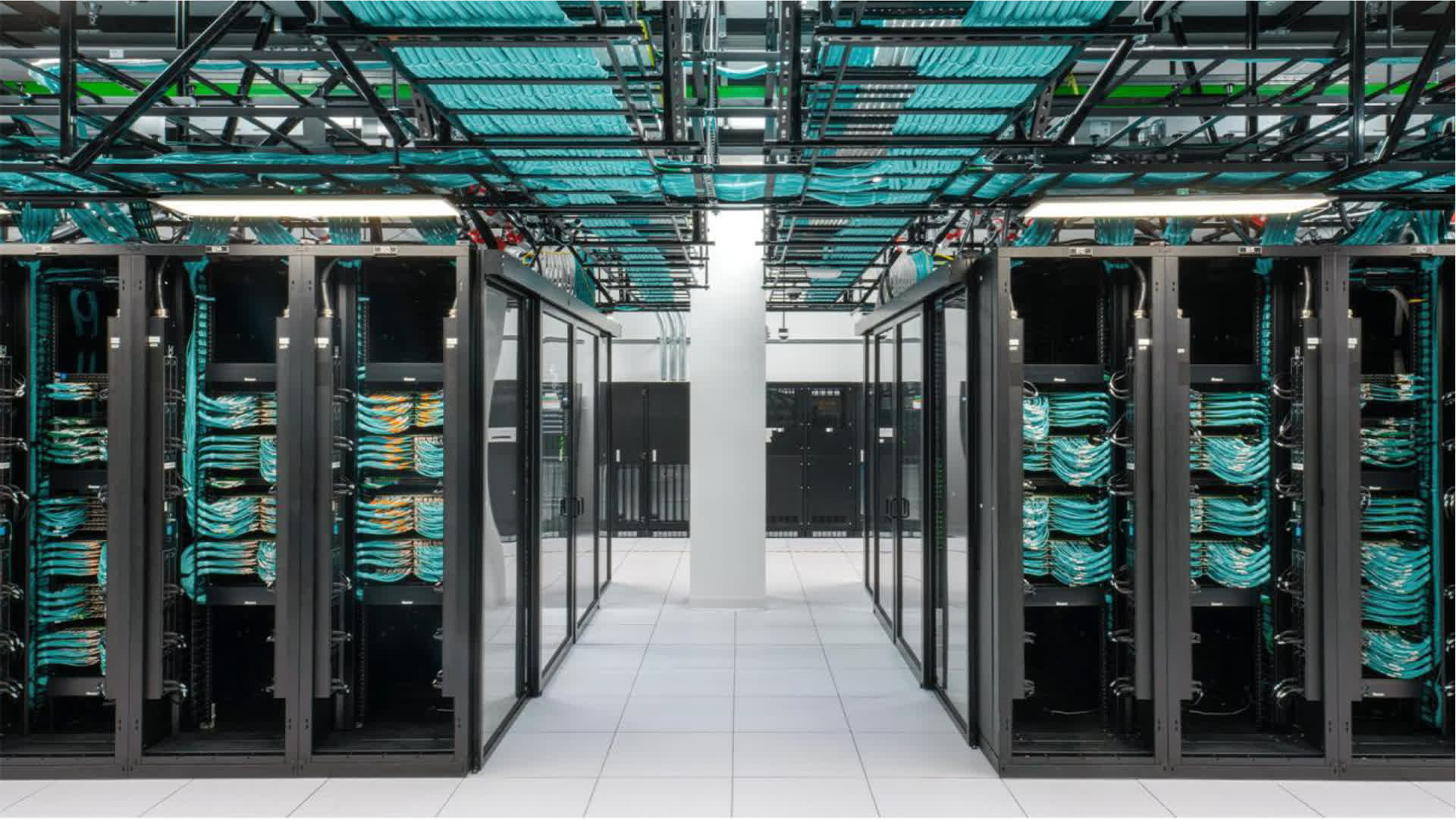
Telemetry within the system also supports performance analysis. The platform tracks power behavior, including short-lived load spikes, allowing operators to stay within power budgets while fine-tuning energy efficiency.

It also captures GPU utilization, memory bandwidth usage, and interconnect performance across multi-node clusters. Taken together, these signals can expose subtle inefficiencies, such as bandwidth saturation or degraded links that can quietly undermine performance during large-scale training or inference workloads.

Thermal management is another focal point. The monitoring agent detects heat concentration and airflow irregularities that can signal insufficient cooling in dense server configurations. Early detection of these thermal imbalances enables corrective action before throttling or component aging occurs, issues that can shorten hardware lifespan and reduce throughput in GPU-heavy racks.
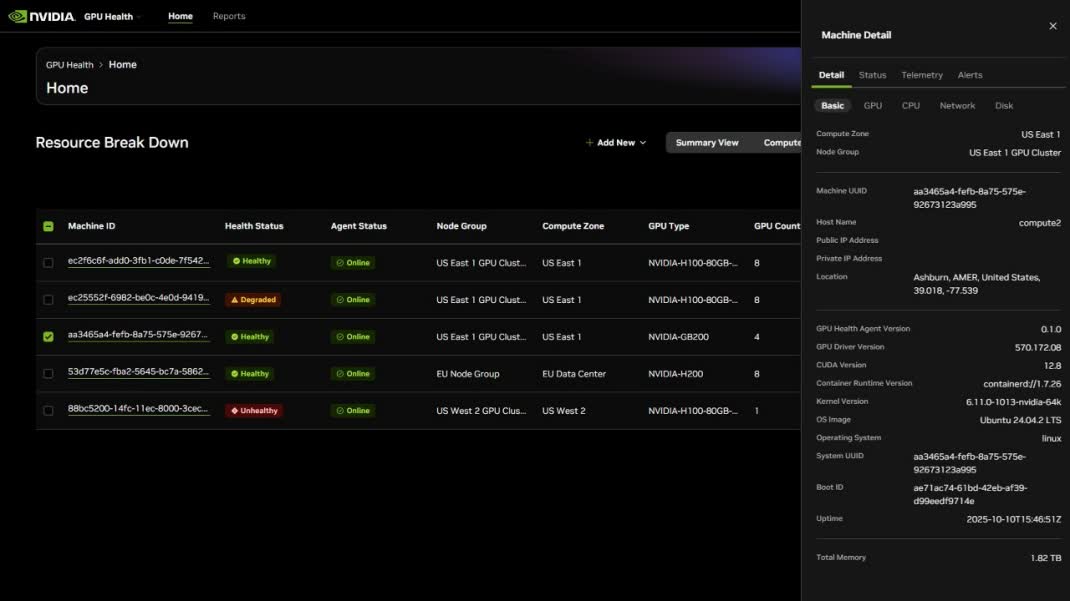
The platform also checks for consistency across distributed systems. It verifies that servers are running identical software stacks, driver versions, and configuration settings.

While the new system extends Nvidia's data center management portfolio, it does not replace existing tools. Data Center GPU Manager (DCGM) remains available for local, low-level diagnostics, though it lacks centralized visualization and typically requires custom integration.

Nvidia's Base Command platform, meanwhile, operates at a different layer entirely, handling AI job scheduling, dataset organization, and workflow orchestration. Together, the three services form a complete system that spans every layer of GPU management: DCGM provides node-level telemetry, Base Command governs workloads, and the new fleet-monitoring software bridges them with fleet-scale visibility across on-premises and cloud deployments.

The opt-in nature of the platform means it is unlikely to function as a meaningful anti-smuggling control, since operators can simply decline to participate. Its real impact is operational, not regulatory, marking a move toward unified GPU observability as AI deployments scale globally.

Permalink to story:

 
I'm sure Orwell would agree with me in not trusting the new techno-fascist-leaning governments.

I'll never understand how people could actually think that they can get away with using VPN or other software to mask themselves when their equipment itself is literally sending out a "hey it's me" call to the internet.

The future of digital technology means everything will have "kill switches". Everything will be traced. Everything will be recognizable online.
 
Nvidia also said they couldn't track their GPUs so that was clearly a lie.

Once china figures out how to activate the Killswitch, they should activate it for all users in the west, just to embarrass them as much as possible.
Or... just use a firewall.

Not to mention that "The software relies on a customer-managed agent". So in other words, it's useless.
 
I'm sure Orwell would agree with me in not trusting the new techno-fascist-leaning governments.

I'll never understand how people could actually think that they can get away with using VPN or other software to mask themselves when their equipment itself is literally sending out a "hey it's me" call to the internet.

The future of digital technology means everything will have "kill switches". Everything will be traced. Everything will be recognizable online.
I don’t know that he would. The danger isn’t that resistance is impossible—it’s that many people simply won’t bother. That’s the part Orwell didn’t fully anticipate.

From a broad surveillance perspective, those that want to resist, can and will. They may have to give up certain things but it will always remain possible to camouflage, obfuscate, and misdirect, from a digital sense. Tracking those who do will always require massive resources, which more often than not, will run up against the cost vs reward bottleneck.

As such, identifying someone on the internet who doesn’t voluntarily give it up, will always be a best-guess process across multiple layers of networks and devices—none of which will provide a permanent, universal ID that must always be revealed. Even if hardware IDs were hard-wired, making them unavoidable would require universal exposure, impossible-to-block enforcement, and global compliance—things networks and protocols simply aren’t designed to support.

Encryption, decentralization, offline use, hardware modification, and device substitution do work. All can and will remain possible and fundamental.

Some people, organizations, and governments might want total traceability, but assuming that it’s inevitable simply ignores built-in limits. The assertion to the contrary simply doesn’t address the reality of how networks and protocols actually function or how those functions would be overcome to support the claim.
 
Or... just use a firewall.

Not to mention that "The software relies on a customer-managed agent". So in other words, it's useless.

I know that.
You know that.
Some other geeks know that.

But Bureaucrats got what they asked for. Except they did know it may not work as expected.
 
There are no "AI datacenters", it's all just another scam. The current LLMs run just fine on existing hardware, there's no reason, need, or demand for piles of new "servers" hosting Nvidia "AI chips" to do what? Something that is already done. The fake Artificial Stupid software already works and runs on every device. There's no further demand and nobody is demanding it.

These fake server farms are a joke and just another investment scam. They'll never be built, they'll never do anything, and the mindless taxpayers will foot the bill anyway - which is completely stolen by said companies. That's how tech works. It's 99% lie, 1% service. There's no Artificial Intelligence and there never will be - because people are just too inane to know the difference anyway, so why bother? Just charge them anyway and watch them PAY.
 
I don’t know that he would. The danger isn’t that resistance is impossible—it’s that many people simply won’t bother. That’s the part Orwell didn’t fully anticipate.

From a broad surveillance perspective, those that want to resist, can and will. They may have to give up certain things but it will always remain possible to camouflage, obfuscate, and misdirect, from a digital sense. Tracking those who do will always require massive resources, which more often than not, will run up against the cost vs reward bottleneck.

As such, identifying someone on the internet who doesn’t voluntarily give it up, will always be a best-guess process across multiple layers of networks and devices—none of which will provide a permanent, universal ID that must always be revealed. Even if hardware IDs were hard-wired, making them unavoidable would require universal exposure, impossible-to-block enforcement, and global compliance—things networks and protocols simply aren’t designed to support.

Encryption, decentralization, offline use, hardware modification, and device substitution do work. All can and will remain possible and fundamental.

Some people, organizations, and governments might want total traceability, but assuming that it’s inevitable simply ignores built-in limits. The assertion to the contrary simply doesn’t address the reality of how networks and protocols actually function or how those functions would be overcome to support the claim.
The only way to be truly untraceable on the internet is not to use it. There are ways to go about being more obscure however and the irony being that a VPN won't necessarily help you with modern AI tools and heuristics they can pinpoint users simply based on activity preferences etc. ask for the give up certain things Yes I'm one of those people I have no smart devices outside of the phones, and the Roku sticks that are plugged into the Smart TVs but none of them are voice controlled. I don't trust smart devices that always listen, I'm also very much active monitoring my firewall for traffic that I don't like or trust, and things like my Roku TV and the Smartphones actually sit outside in the DMZ completely blocked from accessing internal traffic. I pay for Plex premium so it still works because they can't talk to the internal network.
 
Its not tracking all of them, our datacenters are air-gapped and only accessed via compartmented facilities.
 
Back