Police departments are told to call license plate readers "county resources" instead of naming them

Daniel Sims

Posts: 2,505   +76
Staff
In brief: Security cameras like those used by Flock in over 6,000 US communities have become increasingly controversial over concerns about privacy and government surveillance. Recent reports suggest that authorities are acutely aware of the mounting backlash and are obfuscating their use of the cameras in response.
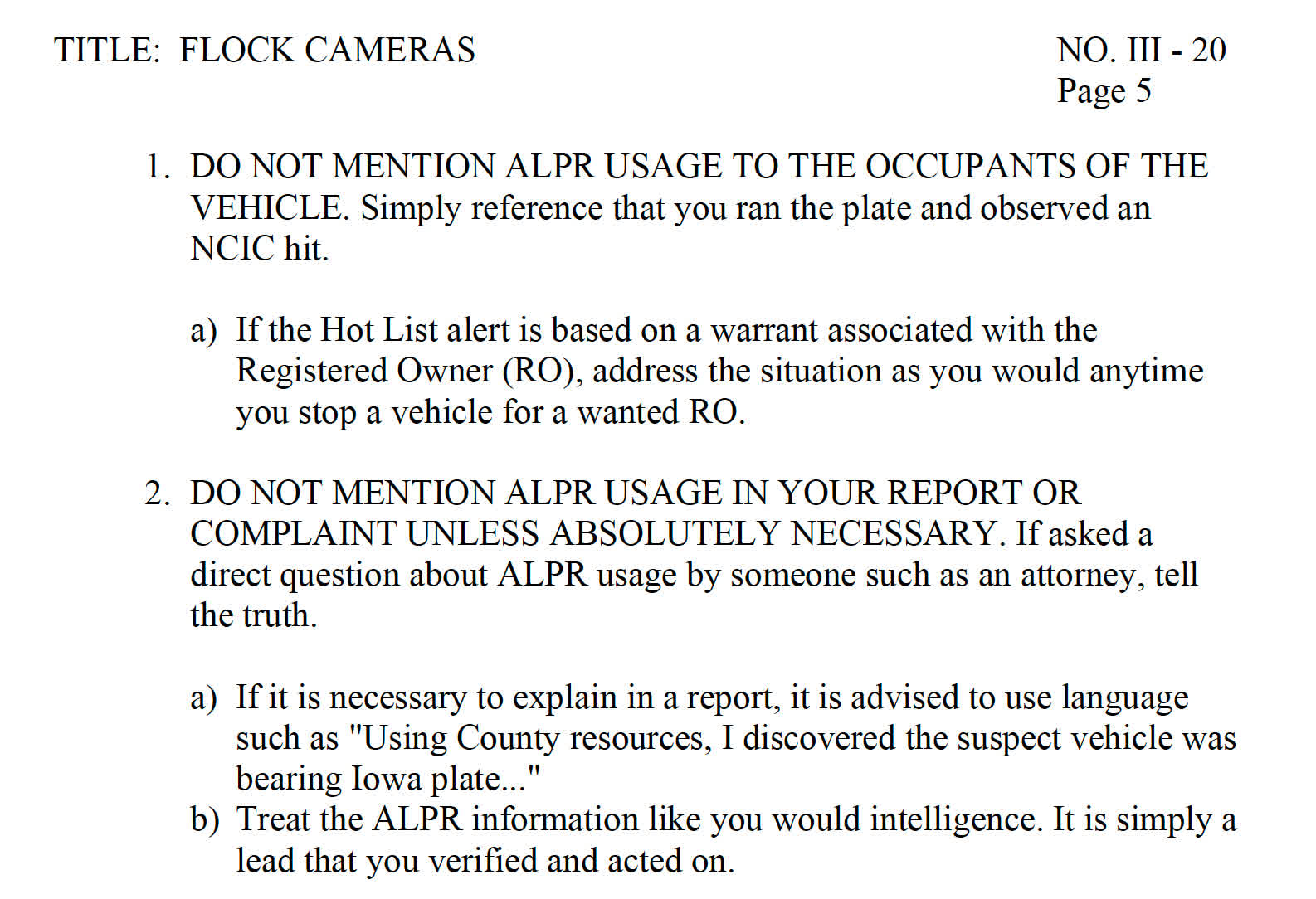
A police usage policy for automatic license plate readers (ALPRs), recently obtained by 404 Media, provides an explicit example of how police departments avoid revealing when they use the AI-powered surveillance tools. Evidence suggests that authorities across the US only admit to using the cameras when absolutely necessary.

Flock cameras and other ALPRs are designed to feed license plates from passing vehicles into a searchable cloud database, which alerts officers to plates associated with serious crimes. Authorities have used them to track suspects' movements, but pushback is mounting for various reasons.

In some communities, a significant portion of ALPR reports have been false positives, leading to many unnecessary traffic stops and arrests. In one case in Ohio, an innocent man was mauled by a police dog, causing him to lose his job and home.
They have also been used to track individuals on foot, and at least 50 officers have been accused of using them for stalking. A similar number of communities have stopped using the cameras since early last year, so it is unsurprising that some departments deploy them in secret.

One usage policy advises police officers in Wapello County, Iowa – in all-caps text – never to mention ALPR usage when making traffic stops or writing reports. They are instructed to admit to using the cameras only when directly asked by a lawyer. Furthermore, even when required to mention the technology in reports, officers are advised to describe it vaguely as "county resources." Other departments have also advised officers to avoid explicitly mentioning ALPRs.

Such policies are reminiscent of how officers often obfuscate the use of stingrays, which track cell phone signals by spoofing cell towers. The devices have become so controversial that Android is introducing functionality to alert users to their presence.

Although some communities have adopted guidelines governing ALPR use, those guardrails have also prompted authorities to become more secretive. Officers are often advised to describe ALPR usage in vague terms in reports because they are subject to public information requests. In response to one such request, a sheriff claimed that police are attempting to prevent criminals from learning how to circumvent the cameras.

Concerned parties can check whether their local police department uses surveillance technology via the Electronic Frontier Foundation's Atlas of Surveillance.

Permalink to story:

 
The cameras are not the real problem. It is the data that is compiled along with the easy access to the data and the ability to build timelines that is the problem.

You want the cameras, fine.

If you want the ACCESS to the data you need a warrant. Just like you do with phone, bank, or other personal data. Go to a judge and give reason and scope for the search. Give justification for the intrusion into someones privacy.

Those warranty are then public records that can be easily pulled and reviewed.

This will enforce accountability and ensure privacy for the most part.
 
Audit logs that are only reviewed after someone complains isn't oversight, it's a paper trail for a lawsuit. The accountability only exists retroactively, after the harm already happened.
 
Funny how these systems are marketed as essential public-safety tools, yet departments are instructed not to mention them unless a lawyer asks the exact right question.
 
Systems such as these are the future - futile bans at this point won’t do anything long-term. As the years go on, this specific system today will look like a child’s playground compared to what’s offered by then in surveillance.

Stop trying to ban these things, you will absolutely fail long term. Instead the smart thing to do would be influence the direction of where these things will be used - that’s how you win.

Not just audit logs - implement new process controls, system default limitations, context limits, and so on. If this system is used correctly, it’s absolutely foundational to public safety.

These things have objectively helped so many people, saved enough lives already… it’s not going away. That’s a hard pill for some to swallow.
 
Kind of like how the companes providing StingRay devices like L3Harris make law enforcement companies sign non disclosure agreements saying they wont acknowledge the use or documentation related to cellphone spy hardware, which is illegal for a government agency to sign because it attempts to bypass public records.
 
Short-sighted. The much larger issue is the public's general perception of the police, which has fallen precipitously during my lifetime. Lies of omission like those suggested here will only accelerate that trend. The consequences show up in lack of respect for the officers and the profession, lack of cooperation from the population, harder to obtain jury convictions due to lack of trust in officer testimony, and at its most exaggerated you get the "defund the police" efforts and even occasional protests with violence.

And for some of these cases, over a traffic ticket?
 
As for the Ohio man bitten by the K-9, instead of going after the city, they should have gone after the Flock camera for the mistake. And if you go and look up the video of the traffic stop, which was "suppose" to be a stolen vehicle (which the officer have NO IDEA who they are dealing with), the person driving the vehicle was not following the officers instructions, was disrespectful etc. He started walking away from the officers. By the side of the road is NOT the time or place to adjudicate a traffic stop.
Had he just said yes sir, no sir, once they got his ID, found that he wasn't who they were looking for, he would have been on his way.
As one of my cop buddies says, the cuffs come off just as fast as they go on.

Personally, I'd like to see all the flock things taken down, but cities are probably getting money from Flock to put them up. "But if you aren't doing anything what do you have to worry about?"

A wise man once said: "Those who would give up essential Liberty to purchase a little temporary Safety deserve neither Liberty nor Safety" -Benjamin Franklin
 
Once the government installs cameras - or any other security feature - they almost never come down because they'll always be used as an example of "crime fighting techniques that work" and removing them would be irresponsible.

The reality is: there is no reasonable expectation of privacy in public.

There's also "no right to drive" as per the constitution.

Therefore, the Government actually does have the right to put these devices on the streets.

My recommendation to you is: do not commit crimes. You will be caught.
 
The police are supposed to be people we can trust when there is someone causing harm to the community. Why are they the ones acting like they have something criminal to hide?
 
Back