Qualcomm's Snapdragon X Elite finds a new home in Geekom's upcoming mini PC

zohaibahd

Posts: 978   +19
Staff
What just happened? A new contender is shaking things up by introducing Qualcomm's powerful Snapdragon chips to the mini desktop PC market. Geekom, a company renowned for its compact PCs, is gearing up to launch the "world's first" consumer mini PC powered by Qualcomm's flagship Snapdragon X Elite processor.
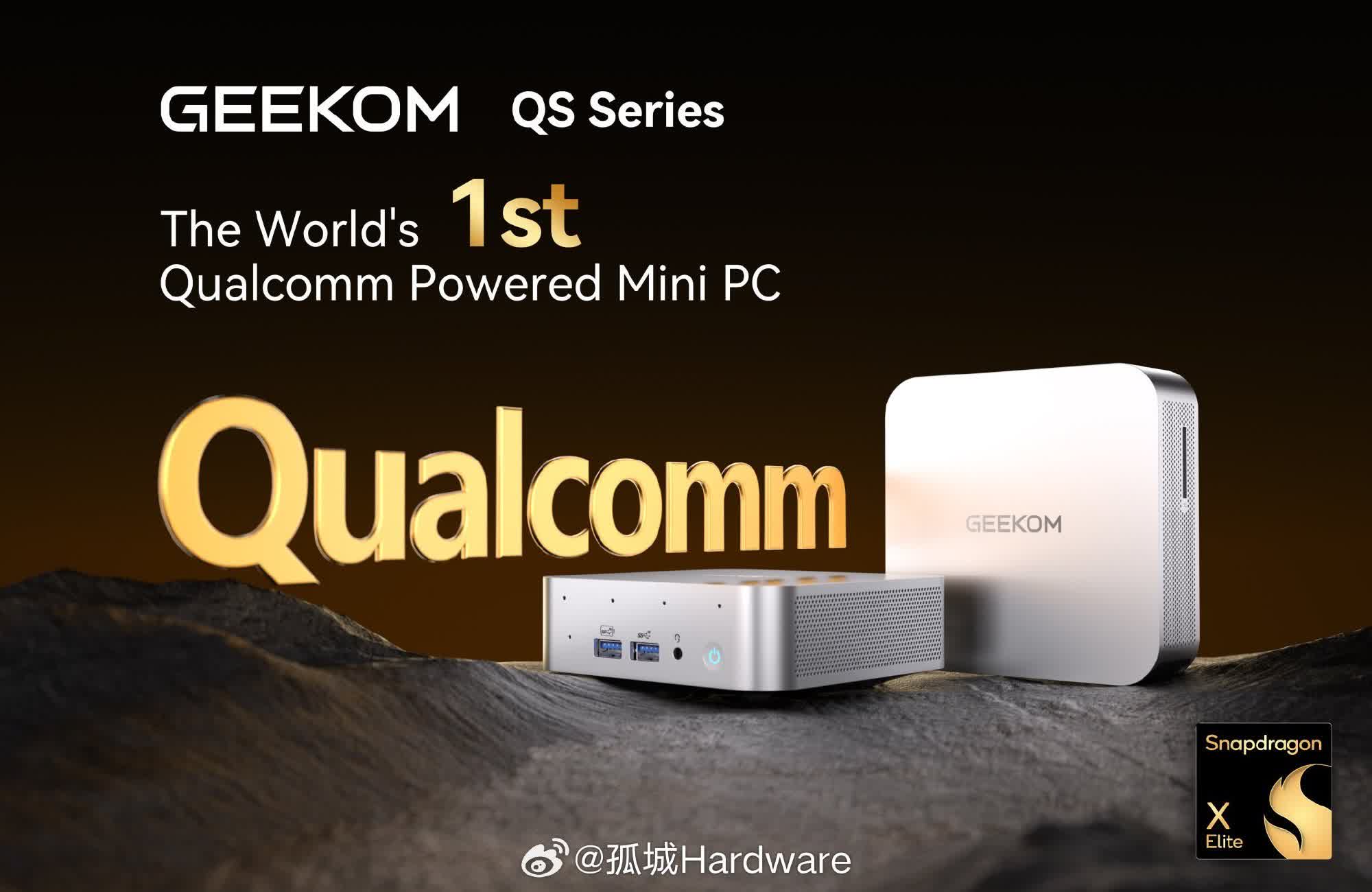
The leaked image from Weibo doesn't reveal much, showing only a sleek aluminum chassis with USB-A ports, an audio jack, and a front-facing power button. However, the fact that Geekom is venturing into Arm-based mini PCs is significant news for Qualcomm's mobile platform.

Qualcomm had previously unveiled its own Snapdragon X Elite developer kit in May, featuring an 8-inch x 7-inch x 1.3-inch design. That product, however, was targeted at developers for app optimization and never made it to a consumer release (it was ultimately canceled).

While Geekom's machine isn't the first to use this silicon, it would be the first Arm-based mini PC with Snapdragon X Elite technology available for purchase.
That said, Geekom has yet to announce a launch date or even confirm the device's existence. As a result, details about the specs – and especially pricing – remain unknown. However, given Geekom's reputation for producing affordable, compact PCs, this new model will likely follow a similar trend.

Even if Geekom's Snapdragon X Elite mini PC is priced at a premium, there's speculation that a lower-cost Snapdragon X Plus variant could be in the works. The leaked screenshot mentions the "QS Series," hinting at a broader lineup that could compete directly with Apple's Arm-powered Mac minis.

The bigger question is whether consumers will embrace Arm-based PCs over the more established x86 architecture in this form factor. While Windows on Arm has historically struggled with app compatibility, recent developer optimizations are slowly making Snapdragon laptops a more viable option.

Early reviews of Qualcomm's "Copilot+" PCs have praised their efficiency and performance, which highlight Arm's advantages over Intel and AMD in ultra-portable laptops.

Still, the Arm PC movement has yet to gain significant traction. Market data from Q3 2024 revealed Qualcomm capturing less than one percent of total PC shipments, meaning that for every 120 computers sold, only one runs on a Snapdragon chip.

Permalink to story:

 
This is a form factor for ARM where I can really get behind it: Basically this device is going to be a hyper-charged version of a Raspberry Pi: Although I'm sure it can run and will ship with Windows 11, most people should just nuke that and install some variant of Linux and then you have either a solid, super efficient media center device, you can turn it into a NAS or you can even run it as a server for a bunch of containers to say block ads, use Plex, etc. Basically all of the above but as a tiny server.

Unlike a Snapdragon Laptop this is something I do see myself grabbing if the price is right: it has to be at the same level as Ryzen based mini pcs or lower so starting at 250-300 USD top for a decently performing version.
 
This is a form factor for ARM where I can really get behind it: Basically this device is going to be a hyper-charged version of a Raspberry Pi: Although I'm sure it can run and will ship with Windows 11, most people should just nuke that and install some variant of Linux and then you have either a solid, super efficient media center device, you can turn it into a NAS or you can even run it as a server for a bunch of containers to say block ads, use Plex, etc. Basically all of the above but as a tiny server.

Unlike a Snapdragon Laptop this is something I do see myself grabbing if the price is right: it has to be at the same level as Ryzen based mini pcs or lower so starting at 250-300 USD top for a decently performing version.
Would be interesting to see how the performance compares to Intel for media centre tasks, like Jellyfin. I'm running a headless laptop with an 1165G7 because of QuickSync.
 
This is a form factor for ARM where I can really get behind it: Basically this device is going to be a hyper-charged version of a Raspberry Pi: Although I'm sure it can run and will ship with Windows 11, most people should just nuke that and install some variant of Linux and then you have either a solid, super efficient media center device, you can turn it into a NAS or you can even run it as a server for a bunch of containers to say block ads, use Plex, etc. Basically all of the above but as a tiny server.

Unlike a Snapdragon Laptop this is something I do see myself grabbing if the price is right: it has to be at the same level as Ryzen based mini pcs or lower so starting at 250-300 USD top for a decently performing version.
Geekom's mini pcs are usually much more than 300. And I have a suspicion that Qualcomm will not sell their CPUs for pennies.
 
Geekom's mini pcs are usually much more than 300. And I have a suspicion that Qualcomm will not sell their CPUs for pennies.


They really need to if they want to get any sizeable Windows Market Share. Otherwise, why bother? All that R&D money for x86 emulation, Windows Drivers, Linux Kernel integration etc would be a waste for them.
 
Although I'm sure it can run and will ship with Windows 11, most people should just nuke that and install some variant of Linux
Except in typical mobile phone fashion, Qualcomm has not upstreamed all necessary drivers as of half a year ago: https://www.qualcomm.com/developer/...nux-kernel-support-for-the-snapdragon-x-elite. It would take more time to have it accepted in mainline, have distro move up to that kernel branch, etc.

It's also using DTB instead of something like ACPI to discover hardware. Each device might need a different kernel build, released by the OEM for each model. That's more like how you flash phone images, than just grab a common ISO and load it on PC or other SBC like Pi.

It's a shame TBH. I was interested in the laptops, but after I learnt their state of Linux support, well, maybe check back in three years, but not now for sure.
 
Back