In context: Universal Flash Storage is a solid-state storage standard developed by JEDEC in collaboration with major memory industry players. Designed as a successor to eMMC storage and external SD cards, UFS has evolved to deliver performance levels that rival those of some PC storage solutions. Samsung is now looking to leverage that performance to accelerate AI workloads on next-generation smartphones.
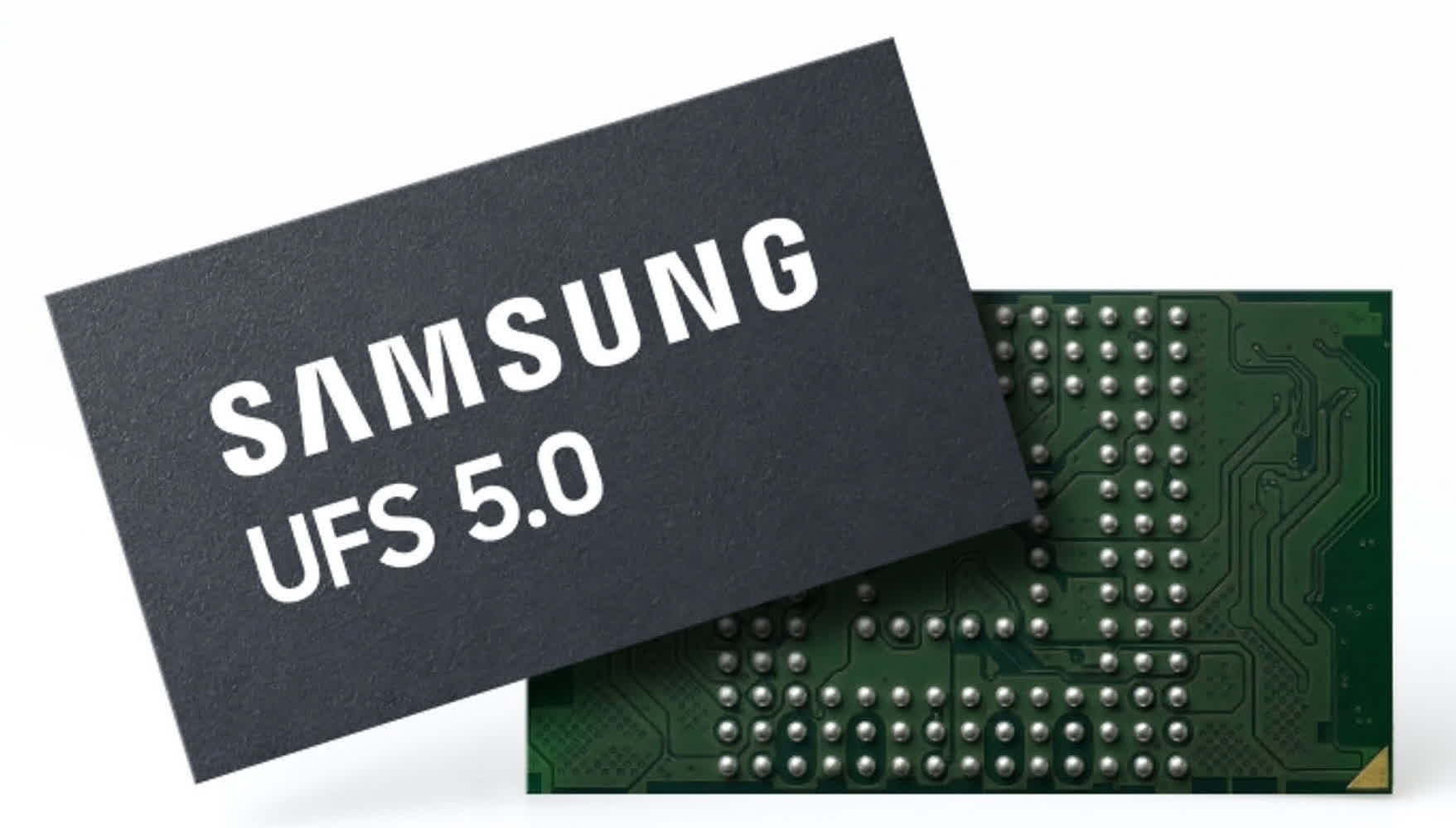
Samsung has announced its Universal Flash Storage 5.0 chips, a flash-based storage solution designed primarily for smartphones, tablets, and other mobile devices. The UFS 5.0 standard delivers a maximum bandwidth of 10.8 GB/s and is positioned as a way to accelerate on-device AI workloads.
Based on the JEDEC-developed UFS interface standard, the technology uses two data lanes to achieve sequential read speeds of up to 10.8 GB/s, while sequential write speeds can reach up to 9.5 GB/s. Samsung claims these chips deliver the highest performance in the mobile storage segment, more than doubling sequential speeds compared to UFS 4.1.
The UFS 5.0 packages measure 7.5 mm × 13 mm × 0.9 mm, making them about 16.7% smaller than UFS 4.1 solutions. The reduced footprint could enable more flexible device designs by improving internal space efficiency for storage components.

Additional improvements in UFS 5.0 include a reported 40% increase in power efficiency, achieved through techniques such as clock gating and multi-voltage operation. As a result, devices can transfer the same amount of data while consuming significantly less energy, which could translate into improved battery life in next-generation mobile products.
Samsung also emphasizes UFS 5.0's role in supporting on-device AI workloads, including offline chatbots and large language models. According to Jangseok Choi, head of memory product planning at Samsung Electronics, storage has become a critical component of emerging AI-driven computing systems. The company points to examples such as repurposed older Pixel devices used in low-cost data center setups as evidence of growing demand for efficient local storage performance.
Samsung is expected to begin mass production of UFS 5.0 chips in the fourth quarter. Capacities will scale up to 1TB per chip, and the company aims to maintain a competitive edge in the flash storage market. Devices such as smartphones, XR headsets, and AI-enabled wearables featuring UFS 5.0 are expected to arrive later, although they are unlikely to come at lower price points.
Samsung shows off ultra-fast UFS 5.0 storage for flagship phones and on-device AI


