Seagate is now shipping HAMR disk drives holding up to 44TB of data

Alfonso Maruccia

Posts: 2,586   +972
Staff
AI Data Bubble: After bringing the first true HAMR drives to market, Seagate is now further advancing its next-gen magnetic storage platform. The new "Mozaic 4+" drives are already here, with massive data hoarding capacities and a specific focus on AI workloads for enterprise customers.
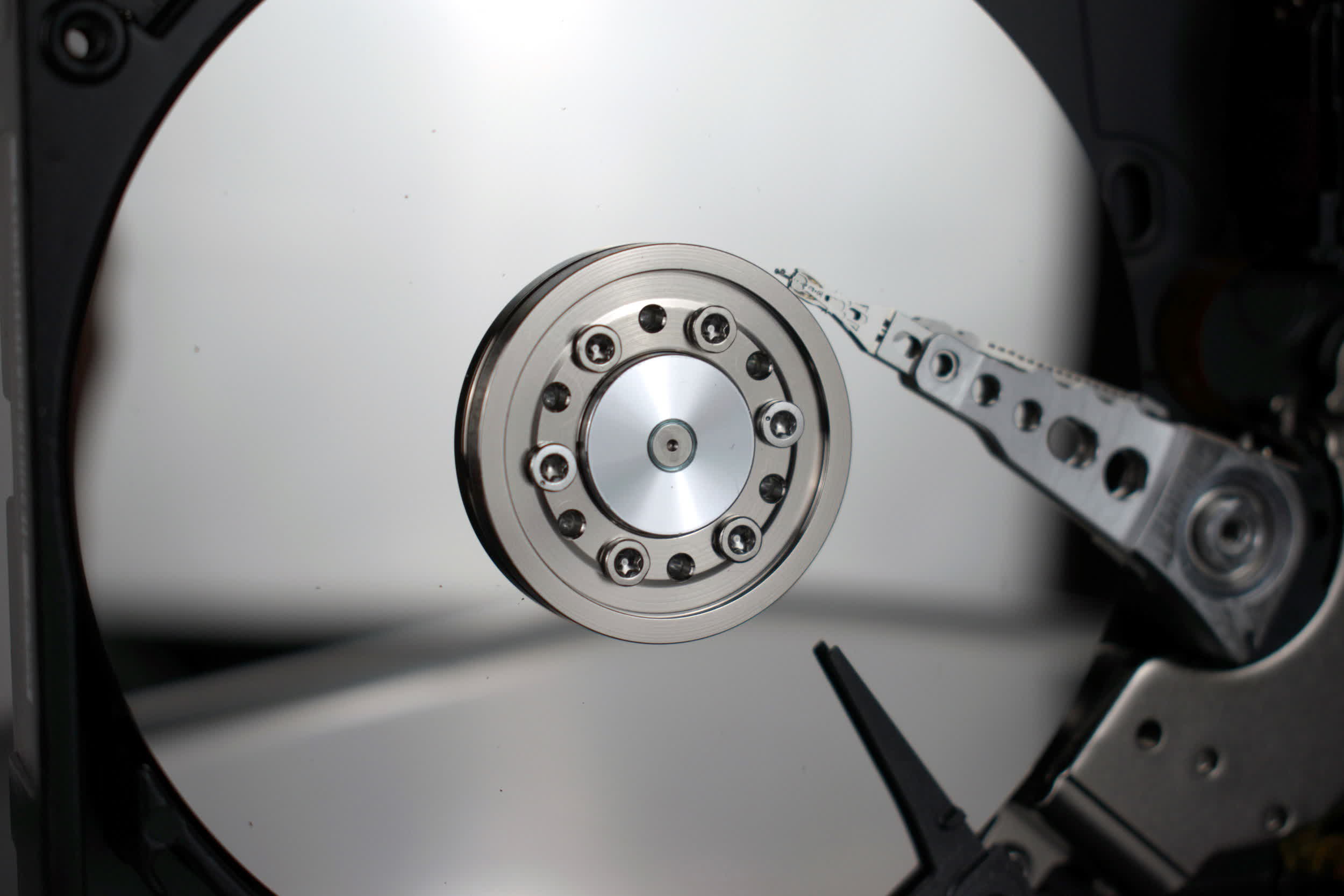
Seagate introduced the Mozaic 3+ platform in 2024, turning the heat-assisted magnetic recording (HAMR) dream into a real product for customers in need of massive storage capacities. The HDD maker is now introducing the next-generation Mozaic 4+ drives, which offer capacities up to 44TB.

The US corporation originally known as Shugart Technology is partnering with two unnamed cloud providers working at hyperscale levels. Seagate said that the Mozaic 4+ drives have been qualified and are now in production, shipping in volume to its first clients. Broader availability for other hyperscalers – as well as lesser customers – should arrive sooner rather than later.
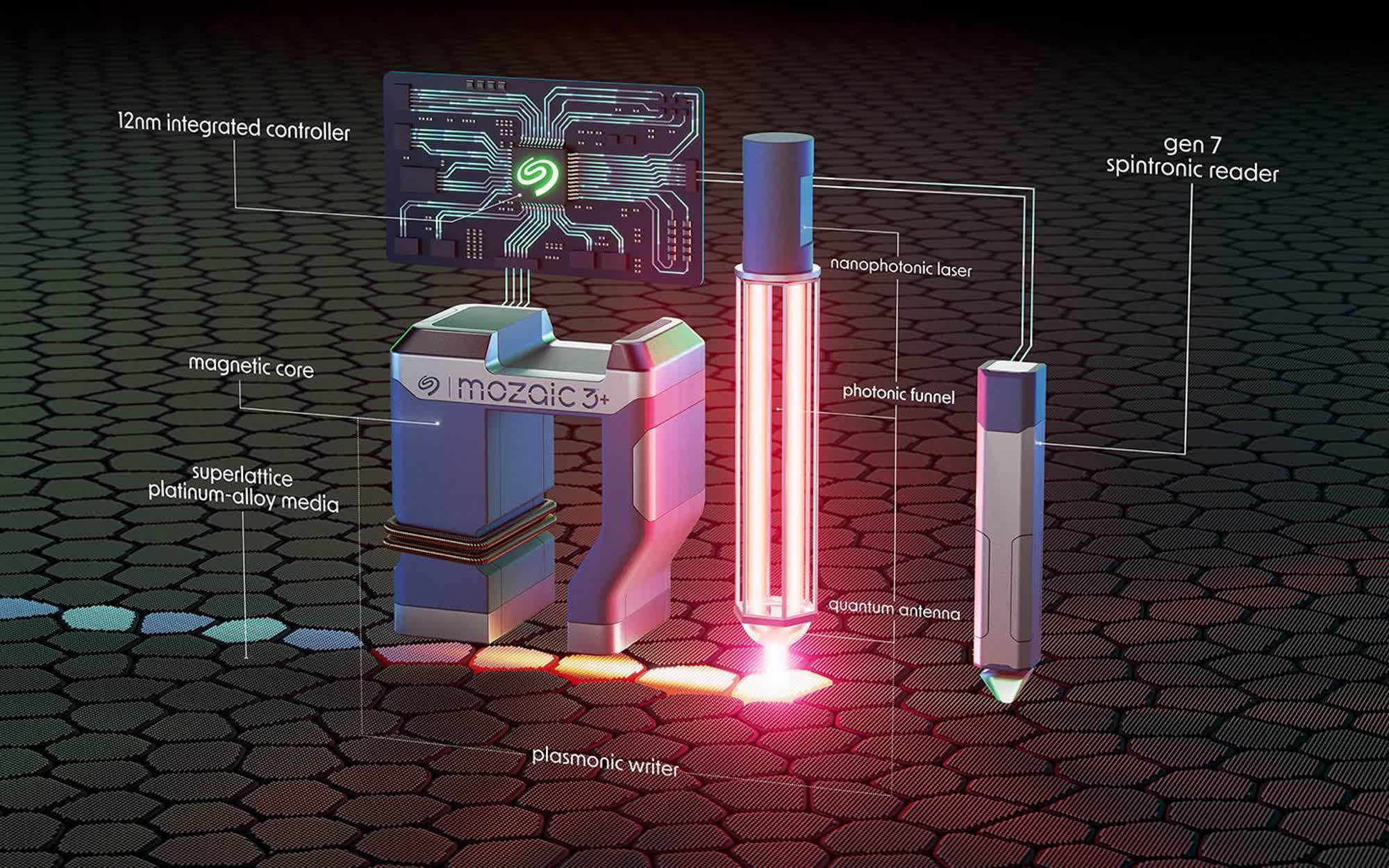
Mozaic 4+ drives are an incremental evolution of the Mozaic 3+ platform, with further improvements in efficiency, reliability, and storage capacity. Seagate explained that when deployed at one exabyte of capacity, the new hard disk drives should improve infrastructure efficiency by around 47% compared to a "standard" 30TB configuration. Seagate said Mozaic 4+ can reduce the footprint of a data center installation by 100 square feet, lowering the annual energy consumption by 0.8 million kilowatt-hours.

This kind of energy efficiency can have a significant impact when dealing with AI-scale operations, providing measurable economic savings. Mozaic 4+ has been specifically designed to benefit hyperscale players and AI data centers, which are, of course, the only meaningful goal almost all technology corporations are focused on right now.

Data is once again an extremely valuable asset, Seagate CEO Dave Mosley said, because extremely large data volumes are now required to train and operate chatbots, military systems, and other complex LLM ventures. High-capacity hard disk drives such as Seagate's HAMR units are an essential element in these new data-hungry efforts.

HAMR technology uses a laser diode embedded in the drive's read/write heads to quickly heat a small spot on the recording platter. This highly localized, sub-nanosecond heating process increases the data density for storing additional digital bits. Western Digital is also working on its own HAMR drives, although the company still describes the technology as a future endeavor.

While WD tries to tackle the "complex and challenging" HAMR technology, Seagate is accelerating the Mozaic + roadmap. The storage company is working to push data density to up to 10TB per platter, and is already envisioning hard disk drives that can hold up to 100 terabytes per drive. Enterprise-class reliability should match today's products. Meanwhile, consumers are struggling to find new HDDs to buy because AI corporations have managed to purchase the whole supply chain.

Permalink to story:

 
Even if I needed this much storage (I don't), it's still a Seagate. Pass.

New Seagates are better than the older designs that were prone to failure. It was difficult for me to admit at first, but the newer Seagate HDDs are much improved. This is coming from someone who returned HDDs from 180 Dell Optiplex PCs out of an order of roughly 300. I spent weeks working out all the replacements. Every bad drive was Seagate. This was maybe 10-12 years ago. The situation is different now.
 
HAMR disk is not around for long enough to see how reliable they are.

They also never talk about speed, so I am guessing it slow much slower than current CMR drives.
 
No, but they have the same warranties so I’d wager they’re probably just as reliable.

They are the same speed - do some research… they still do 7200rpm and sustain 300mb/s

Proof is in the pudding nothing is certain right now... Besides why do I need to to do research on behalf a company advertising their product? They should give stats from the start go...

I am the client !!! give me facts...
 
Proof is in the pudding nothing is certain right now... Besides why do I need to to do research on behalf a company advertising their product? They should give stats from the start go...

I am the client !!! give me facts...
Facts - they are cheaper and have more capacity than their competitors… and they are just as reliable if not more so… good enough for me…
 
You got the data? because they dont?
Straight from ChatGPT - since you seem to be too lazy to look it up…
1. Reliability vs WD / Toshiba
Seagate HAMR reliability

  • Seagate’s current HAMR platform (Mozaic 3+/4+) is rated ~2.5 million hours MTBF, which is the same rating as their conventional enterprise drives.
  • Internal testing suggests 7+ years head life, longer than typical PMR drives (4–5 years expectation).
  • Over 500,000 HAMR drives have been tested during development.

Compared with Western Digital / Toshiba

Real-world failure data (Backblaze and similar large deployments):

BrandTypical enterprise AFR
Western Digital Ultrastar~0.8%
Seagate Exos~1.1%
Toshiba MG series~1.2%

These differences are small and model-dependent, not really brand-wide.

Important point:


HAMR itself does not appear to reduce reliability. It mainly changes how bits are written (laser-assisted heating), not the mechanical design.

2. Typical speeds

Most HAMR drives are still 7200 RPM SATA/SAS HDDs, so speeds are similar to other modern enterprise drives.

Sequential speed:

Drive typeSequential throughput
Seagate HAMR (30–44TB Exos M)~275–300 MB/s
WD Ultrastar high-capacity~280–310 MB/s
Toshiba MG series~260–290 MB/s

HAMR drives around 275–300 MB/s sustained transfer.

Higher density actually helps slightly because more data passes under the head per rotation.

Random performance. Like all HDDs:

  • ~80–120 IOPS random
  • similar latency (~4–9 ms)

HAMR doesn’t change random I/O much because the limiting factor is still mechanical movement.

3. Other characteristics of HAMR drives

Pros

  • Much higher capacities (30TB+ already shipping)
  • Similar power usage to existing drives
  • Comparable reliability targets

Cons

  • Slightly higher heat and power (laser + denser platters)
  • New technology → fewer long-term field stats
  • Often louder due to higher platter counts

HAMR drives are:

✔ Safe to use
✔ Similar reliability targets to enterprise HDDs
✔ Best option if you want 30–40TB drives

QuestionAnswer
Reliability vs WD/ToshibaRoughly equal on paper
Speed~275–300 MB/s sequential
Random performanceSame as other HDDs
————
You’re welcome.
 
"Seagate said Mozaic 4+ can reduce the footprint of a data center installation by 100 square feet, lowering the annual energy consumption by 0.8 million kilowatt-hours."

What's the cost-benefit ratio? How much did the manufacturing footprint change when tooling up for the new design?
 
Proof is in the pudding nothing is certain right now... Besides why do I need to to do research on behalf a company advertising their product? They should give stats from the start go...

I am the client !!! give me facts...
If you want to make an informed decision you don't rely on the manufacturer for data - marketing is useless. If you dont want to research, just believe whatever the seller tells you. I mean presumably you're an adult who's bought things in the past?
 
Even if I needed this much storage (I don't), it's still a Seagate. Pass.
Not only have Seagate updated their designs so they're as reliable as their competition, sometimes even more reliable, the key for me, they don't actively lie on their spec sheets to a fairly extreme degree.

Western Digital are selling Red drives, designed to be in a NAS, that are SMR and not CMR, they even got sued in court for lying about this recently.

Synology and QNAP even added a warning in their firmware for certain WD Red drives to be flagged as not compatible, imagine, buying a WD Red HDD, specifically marketed for NAS use, but your NAS flags them as not compatible, they honestly deserved to be sued much more than they were.
 
Seagate said Mozaic 4+ can reduce the footprint of a data center installation by 100 square feet

So if I have a 95 square foot data center, these drives will now enable it to defy the laws of physics? Or more realistically, these will shrink a million square ft center by only a trivial 0.01%?

Seagate's actual claim is that these will lower the footprint by 100 sq. ft per exabyte deployed ... a rather important distinction.
 
HAMR has not proven itself the same way as Helium has. And no - the length of the warranty is not an indication of reliability. The same <300MB/s is the problem when the sizes keep increasing, but the speeds have stagnated.

It's like trying to fill a Olympic swimming pool with a simple garden hose. It's tedious relative to the size of the storage. And the prices...

32TB already costs 830€+
Id wager 44TB would cost close to 1500€

While HDD's were in the 100-300 range depending on the capacity some specific home users (data hoarders etc) were willing to spend that kind of cash. With prices quickly approaching and likely surpassing four figures HDD's will be relegated strictly for enterprise use.
 
Back