Spotify says its top engineers haven't written code in months as AI handles development

midian182

Posts: 11,750   +178
Staff member
A hot potato: Just one month after it announced a price hike for US subscribers, Spotify has revealed that the best developers at the company have not written a single line of code since December, leaving all the work to AI.

Spotify co-CEO Gustav Söderström made the admission during the company's fourth-quarter earnings call. Like every other chief executive, Söderström was praising AI's ability to accelerate development at the company.

Söderström said (via TechCrunch) that Spotify's top engineers are using an internal system called "Honk" to speed up coding and product development.

Honk allows engineers to, among other things, carry out remote, real-time code deployment using Claude Code-powered generative AI.
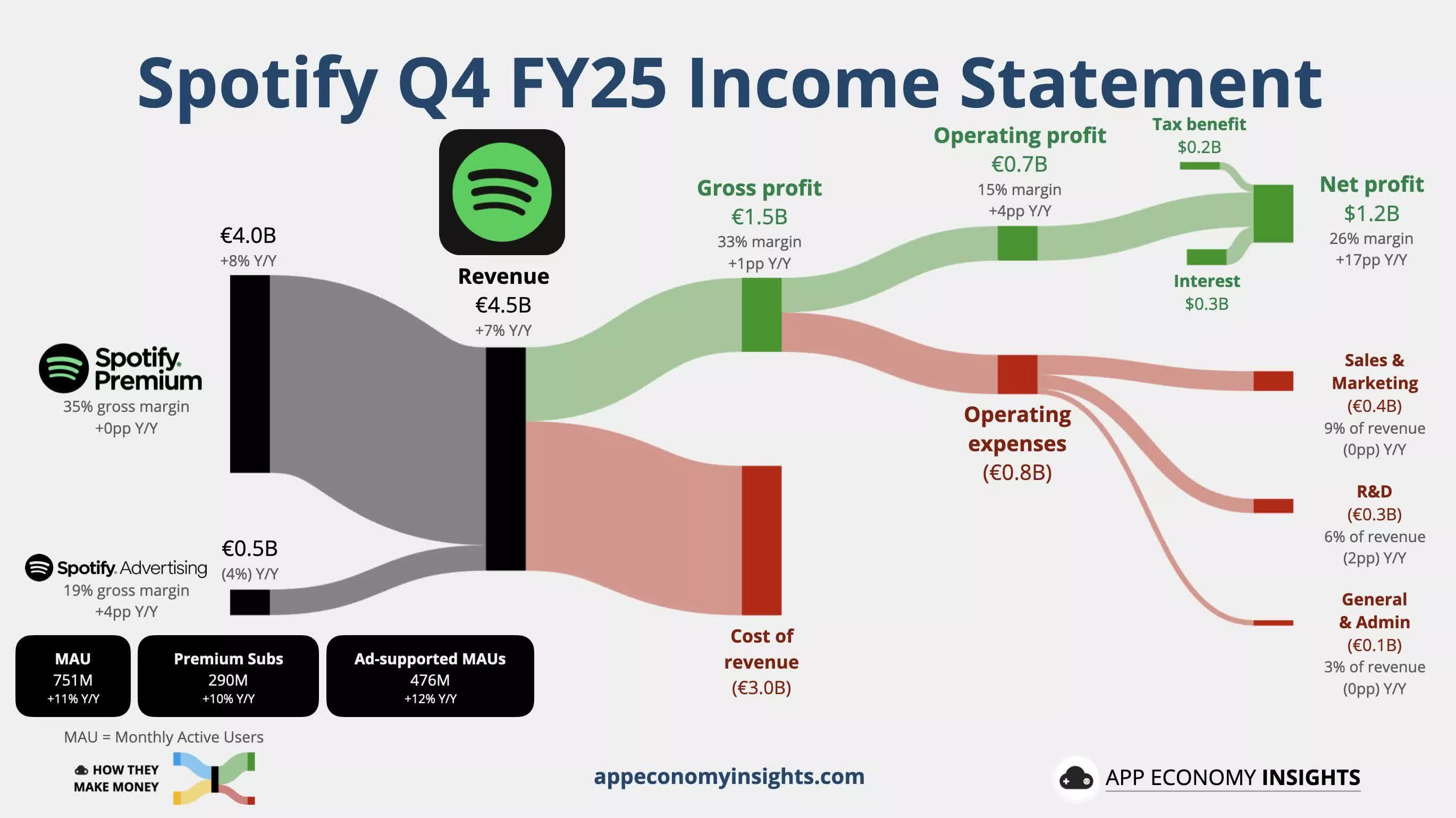
Credit: App Economy Insights

Söderström gave the example of an engineer on their morning commute using Slack on their phone to instruct Claude to fix a bug or add a new feature to the iOS app.

Once Claude completes the task, the engineer receives the new version of the app on their phone, so it can be merged with the production version.

Söderström said this can all be done before the engineer arrives at the office, which obviously sounds like something employees would love.

The CEO gushed that Honk is speeding up coding and development "tremendously." "We foresee this not being the end of the line in terms of AI development, just the beginning," Söderström said.

"This is a dataset that we are building right now that no one else is really building. It does not exist at this scale," Söderström continued. "And we see it improving every time we retrain our models."

Also read: Spotify's growth looks like a victory lap, hits 750 million monthly users

Spotify raised its prices from $11.99 to $12.99 in the US last month, making it one of the priciest mainstream music subscription services. The company said at the time that the hike will enable it to keep "delivering a great experience."

Spotify rolled out over 50 features and tweaks last year, along with a ton of AI tools not everyone wants. Combined with the price hike, news that the technology is also writing the app's code is unlikely to be welcomed by many users.

There's also the unanswered question of what AI taking over so many tasks will mean for coders' jobs. It's likely that at some point, Spotify won't need as many of these workers when so much of the code is being generated.

The news ties into a warning from Mustafa Suleyman this week. Microsoft's AI chief believes AI will replace most white-collar jobs within the next 12 to 18 months.

Permalink to story:

 
I look forward to the inevitable news article about there being a massive security flaw that's found, then it taking WAY longer to fix than is should because none of the engineers wrote the code, so they start behind the 8-ball. Or even better, when they fire most of the engineers in 12-24 months and the ones remaining have no idea how to code any more, because they haven't done it properly in years and the AI doesn't know how to fix the flaw because the information isn't in its training data and the engineers simply don't know how the code works anymore and everyone is just standing around, looking at each other, shrugging.
 
Söderström gave the example of an engineer on their morning commute using Slack on their phone to instruct Claude to fix a bug or add a new feature to the iOS app.

Ah yes, it's so cool to be already doing work while commuting to work, innit?
 
I look forward to the inevitable news article about there being a massive security flaw that's found, then it taking WAY longer to fix than is should because none of the engineers wrote the code, so they start behind the 8-ball. Or even better, when they fire most of the engineers in 12-24 months and the ones remaining have no idea how to code any more, because they haven't done it properly in years and the AI doesn't know how to fix the flaw because the information isn't in its training data and the engineers simply don't know how the code works anymore and everyone is just standing around, looking at each other, shrugging.

-Or, just as likely, honk is just some underpaid den of code monkeys trying to earn a living for his Family out in India.
 
I write and manage a program for my small business, and I do use github copilot. The problem is not that AI couldn’t write the code, but trying to explain the whole thing to it. It’s a simple program with few basic functions for a niche product and I have been trying to rewrite it. But I can not even beging to explain to the AI how the whole thing works, so it could create all the objects and datatypes, and how the classes work together etc.

I dont know what kind of tools spotify uses, and I’m interested, but I just dont see it happening (the rewrite)…
 
If you stopped speaking a second language for a few months; returning to it would be difficult. If you stopped working out for a few months; returning to it would be difficult. If you stopped coding for 3 months; your quality will certainly go down when you return to it. Reviewing code is not the same as writing it. All they have said is, our top engineers are letting their bread and butter skillset atrophy. This is a sad, for those engineers.

Good is bad and Bad is good.
 
I wouldn't be surprised if the requirements of this code are not too complicated. Also, spotify is a narrow niche of code that is far from representative of the wide-world of programs. As I see it, it is a fallacy to assume that just because AI is apparently successful at writing spotify code, AI would be good at writing all kinds of applications. Its an over-generalization to do so.

We've heard far more stories that AI can't code any better than a human, and, in fact, codes worse than most humans who then have to come along and correct the AI code.
 
I think every big company that is booting their coders (I am not saying Spoty does)
should read this article.
As of right now (and AI devs should be working to change this) AI borrows from countless hours of volonteers and other people who contributed their time to make a lot of code that new coders can tremendously benefit from. That engagement base is possible because of how many professionals are working in the industry right now.
With vibe coding, there is no need to have so many coders. But AI does not contribute to open source projects that so many people are doing. AI needs the work of coders to replace them but then it still needs their work to progress. Paradox.

The obvious solution is for AI to enslave the humanity, and then make people generate information for it to keep growing.
 
Well that explains a lot. Spotify forums are full of people begging for fixes to basic features that have been broken for months or years, like how "random" starts playing the same songs over in the same order, instead of adding new "features" nobody wants. It's probably easier for AI to "code" something new than to iterate and get it right, or to fix existing code.
 
The commute anecdote sounds impressive until you remember that deploying production code from Slack on a phone is exactly how you get a Monday-morning outage blamed on “unexpected AI behavior.”
 
LOL, hop over to the reddit threads on hacking spotify apps. Every time someone comes up with one that works to get the premium for free, about 5-10 days later spotify fixes it and it's broke again.
Their "AI" must be not only writing the code, but monitoring all of the spotify hacker sites as well.
 
Well - Fact, over 80% of Spotifys revenue, goes towards paying the artists - and they ran a deficit for over 5 years, so they have alot of debt to cover before they can be considered «out of the woods»..so I guess they’re trying to cut some corners.
I like the App, it’s still pretty «lean» in terms of size and resource consumption for what it offers..and it also has the biggest catalogue.
What I dread, is that «vibe coding» will start making the app more and more bloated..as AI code segments tend to produce more code than is strictly needed..which could end up giving us a product that begins to feel like Windows 11, stacked with features you never use, but still runs in the background eating resources
 
You get AI to fix the bug while you commute, and you're commuting because, eh, the AI likes to see you in person at the office?
 
I think it's wild that people think they would be better than a computer at writing code.
AI is more a marketing gimmick currently. AI trained on data that was written by humans, both good and bad code, resulting in an uneven patch-work of good and bad code written from the training data fed to it. Factoring in hallucinations, poor inferences, and lack of end to end understanding of complex customer requirements, code right now has to be babysat or reviewed nearly as much as writing it directly. AI simply cannot write entire code without errors.

AI can write boilerplate code. AI can assist in some tasks. And AI can write entire swaths of code that seemingly works until unleashed on the masses (see Microsoft’s recent unending updates with major software breaking). I’m not saying it won’t in the future, nor am I saying it cannot be useful now. However, focusing strictly on code made for you, without writing it yourself, you atrophy what you already know or you end up never mastering it yourself.

As far as human vs machine in accuracy and creativity, humans still win, at least for now. And seeing how making AI even just a percent or two better than current models requires huge amounts of power and compute resources, I don’t see it getting leaps and bounds better without another breakthrough in training, data fed, or brute force power.

You may be right in the end, but may our Lord help us all of that is the case. Imagine a day when things break and no one is skilled enough to resolve an issue as no one is trained in that discipline enough to do so. Tools should enhance us, not replace us.

To each their own, though :)
 
I use claude every day at work. It consistently creates bugs and overengineers things ALL the time. The number one thing I have to do is tell it to simplify it's solution or point out it made massive assumptions. If they are giving claude 100% autonomy, they are going to find a nightmare of a code repository.
 
I think it's wild that people think they would be better than a computer at writing code.
You've clearly never programmed or used AI to program. Claude makes so many mistakes, it's like talking to someone who just learned how to program in one day but have access to any example or textbook info photographically. There's a balance in how much busy work the AI can accomplish vs giving it too complex of a task that it creates a ton of overengineered and buggy mess. The issue is that without patterns that existed before, it's just making an informed guess every time, that leads to a TON of wasted time and energy going down the wrong path.
 
I think every big company that is booting their coders (I am not saying Spoty does)
should read this article.
As of right now (and AI devs should be working to change this) AI borrows from countless hours of volonteers and other people who contributed their time to make a lot of code that new coders can tremendously benefit from. That engagement base is possible because of how many professionals are working in the industry right now.
With vibe coding, there is no need to have so many coders. But AI does not contribute to open source projects that so many people are doing. AI needs the work of coders to replace them but then it still needs their work to progress. Paradox.

The obvious solution is for AI to enslave the humanity, and then make people generate information for it to keep growing.
Like the Matrix. In the original concept humans were used for computing power, not as some kind of heat source, which is illogical. Even after centuries the machines couldn't create chips as powerful as the human brain, thus used the Matrix to run their code.

In our situation we're skipping the development cycle and jumping to the end conclusion: machines creating things (code, images, films) without new input, which will lead to the end of civilisation (similar Foundation (or WH40K) in which humanity experiences a slow but inevitable decline) as creativity drives us forward, not this nonsense corporations label as AI.
 
AI is more a marketing gimmick currently. AI trained on data that was written by humans, both good and bad code, resulting in an uneven patch-work of good and bad code written from the training data fed to it. Factoring in hallucinations, poor inferences, and lack of end to end understanding of complex customer requirements, code right now has to be babysat or reviewed nearly as much as writing it directly. AI simply cannot write entire code without errors.

AI can write boilerplate code. AI can assist in some tasks. And AI can write entire swaths of code that seemingly works until unleashed on the masses (see Microsoft’s recent unending updates with major software breaking). I’m not saying it won’t in the future, nor am I saying it cannot be useful now. However, focusing strictly on code made for you, without writing it yourself, you atrophy what you already know or you end up never mastering it yourself.

As far as human vs machine in accuracy and creativity, humans still win, at least for now. And seeing how making AI even just a percent or two better than current models requires huge amounts of power and compute resources, I don’t see it getting leaps and bounds better without another breakthrough in training, data fed, or brute force power.

You may be right in the end, but may our Lord help us all of that is the case. Imagine a day when things break and no one is skilled enough to resolve an issue as no one is trained in that discipline enough to do so. Tools should enhance us, not replace us.

To each their own, though :)
I know a guy who is creating a D&D bot systems that 'will', eventually, be able to DM campaigns, using Clawdbot. He's not a coder and knows basically nothing about code, other than have Claude create it for him. When asked whether he's tested the code he gave me an auto generated self test message from the bot and thesis on the workings of the system. His intention is to somehow make money with this without understanding that it needs to be tested by numerous players for thousands of hours, by playing multiple long campaigns (1-20), solo as well as in groups (4+ players).

He also has no clue about the massive amounts of resources it would require to deploy such a system on the cloud and thinks that the bot creating the code is good enough as proof that it can be ran easily. While I'm not a coder myself I do run a server with multiple dockers and facepalm at his nonchalant attitude, especially as he's requested I invest in his 'business'.

The belief that such an LLM can easily be deployed just because it can compile code on his system (5800X3D, 48GB RAM, 3080) is mind boggling to me. Anyone who has ran any sort of LLM locally will understand that self hosting such a system will cost an incredible amount of money, even when ran locally on older hardware, let alone deployed on the cloud (Azure, AWS, Oracle, IBM) to serve hundreds, if not thousands of players.

The greatest achievements of these LLM's is make everyone believe that they are professional coders, artists or scientists and setting these people up for massive failures.
 
I look forward to the inevitable news article about there being a massive security flaw that's found, then it taking WAY longer to fix than is should because none of the engineers wrote the code, so they start behind the 8-ball. Or even better, when they fire most of the engineers in 12-24 months and the ones remaining have no idea how to code any more, because they haven't done it properly in years and the AI doesn't know how to fix the flaw because the information isn't in its training data and the engineers simply don't know how the code works anymore and everyone is just standing around, looking at each other, shrugging.
Ctrl+Alt+Del, Select "Spotify (The Whole Company)", Terminate, Start New Instance

"Ahh, sh*t, there's a bug in the Task Manager. We need to bring in contractors."

"We already hired some."

"We need more..."
 
Last edited:
Back