The AI bubble is the only thing keeping the US economy together, Deutsche Bank warns

Alfonso Maruccia

Posts: 2,515   +935
Staff
You have been warned: Warnings about the overinflated prospects of a still-hypothetical "AI economy" continue to mount. Some analysts expect the AI bubble to burst sooner rather than later, arguing that current investment growth cannot continue indefinitely in a finite world.

According to a research note recently sent to clients by Deutsche Bank, the AI boom is currently helping the US economy avoid a recession but it cannot continue indefinitely. George Saravelos, Global Head of FX Research at Deutsche Bank, said the US would be close to a recession this year if Big Tech were not spending so heavily on building new AI data centers.

The "AI machines" are literally saving the US economy right now, Saravelos said, but this kind of growth cannot be sustained unless spending remains on an ever-growing course. Nvidia, the major supplier of powerful AI accelerators used in data centers, could potentially bear much of the residual growth the US economy has experienced in recent months.

"The bad news is that in order for the tech cycle to continue contributing to GDP growth, capital investment needs to remain parabolic. This is highly unlikely," Saravelos said.
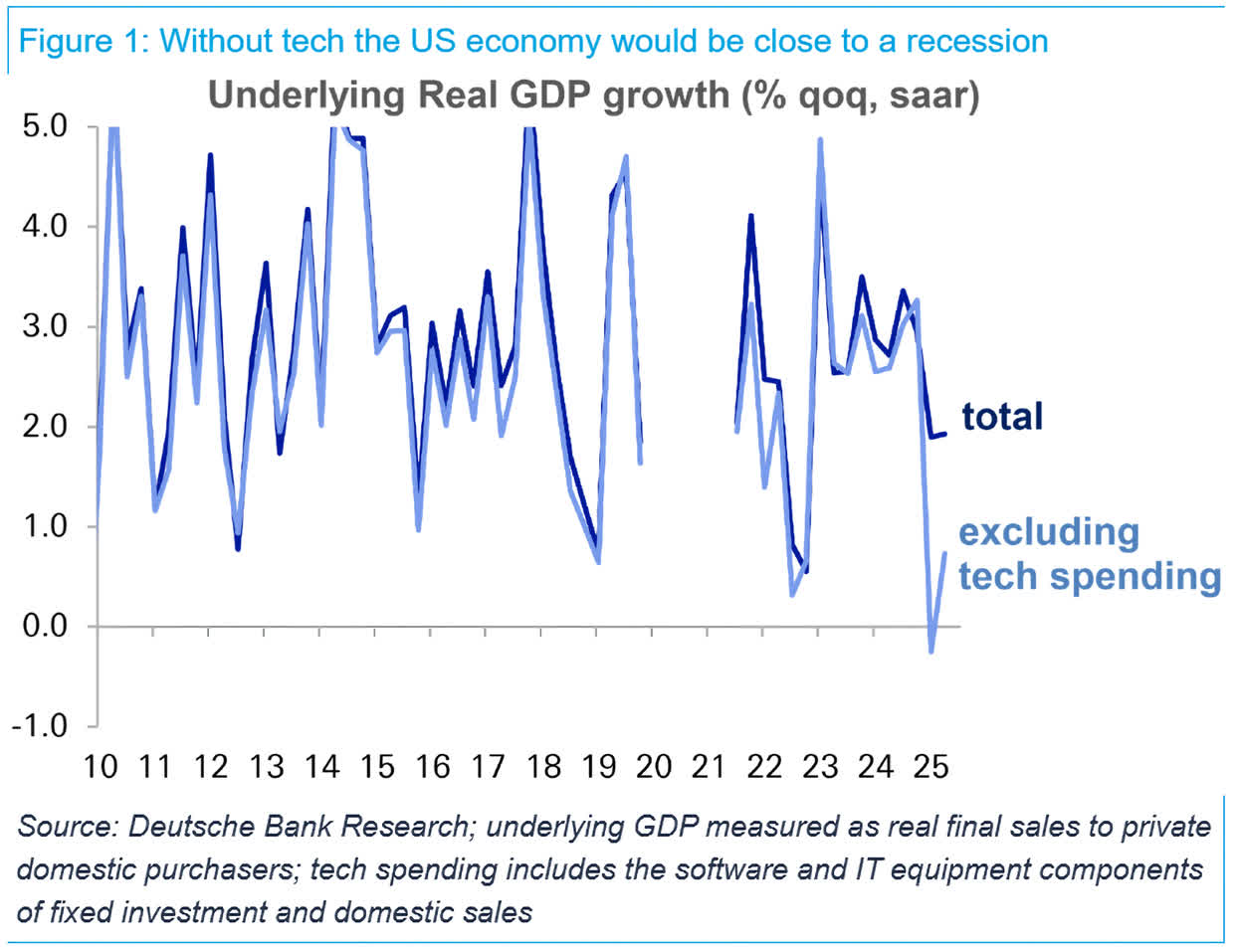
Deutsche Bank highlights that much of this growth comes from new facilities being built by human workers, while the AI technology and services sector has yet to make a meaningful contribution to the GDP.

Around half of the market gains captured by the S&P 500 index have been driven by tech-related stocks, Deutsche Bank warns. A separate report by Torsten Sløk of Apollo Management concurs, noting that equity investors are "dramatically overexposed" to AI investments.

According to analysts at Bain & Co., even with all this spending, AI is likely to generate insufficient revenue to fund further growth initiatives. By 2030, anticipated demand for AI services would require $2 trillion in annual revenues, leaving a shortfall of $800 billion globally to meet that demand.
Nvidia recently committed $100 billion to OpenAI to build an additional 10 gigawatts of AI computing capacity, while OpenAI escalated the investment by planning a full network of new AI data centers. Meanwhile, OpenAI CEO Sam Altman has acknowledged that AI investors are behaving irrationally, and some will inevitably lose significant sums of money as a result.

Will AI capital expenditure continue to surge with staggering figures and impossibly high revenue expectations? Baidu CEO Robin Li recently predicted that 99 percent of so-called AI companies will not survive the bubble, while legitimate businesses are now squandering money and potential productivity gains in an attempt to turn everything into an AI workload.

Permalink to story:

 
If it was such a bubble, then explain me the OpenAI and Oracle situation...

The difference between the dotcom and now, is that the company fueling the AI Frenzy are bluechip stocks with some of the largest market cap of the world, it is not startups like it was in 2000.
 
If it was such a bubble, then explain me the OpenAI and Oracle situation...

The difference between the dotcom and now, is that the company fueling the AI Frenzy are bluechip stocks with some of the largest market cap of the world, it is not startups like it was in 2000.
Some companies are making real money on AI, including TSMC and Nvidia and Oracle. TSMC money comes from Nvidia and other companies, Nvidia's money comes from Microsoft and OpenAI, Oracle's money comes from OpenAI.

The rest are either raising and blowing huge amounts of investor money, taking on debt, or participating in complex financial schemes to hide how much debt they are taking on and how much investor money they are spending.

It is definitely a bubble for most of the field and only Nvidia's earnings growth is keeping it from exploding in everyone's face.
 
Stock price is not the economy and yes the economy is not doing well especially when you have sweet potato head dictator running it the same way he ran his hotels into six bankruptcies.

https://www.investopedia.com/the-stock-market-and-the-economy-11713642
He would not be a president if previous administration wasn't covering its ears to not hear about the problems that affect most normal people. Furthermore, certain ideology has become so toxic, that a lot of people would vote for anybody if he was not its supporter.

In summary, problems need to be fixed. And big ones cannot wait for years. How do you drive the culture so low that people have negative feelings about words like inclusion and diversity for example? But even more concerning, the people from the side that lost can't seem to grasp that it is their actions and values resulted on the loss of power and influence. They were never worthy to be moral judges, they never had higher standards than everyone else, even though they insisted they do. And at the end, people began to oppose their values which they ignored when they were not so aggressive and invasive.
 
If it was such a bubble, then explain me the OpenAI and Oracle situation...

The difference between the dotcom and now, is that the company fueling the AI Frenzy are bluechip stocks with some of the largest market cap of the world, it is not startups like it was in 2000.
Both companies burning massive amounts of cash chasing the dragon. OpenAI burns through billions a quarter of venture capitalist funding and Oracle is taking out debt and cashing in their reserves desperately expanding into every market possible. Oracle's C suites are buying controlling states in TV companies FFS.

The ones making the money are, again, the shovel merchants. nVidia, TSMC, ece. Deutsche Bank isn't wrong either, the SnP 500 is dominated by tech companies. If you remove AI companies, the market has been doing pretty poorly for awhile now. And SO much of our economy is built on these investments that a major downturn certainly would not bode well.
He would not be a president if previous administration wasn't covering its ears to not hear about the problems that affect most normal people. Furthermore, certain ideology has become so toxic, that a lot of people would vote for anybody if he was not its supporter.

In summary, problems need to be fixed. And big ones cannot wait for years. How do you drive the culture so low that people have negative feelings about words like inclusion and diversity for example? But even more concerning, the people from the side that lost can't seem to grasp that it is their actions and values resulted on the loss of power and influence. They were never worthy to be moral judges, they never had higher standards than everyone else, even though they insisted they do. And at the end, people began to oppose their values which they ignored when they were not so aggressive and invasive.
The negative feelings over DEI labels is simple. They go directly against the words of MLK jr. Instead of judging the content of their character, DEI practices explicitly value people based on physical traits they were born with and explicitly excludes anyone who is not part of the "in" group, enabling the very type of racism and hostility it claims to solve; instead it dovetails into express hatred over groups thought to have "privilege" and turning into the very monster it purports to fix.

When you tell people that certain individuals peaked at birth and that makes them better then others, you tend to piss off a lot of people.
 
The ones making the money are, again, the shovel merchants. nVidia, TSMC, ece. Deutsche Bank isn't wrong either, the SnP 500 is dominated by tech companies. If you remove AI companies, the market has been doing pretty poorly for awhile now. And SO much of our economy is built on these investments that a major downturn certainly would not bode well.

I'm not so sure that everyone but tech is doing so poorly. The stock market has gone from an investment vehicle for people to own a part of a company they believe in and get a return on that faith to almost gambling. That quaint notion has long since died. By chasing the "next big thing", the stock market works more like a casino. Stocks rise and fall on rumor, planted stories, fads, or things that look bad, but have zero chance of affecting sales or income. I may be out there, but the stock market has become a zero sum game. Not because the pie cant grow, but because investment dollars are limited by a lack of readily available cash that is not invested. And since the major players have divided the market by "sectors" with different risk profiles, it often looks like a rise in company a's stock almost always results in company b's stock dropping. Pulling money to buy the hot stock of the day.

As a result, everyone has pushed Nvidia, Oracle, OpenAI, et al to dizzying heights with a big part (if not most) of the money comming from the rest of the market, not due to the rest of those companies performance.

So, If we can live through GE, Chrysler, Steel mills, and countless other companies crashing and burning without taking the whole economy with it, I think we would survive the AI crash. After all, how smart is it to throw all of your eggs in a basket (and more money than most other entire countries have) with a product that is incorrect, hallucinates, fools people by being close, as the next savior of the planet without a clear way to monetize it.

At least it makes cute pictures and cartoons.
 
Last edited:
“The market can stay irrational longer than you can stay solvent.” That feels right for today. Betting against this market is risky. We’re not at the peak yet. Just mentioning “AI data centers” is still enough to push a company's stock up 20–50%.

This isn’t the dot-com bubble, but a bubble none the less. The market is far ahead of itself on AI. Large hardware tech companies like Nvidia and Broadcom may be the “shovel sellers,” but the real issue is the massive money flowing into $100B+ data center projects and billion-dollar power plants. It’s an arms race to win AI.

When it ends, CEOs will cash out with stock options and golden parachutes, while regular investors take the hit in 401k's and deal with the wreckage left behind. It’s not if, it’s when. My guess, maybe 1–2 years. We’ll see a few pullbacks that gets everyone thinking the bubble popped only to get bought up into new highs. It will pop. What that trigger is, no one knows. Maybe, if you see a big AI announcement and the stock goes nowhere or even down, then you should start to worry.

Oh, you should never confuse the stock market with the economy, though they are obvious connected. In the short term (years), market performance is heavily influenced by financial flows such as corporate stock buybacks, ETF and passive investment inflows, and speculative trading, which can drive prices higher regardless of economic conditions. This is why markets sometimes rise even during periods of weak growth or job losses (now). However, over the long run, stock valuations remain tied to corporate earnings, which depend on broader economic activity.
 
Oh, you should never confuse the stock market with the economy, though they are obvious connected. In the short term (years), market performance is heavily influenced by financial flows such as corporate stock buybacks, ETF and passive investment inflows, and speculative trading, which can drive prices higher regardless of economic conditions. This is why markets sometimes rise even during periods of weak growth or job losses (now). However, over the long run, stock valuations remain tied to corporate earnings, which depend on broader economic activity.

While as an overview, you are correct, what bothers me the most is how decisions that are made, be them on investment choices or decisions made by these companies themselves, seems to be tied less and less to corporate earnings. There are companies that grow there earnings consistently, year in and year out, yet their stock prices are up and down like a yo yo that can not be tied to fundamentals.

Put this with corporate decision makers embracing AI and other tech when there is no practical or profitable way to integrate it in their company, especially while investing great sums of capitol, seems reckless.

The best part is, we've seen this movie before. Every CEO spent how much integrating blockchain? In house financing to capture finance revenue on top of sales? AI to replace the entire staff of a company? Intel trying to be a foundry for less than a month while the board plans to get rid of it to salvage the stock price?

It's not like this hasn't happened before in the past, it just looks to me that the frequency and scale of these blunders is increasing far faster than I'd care for.
 
I'm not so sure that everyone but tech is doing so poorly. The stock market has gone from an investment vehicle for people to own a part of a company they believe in and get a return on that faith to almost gambling. That quaint notion has long since died. By chasing the "next big thing", the stock market works more like a casino. Stocks rise and fall on rumor, planted stories, fads, or things that look bad, but have zero chance of affecting sales or income. I may be out there, but the stock market has become a zero sum game. Not because the pie cant grow, but because investment dollars are limited by a lack of readily available cash that is not invested. And since the major players have divided the market by "sectors" with different risk profiles, it often looks like a rise in company a's stock almost always results in company b's stock dropping. Pulling money to buy the hot stock of the day.

As a result, everyone has pushed Nvidia, Oracle, OpenAI, et al to dizzying heights with a big part (if not most) of the money comming from the rest of the market, not due to the rest of those companies performance.

So, If we can live through GE, Chrysler, Steel mills, and countless other companies crashing and burning without taking the whole economy with it, I think we would survive the AI crash. After all, how smart is it to throw all of your eggs in a basket (and more money than most other entire countries have) with a product that is incorrect, hallucinates, fools people by being close, as the next savior of the planet without a clear way to monetize it.

At least it makes cute pictures and cartoons.
It's not down, but it isn't up either. If you remove big tech stocks, the stock market has effectively stalled out, with only small gains every 3-4 years. Once you factor in inflation, non tech stocks have technically lost value since the great financial crisis of 08.

 
It's not down, but it isn't up either. If you remove big tech stocks, the stock market has effectively stalled out, with only small gains every 3-4 years. Once you factor in inflation, non tech stocks have technically lost value since the great financial crisis of 08.


Yes, but my point is that many of these companies do quite well and are in no danger of failing. I further think that the lack of investment in these type of solid companies is because investors have all of their money tied up looking for the pot of gold at the end of the rainbow. As the other poster said, when this whole merry go round finally stops, most will be left holding the bag.
 
Eventually there will consolidation, the market has too many players. Right now it's a race for dominance, all races have losers. Any ill-effects on the US economy will be overshadowed by the success of the rest of economy. America is very resilient! The Germans are a bunch of pinheads making guesses, Chicken Littles who probably own millions in shorts positions.
 
While as an overview, you are correct, what bothers me the most is how decisions that are made, be them on investment choices or decisions made by these companies themselves, seems to be tied less and less to corporate earnings. There are companies that grow there earnings consistently, year in and year out, yet their stock prices are up and down like a yo yo that can not be tied to fundamentals.

Put this with corporate decision makers embracing AI and other tech when there is no practical or profitable way to integrate it in their company, especially while investing great sums of capitol, seems reckless.

The best part is, we've seen this movie before. Every CEO spent how much integrating blockchain? In house financing to capture finance revenue on top of sales? AI to replace the entire staff of a company? Intel trying to be a foundry for less than a month while the board plans to get rid of it to salvage the stock price?

It's not like this hasn't happened before in the past, it just looks to me that the frequency and scale of these blunders is increasing far faster than I'd care for.
Again, the fundamentals of investing still apply here. Diversify your investments, invest in companies that meet some minimum thresholds of quality (pick whatever criteria you like), and try not to buy companies at high valuations. You will miss out on some gains but you will also survive the crashes with far less losses.

I am steadily cashing out on the US market (valuations are high, earnings are growing but unsteadily, a possible recession is coming medium-term, political stability is damaged in the US) and moving my money to international equities where the prices are lower.
 
He would not be a president if previous administration wasn't covering its ears to not hear about the problems that affect most normal people. Furthermore, certain ideology has become so toxic, that a lot of people would vote for anybody if he was not its supporter.

In summary, problems need to be fixed. And big ones cannot wait for years. How do you drive the culture so low that people have negative feelings about words like inclusion and diversity for example? But even more concerning, the people from the side that lost can't seem to grasp that it is their actions and values resulted on the loss of power and influence. They were never worthy to be moral judges, they never had higher standards than everyone else, even though they insisted they do. And at the end, people began to oppose their values which they ignored when they were not so aggressive and invasive.
While frustrations with past administrations are valid, it's an oversimplification to claim that one side "covered its ears" while ignoring the policies that did aim to address systemic issues — such as expanding healthcare access, improving environmental protections, investing in clean energy, and advancing civil rights. These are not fringe issues; they affect millions of working-class Americans.

The idea that only one side cares about "normal people" often ignores policies intentionally aim to uplift marginalized and economically struggling groups — whether through raising the minimum wage, expanding union protections, or ensuring affordable healthcare.

It’s worth asking: what exactly is considered “toxic”? If you're referring to values like inclusion, equality, and diversity, these are principles that liberal movements have championed not to punish or shame people, but to ensure fairness and justice. These ideals are not inherently invasive — they’ve become politicized by narratives that frame inclusion as an attack rather than a broadening of opportunity.

Much of the backlash against the previous administration is based on misinformation or a reaction to how progress challenges traditional power structures — not necessarily because the ideas themselves are harmful.

Previous administration proposals have put forward immediate solutions to big problems: climate change legislation, criminal justice reform, student loan relief, and better worker protections. The fact that many of these proposals are blocked or delayed is often due to political polarization and obstruction — not a lack of urgency from the left.

Moreover, rushing to "fix" things without considering long-term consequences can lead to reactionary policies that help in the short term but harm in the long run — particularly when they’re driven by cultural resentment rather than data or human needs.

Culture is driven low when those very words are politicized and mocked. The previous administration’s view is that diversity and inclusion aren’t hollow buzzwords — they’re essential to building a fair society. If people have negative associations with them, it’s often due to targeted campaigns that portray these values as threats to tradition or free speech, rather than tools for greater equity.

It’s not inclusion that divides people — it’s the fearmongering around it.

This framing implies that one side “deserved” to lose because they had “arrogant” or “hypocritical” values. But liberal movements have often acknowledged their flaws and adapted over time — as any healthy movement should. No ideology has a monopoly on morality, but dismissing progressive values outright ignores the tangible improvements they’ve brought in civil rights, education, and public health.

Also, "losing influence" isn't necessarily a rejection of values — sometimes it's the result of gerrymandering, voter suppression, or media manipulation. Liberal values continue to resonate with millions, especially younger generations.

From a liberal point of view, it’s reductive and harmful to paint inclusion, diversity, or progressive values as "toxic" just because they challenge long-standing norms. Cultural change is hard, and not everyone will agree — but opposing these values wholesale because they make some uncomfortable risks undermining the very democratic principles that allow diverse societies to function.
 
Last edited:
He would not be a president if previous administration wasn't covering its ears to not hear about the problems that affect most normal people. Furthermore, certain ideology has become so toxic, that a lot of people would vote for anybody if he was not its supporter.

You mean the guy who fixed the economy in 9 months, when it took Obama 9 years to accomplish the same type of recovery? Reduce minority unemployment to their lowest levels ever? Grow manufacturing to its fastest rate since the 90s? You know, literally EVERYTHING people had been complaining about for decades?

Yes, inflation peaked (I argue largely because the Fed was comically late raising rates), but GDP growth consistently outpaced it, and it was down to a reasonable (though still a tick high) 2.5% by the end of his term. And lets not forget the other guy was actively campaigning on a policy that would *raise* inflation.

Then again, it would be nice for a Democrat to inherit an economy that wasn't in some state of disrepair.
 
While frustrations with past administrations are valid, it's an oversimplification to claim that one side "covered its ears" while ignoring the policies that did aim to address systemic issues — such as expanding healthcare access, improving environmental protections, investing in clean energy, and advancing civil rights. These are not fringe issues; they affect millions of working-class Americans.

The idea that only one side cares about "normal people" often ignores policies intentionally aim to uplift marginalized and economically struggling groups — whether through raising the minimum wage, expanding union protections, or ensuring affordable healthcare.

It’s worth asking: what exactly is considered “toxic”? If you're referring to values like inclusion, equality, and diversity, these are principles that liberal movements have championed not to punish or shame people, but to ensure fairness and justice. These ideals are not inherently invasive — they’ve become politicized by narratives that frame inclusion as an attack rather than a broadening of opportunity.

Much of the backlash against the previous administration is based on misinformation or a reaction to how progress challenges traditional power structures — not necessarily because the ideas themselves are harmful.

Previous administration proposals have put forward immediate solutions to big problems: climate change legislation, criminal justice reform, student loan relief, and better worker protections. The fact that many of these proposals are blocked or delayed is often due to political polarization and obstruction — not a lack of urgency from the left.

Moreover, rushing to "fix" things without considering long-term consequences can lead to reactionary policies that help in the short term but harm in the long run — particularly when they’re driven by cultural resentment rather than data or human needs.

Culture is driven low when those very words are politicized and mocked. The previous administration’s view is that diversity and inclusion aren’t hollow buzzwords — they’re essential to building a fair society. If people have negative associations with them, it’s often due to targeted campaigns that portray these values as threats to tradition or free speech, rather than tools for greater equity.

It’s not inclusion that divides people — it’s the fearmongering around it.

This framing implies that one side “deserved” to lose because they had “arrogant” or “hypocritical” values. But liberal movements have often acknowledged their flaws and adapted over time — as any healthy movement should. No ideology has a monopoly on morality, but dismissing progressive values outright ignores the tangible improvements they’ve brought in civil rights, education, and public health.

Also, "losing influence" isn't necessarily a rejection of values — sometimes it's the result of gerrymandering, voter suppression, or media manipulation. Liberal values continue to resonate with millions, especially younger generations.

From a liberal point of view, it’s reductive and harmful to paint inclusion, diversity, or progressive values as "toxic" just because they challenge long-standing norms. Cultural change is hard, and not everyone will agree — but opposing these values wholesale because they make some uncomfortable risks undermining the very democratic principles that allow diverse societies to function.

Couldn't have said it better myself.
 
“The market can stay irrational longer than you can stay solvent.” That feels right for today. Betting against this market is risky. We’re not at the peak yet. Just mentioning “AI data centers” is still enough to push a company's stock up 20–50%.

You sound young and inexperienced.. /s

(whilst nodding at the same time)

Thing is there are so many that must have got hoovered into this market in the last few years they must have no perspective of the past. Maybe all those that did retired on their millions before the GFC hit, leaving the rest in the sandpit.
 
Some companies are making real money on AI, including TSMC and Nvidia and Oracle. TSMC money comes from Nvidia and other companies, Nvidia's money comes from Microsoft and OpenAI, Oracle's money comes from OpenAI.

The rest are either raising and blowing huge amounts of investor money, taking on debt, or participating in complex financial schemes to hide how much debt they are taking on and how much investor money they are spending.

It is definitely a bubble for most of the field and only Nvidia's earnings growth is keeping it from exploding in everyone's face.
AND... the stock market is driven by THOSE companies right now.

Micron, TSMC, Nvidia, AMD, Oracle, Microsoft... unlike during the dotcom era which was small cap IPOs like PET.com and such.

AI is this driven by other sectors as well, such as government, auto, robotics and the defense sector. It is not going to stop out of nowhere. Not to mention this is now a race between nations and a question of national security for every countries.

People make the easy allusion that AI is ChatGPT and Midjourney, when in reality is so much more. All the doom and gloom are from people not grasping what is going on. AI is not for making money, but for cutting cost and providing new capabilities which governments are pushing for.

It is nowhere near like the dotcom bubble was. It has a solid foundation based upon much more than pure speculation.
 
Back