This fusion energy startup thinks it can cut lasers out of the equation

Skye Jacobs

Posts: 2,030   +59
Staff
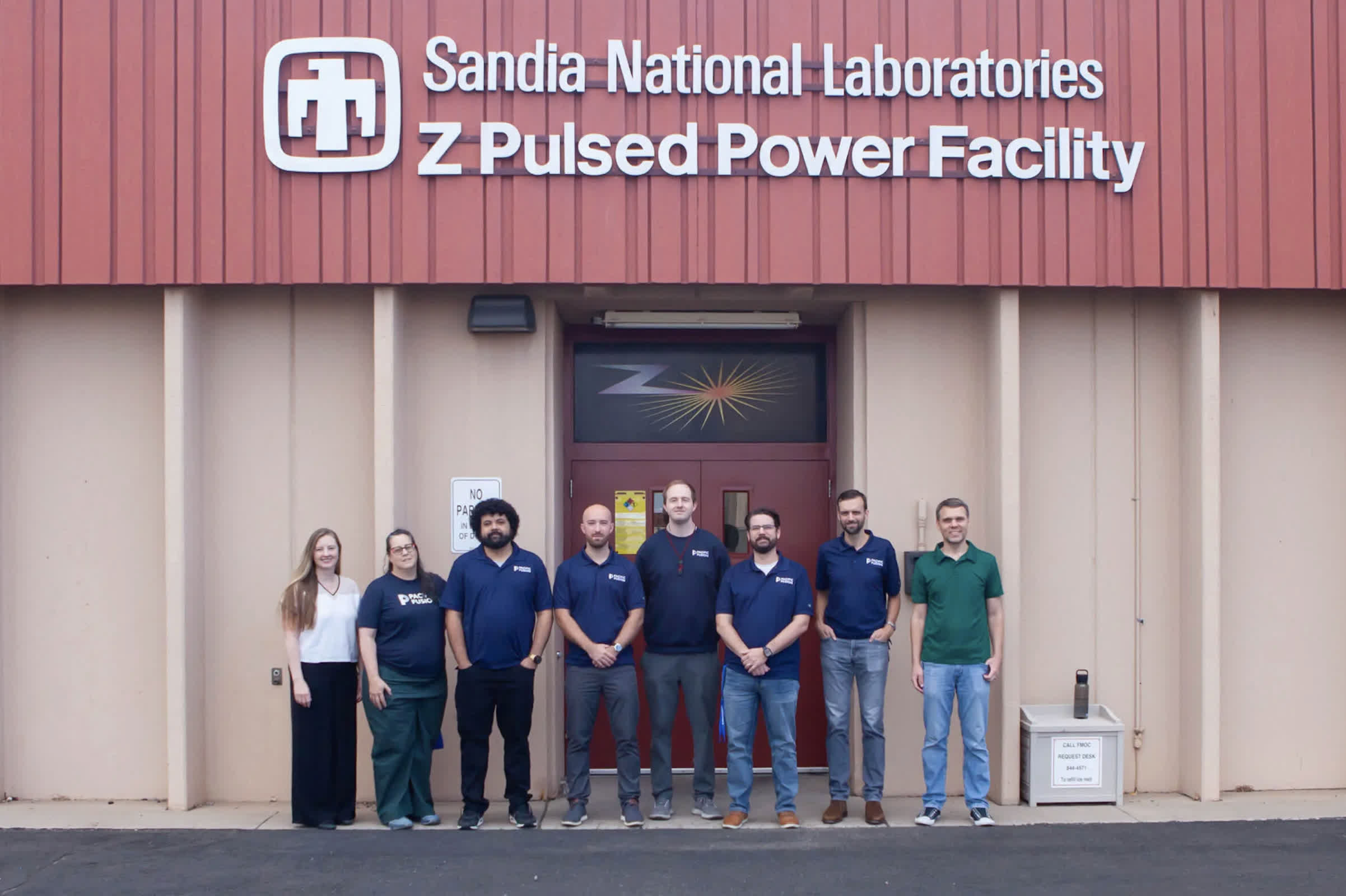
Forward-looking: For decades, fusion energy has been hailed as the ultimate clean-power breakthrough – a virtually limitless source of electricity that mimics the reactions fueling the Sun. Yet one of fusion's core paradoxes has stubbornly persisted: the energy required to start the reaction still exceeds the energy it produces. At Sandia National Laboratories, the startup Pacific Fusion believes it may have inched closer to changing that equation.

The company shared results from a new set of experiments with TechCrunch, suggesting that it could eliminate one of the most expensive and complex components of its fusion process – the laser preheating system – by making subtle adjustments to the machinery that ignites the reaction.

The approach, known as pulser-driven inertial confinement fusion, aims to compress a small fuel pellet using massive, precisely timed bursts of electricity. These pulses are directed through a cylinder surrounding the pellet, generating a magnetic field that collapses inward at extraordinary speed – less than 100 billionths of a second – forcing hydrogen atoms to fuse and release energy.

It's the same principle behind the National Ignition Facility's record-setting experiments, but instead of lasers, Pacific Fusion relies on pulsed power. "The faster you can implode it, the hotter it'll get," Keith LeChien, Pacific Fusion's co-founder and CTO, told TC.

Historically, pulser-driven fusion systems have required extra preheating to reach ignition temperatures. Researchers often rely on lasers or magnetic fields for this step, which can account for up to 10 percent of total input energy. Such systems are extremely expensive: large lasers capable of delivering the necessary energy routinely exceed $100 million and require intensive maintenance.

Pacific Fusion's Sandia tests suggest the company may be able to eliminate that step. By altering the structure of the cylindrical chamber and fine-tuning the electrical current profile during the reaction, the team found a way to let a controlled amount of magnetic flux "leak" into the fuel just before compression. This preheats the pellet without the need for lasers or additional magnets.

The company uses plastic fuel targets encased in aluminum, and by adjusting the aluminum's thickness, engineers can fine-tune how much of the magnetic field seeps through. Manufacturing these targets doesn't require exotic materials or extreme tolerances – the precision is comparable to that of a standard .22-caliber bullet casing.
"It doesn't take much energy to actually allow that magnetic field into the center of the fuel," LeChien said. "It's a tiny fraction – much less than one percent of the system's total energy."

Eliminating major components like high-powered lasers could simplify operations and reduce costs, though the impact is modest compared with the broader challenge of making fusion economically viable.

Pacific Fusion, founded only a few years ago, plans to bring its first commercial-scale plant online in the early to mid-2030s, a timeline similar to that of more established competitors. The company also emphasizes that its experiments help refine simulations, ensuring that models more accurately reflect physical reality.

"A lot of people have simulated things and said, 'Oh, this will work or that will work,'" LeChien said. "It's very different to actually build it and have it work. Closing that loop is hard."

Even if these incremental improvements don't immediately make fusion power cheap, they demonstrate progress at the engineering level rather than purely theoretical work. Each iteration – whether in how power is pulsed, fuel is contained, or magnets behave – is bringing the world's most ambitious energy experiment closer to commercial reality.

Permalink to story:

 
Couple reasons why we won't see fusion energy in America.
1. CEO/Stockholders
2. Environmentalist

You know good and well the corporate world won't be able to make a TON of money off
of it and the environmentalist will find something about it that they don't like. ;) /sarcasm but somewhat true.
 
The Sun has massive amounts of mass that cause Hydrogen to simply fuse into Helium. It simply is.
And it won't last forever. Eventually it will use all its Hydrogen and become a Red Giant and then shrink to a White Dwarf.

Man will never be able to achieve fusion without putting more energy in than we get out of it.
 
Couple reasons why we won't see fusion energy in America.
1. CEO/Stockholders
2. Environmentalist

You know good and well the corporate world won't be able to make a TON of money off
of it and the environmentalist will find something about it that they don't like. ;) /sarcasm but somewhat true.
I totally get that this was sarcastic (not entirely), however I honestly don’t think we should be quite so pessimistic, personally.

If fusion works, I don’t think it’s going to be some magical free-energy fairyland. There are still going to be massive costs associated in infrastructure, reactor maintenance, fuel processing, grid integration, licensing, IP, servicing, upgrades, etc that’ll cost plenty.

Utilities, defense contractors, energy conglomerates, and tech giants are all going to be building, owning, and operating all of that infrastructure, and paying for it.

IMO, if fusion really becomes viable, Wall Street will sprint toward it like any new tech breakthrough. And it’ll fuel the next-gen AI world. That alone should prop up capitalist markets.

And environmentalists aren’t a monolith, either. Sure, someone will object to something—that’s true of literally every technology ever invented. But mainstream environmental orgs seem to be increasingly supportive of nuclear. And many would likely be strongly supportive of fusion because it’s CO2, meltdown risks and long-lived waste should be much lower.

If fusion becomes practical, I don’t think it’ll be slowed or stopped—it’ll be devoured by markets and hailed as a new age.
 
There is one thing I haven't heard explained. First, what's the longest reaction time achieved so far, and next, how do you keep the reactor fueled during operation considering it's a plasma in a magnetic containment field.
 
The proton-proton chain is what our star uses to fuse hydrogen into helium. When you look into the details, it’s pretty wild what has to happen at the atomic level for this reaction to take place. The odds are staggering, beyond staggering, borderline impossible. Quantum tunneling plays a key role.

A star has two huge advantages over human attempted fusion. Mass (size/density) and with size/density comes extreme pressure and temperature. This is not easily replicated on earth.. we don't have the materials science to contain the temperatures required. A Tokamak use's magnetic confinement for the super heated plasma, which itself I could write 10 pages on.

Directed Focused Energy Arrays (laser) - attempts to avoid the issues of magnetic confinement and to pulse a high energy beam at a small target of fissile material to grant a larger output of energy then what was put in. I have not followed this research much as it seems like a dead end. At best this type of fusion would and could compliment the former as a secondary fusion source to charge capacitors for a more efficient secondary fusion cycle and perhaps prime magnetic coils back to the primary.
 
Achieving efficient nuclear fusion necessitates a profound understanding of the underlying physics. This "profound" understanding implies delving into the most fundamental levels of nature. If the Standard Model of particle physics can be likened to a low-level programming language like C, then achieving control over fundamental processes may require an understanding analogous to assembly language, a deeper, even lower, more granular level.

Consequently, a critical question arises: what is the true nature of a fundamental particle like the quark? The classifications used in the Standard Model such as up, down, charm and the associated color charges, represent high-level abstractions, primarily useful for predicting behavior under specific conditions rather than describing fundamental mechanisms.

To effectively manipulate physical interactions at the most basic level, rather than merely predicting outcomes, a deeper comprehension of the underlying processes is essential. At this fundamental level, the description might involve phenomena such as specific frequency characteristics and local topological behaviors associated with quantum fields, potentially manifesting as excitations often simplified as "virtual particles." These are not envisioned as solid, classical objects but rather as resonant, dynamic configurations (“swarms of virtual particles”) behaving within a quantum field framework. Notably, the historical concept of a luminiferous aether, once considered a fundamental low level medium, has been discarded, presenting a challenge for visualizing these interactions.

A related conceptual challenge lies in interpreting the famous equation E=mc^2. While the Standard Model assigns mass-energy equivalence to particles like quarks, questioning whether this constitutes intrinsic mass at the most fundamental level is plausible. It might be more accurate to consider the quark as possessing a distinct, unique form of energy, characterized by specific properties arising from its fundamental interactions and behavior, with mass emerging as a phenomenon at a higher, "macroscopic" scale.

Furthermore, at this fundamental level, different types of energy carriers (like quarks) are arguably not interchangeable. Their distinctness stems from their unique nature and interaction patterns, somewhat analogous to how a swarm of one species behaves differently from a swarm of another, even under similar conditions or in different mediums. While such nuances might be less critical in everyday interactions, where we primarily engage with higher-level structures like atoms, molecules, alloys and materials, they become crucial in the context of fusion.

In fusion research, we directly operate within an environment where these fundamental particles and their interactions are paramount. Without a deeper understanding of their true nature, navigating and controlling this environment effectively remains improbable. This situation is analogous to sending sophisticated, unshielded electronic equipment to Mars without accounting for the conductive properties of the Martian dust. Consequently, a successful fusion reactor is likely to be a highly sophisticated, high-precision machine, potentially compact yet intricate, reminiscent of advanced systems like the ASML EUV lithography machines.
 
The Sun has massive amounts of mass that cause Hydrogen to simply fuse into Helium. It simply is.
And it won't last forever. Eventually it will use all its Hydrogen and become a Red Giant and then shrink to a White Dwarf.

Man will never be able to achieve fusion without putting more energy in than we get out of it.
NIF has already made a net energy gain in 2022…
 
Achieving efficient nuclear fusion necessitates a profound understanding of the underlying physics. This "profound" understanding implies delving into the most fundamental levels of nature. If the Standard Model of particle physics can be likened to a low-level programming language like C, then achieving control over fundamental processes may require an understanding analogous to assembly language, a deeper, even lower, more granular level.

Consequently, a critical question arises: what is the true nature of a fundamental particle like the quark? The classifications used in the Standard Model such as up, down, charm and the associated color charges, represent high-level abstractions, primarily useful for predicting behavior under specific conditions rather than describing fundamental mechanisms.

To effectively manipulate physical interactions at the most basic level, rather than merely predicting outcomes, a deeper comprehension of the underlying processes is essential. At this fundamental level, the description might involve phenomena such as specific frequency characteristics and local topological behaviors associated with quantum fields, potentially manifesting as excitations often simplified as "virtual particles." These are not envisioned as solid, classical objects but rather as resonant, dynamic configurations (“swarms of virtual particles”) behaving within a quantum field framework. Notably, the historical concept of a luminiferous aether, once considered a fundamental low level medium, has been discarded, presenting a challenge for visualizing these interactions.

A related conceptual challenge lies in interpreting the famous equation E=mc^2. While the Standard Model assigns mass-energy equivalence to particles like quarks, questioning whether this constitutes intrinsic mass at the most fundamental level is plausible. It might be more accurate to consider the quark as possessing a distinct, unique form of energy, characterized by specific properties arising from its fundamental interactions and behavior, with mass emerging as a phenomenon at a higher, "macroscopic" scale.

Furthermore, at this fundamental level, different types of energy carriers (like quarks) are arguably not interchangeable. Their distinctness stems from their unique nature and interaction patterns, somewhat analogous to how a swarm of one species behaves differently from a swarm of another, even under similar conditions or in different mediums. While such nuances might be less critical in everyday interactions, where we primarily engage with higher-level structures like atoms, molecules, alloys and materials, they become crucial in the context of fusion.

In fusion research, we directly operate within an environment where these fundamental particles and their interactions are paramount. Without a deeper understanding of their true nature, navigating and controlling this environment effectively remains improbable. This situation is analogous to sending sophisticated, unshielded electronic equipment to Mars without accounting for the conductive properties of the Martian dust. Consequently, a successful fusion reactor is likely to be a highly sophisticated, high-precision machine, potentially compact yet intricate, reminiscent of advanced systems like the ASML EUV lithography machines.
We’ve had successful fusion reactors for decades starting in the 50’s. The issue now is having one efficient enough to be able to bolt a power station to and produce a net gain in power
 
There is one thing I haven't heard explained. First, what's the longest reaction time achieved so far, and next, how do you keep the reactor fueled during operation considering it's a plasma in a magnetic containment field.
The French WEST tokamak recently held a fusion-relevant plasma for about 22 minutes, a new record for magnetic confinement duration.

Note: that’s plasma confinement duration, not net power gain or continuous reactor power output.

https://www.earth.com/news/france-breaks-record-by-keeping-a-fusion-plasma-reactor-running-for-22-minutes

As I understand it, the fuel is typically frozen deuterium/tritium ice pellets or gas and injected into the plasma at a high enough velocity to penetrate the magnetic field. There are probably other methods but I think this is the most common approach at the moment.
 
Last edited:
I don't think so. They are not reporting all the energy required for input.
They’re reporting the reaction energy which shows we can gain more energy out of a reaction that put into it. JET gets to around 0.7, SPARC is on track to achieve Q>1 with the goal of Q>10 and ITER is only a few years off of being complete
 
Back