You are using an out of date browser. It may not display this or other websites correctly.
You should upgrade or use an alternative browser.
You should upgrade or use an alternative browser.
UCF graduates boo commencement speaker for calling AI "the next industrial revolution"
- Thread starter Skye Jacobs
- Start date


ZedRM
Posts: 3,414 +2,351
That speaker should have had better sense than to discuss such a negatively provocative and controversial subject. This reaction from the onlookers might have been uncivilized. It was also not unpredictable. She was most unwise with the choice of speech subject and the audience didn't fail to highlight her mistake.
Future speakers might want to take events like this to heart when planning a speech.
Future speakers might want to take events like this to heart when planning a speech.
Last edited:
ZedRM
Posts: 3,414 +2,351
There is a severe difference between the advent of the electrical age and the emergence of technologies that can do and have done real harm to our culture and society. Your annoyance here is expression of the symptom of the problem, nothing more.Yes, there are literally old images and caricatures of how electricity was seen. It's the same old, same old. Fear of new stuff. I'm so tired of it.

Endymio
Posts: 5,605 +5,232
You're forgetting what Orwell taught us of DoubleThink: the ability to believe in two opposing, contradictory sets of facts, in order to virtue-your adherence to liberal ideology.Do the luddites hate AI because it could take their job or because it sucks? It can’t really be both.
Oops! You're forgetting that the advent of electricity was *also* marked by the same sky-is-falling zealotry that accompanies AI. There were mass complaints and protests about the dangers of electrification of cities, loss of jobs, etc, etc, ad infinitum.There is a severe difference between the advent of the electrical age and the emergence of technologies that can do and have done real harm to our culture and society. Your annoyance here is expression of the symptom of the problem, nothing more.
My favorite are the people who claimed electric lights would destroy the social fabric, by allowing people to engage in so many illicit activities after dark, when all good god-fearin' people simply blew out the candles and went to bed.
And guess what? Somehow we survived it all.
Last edited:
ZedRM
Posts: 3,414 +2,351
That was no "oops". It was deliberate. These two things are not similar. Comparing them is wily-coyote levels of thinking.Oops! You're forgetting that the advent of electricity was *also* marked by the same sky-is-falling zealotry that accompanies AI.
Yes, the difference is that electricity improved life considerably and started doing so immediately upon introduction. AI has not. It had caused worker lay-offs on a world-wide scale. It's use is consuming more electrical power in a single month than anything else uses in three months. It's use is creating detectable heat pockets that our environment can not withstand. Yet we're building more and more AI data centers.And guess what? Somehow we survived it all.
These are facts, not whimsical nonsense.
AI is not a good thing for oh-so-many reasons. Only the foolish say otherwise. AI needs to be stopped.
Endymio
Posts: 5,605 +5,232
They're not only similar, they're identical. As were the concerns over loss of jobs due to the steam engine, the automobile, and the computer.That was no "oops". It was deliberate. These two things are not similar. Comparing them is wily-coyote levels of thinking.
These are all tools, as is AI: for people willing to learn to use them, they make you more powerful, more productive, and more employable. Not less.
AI has. Educate yourself. It's already improving outcomes for millions of medical patients, helping design new pharmaceuticals, new stronger, lighter, and safer materials, and improve logistics to deliver products faster, cheaper, and with less fuel consumption and less wastage - to name just a few of the hundreds of thousands of use cases.Yes, the difference is that electricity improved life considerably and started doing so immediately upon introduction. AI has not.
ZedRM
Posts: 3,414 +2,351
You have not validated your point.They're not only similar, they're identical. As were the concerns over loss of jobs due to the steam engine, the automobile, and the computer.
These are all tools, as is AI: for people willing to learn to use them, they make you more powerful, more productive, and more employable. Not less.
Love the irony.AI has. Educate yourself.
Let's assume your stated information is correct, how does any of that offset the serious problems created? (hint, they do not)It's already improving outcomes for millions of medical patients, helping design new pharmaceuticals, new stronger, lighter, and safer materials, and improve logistics to deliver products faster, cheaper, and with less fuel consumption and less wastage - to name just a few of the hundreds of thousands of improvements.
"Yes, the planet got destroyed. But for a beautiful moment in time we created a lot of value for shareholders."
Endymio
Posts: 5,605 +5,232
Real life isn't a Terminator film. I'm shocked that a staff member of a tech site would display such an anti-technological perspective."Yes, the planet got destroyed. But for a beautiful moment in time we created a lot of value for shareholders."
And "corporate profits aside", China is subsidizing AI research far more heavily than the US government is, and is presently building an army of several million AI-powered drones and robotic quadruped warriors (aka "robotic dogs"). If we don't do the same, then twenty years from now, you can expound your Luddite views in a CCP reeducation camp.

JaredTheDragon
Posts: 864 +581
It used to take months and many skilled laborers to build a house. Then DeWalt's radial arm saw came along. Got rid of a lot of guys
"This saw, originally called the "Wonder-Worker," revolutionized woodworking by allowing multiple cutting operations without changing setups."
Oh and people prefer booing to thinking. Even graduates
This saw "got rid of" exactly zero laborers. There are all kinds of tools that help with speed and accuracy in construction - and absolutely every one requires a laborer. Your fallacious comparison is a fallacy.
JaredTheDragon
Posts: 864 +581
They're not only similar, they're identical. As were the concerns over loss of jobs due to the steam engine, the automobile, and the computer.
These are all tools, as is AI: for people willing to learn to use them, they make you more powerful, more productive, and more employable. Not less.
AI has. Educate yourself. It's already improving outcomes for millions of medical patients, helping design new pharmaceuticals, new stronger, lighter, and safer materials, and improve logistics to deliver products faster, cheaper, and with less fuel consumption and less wastage - to name just a few of the hundreds of thousands of use cases.
Your fake Artificial Stupid religion has done no such thing. It hasn't changed or helped anyone and it never will - it's just a glorified search engine, not even remotely intelligent.
Who paid you to type all that, Microsoft or Meta or Google?
Endymio
Posts: 5,605 +5,232
Was your post a joke? In the 1800s, a tiny 900 sq. foot home took 1500+ man-hours to construct -- and that's without having to install wiring, HVAC, and almost no plumbing. Today, we build far better equipped homes four times that size in the same amount of time.This saw "got rid of" exactly zero laborers. There are all kinds of tools that help with speed and accuracy in construction - and absolutely every one requires a laborer. Your fallacious comparison is a fallacy.
This exposes the fatal flaw in all the "AI will steal our jobs!" reasoning. Had we continued today to build poorly-equipped tiny box homes, we would have indeed put nearly all the construction industry out of work. But those power tools (and other advances) allow the average person to now afford far larger, much more luxurious housing. And in the near future, even middle-class citizens will have a panel of specialist doctors monitoring their health in real-time 24x7; a cadre of legal eagles continually advising them; and a team of world-class financial advisors handling their investments ... all powered by AI.
You've never even used an AI product, save a free LLM chatbox, which constitutes the poor 1% of the entire AI industry. Why not educate yourself before attempting to debate a subject?Your fake Artificial Stupid religion has done no such thing. It hasn't changed or helped anyone and it never will - it's just a glorified search engine, not even remotely intelligent.
AI quite literally saved my life last year, when it found an issue that a human radiologist missed -- though he'd been instructed specifically to look for it. I paid that human expert over $5K and waited three days for the results ... AI performed it in microseconds, for a few pennies of electric cost.
I would ask who paid you to post absurd disinformation, but it's clear you're working freelance.Who paid you to type all that, Microsoft or Meta or Google?
Last edited:
Real life isn't a Terminator film. I'm shocked that a staff member of a tech site would display such an anti-technological perspective.
And "corporate profits aside", China is subsidizing AI research far more heavily than the US government is, and is presently building an army of several million AI-powered drones and robotic quadruped warriors (aka "robotic dogs"). If we don't do the same, then twenty years from now, you can expound your Luddite views in a CCP reeducation camp.
Bizarre it's not a terminator film, yet your robot dogs of death are your scare tactic to tells us we should do the same.
Houses you say are better bigger, more luxurious.
In the UK I can tell you that the population is 3x what it should be almost 4.
Housing land is already bought up to be built on, but they don't to keep prices high. Only build when you have a few left to sell. And built now faster but all the corners that shouldn't be skipped are. **** housing. And **** tactics to fleece people of money rather than help.
And then medical. I agree it could help and be revolutionary. The costs would be miniscule but the bill will still be the same because you still have e overpriced useless doctors to pay wages to and they won't go away because the mark up on the drugs and surgeries are still there, the American government makes a killing hoping you will get sick.
The current govt is proof that they don't give a **** about the people. Justice, integrity. They care about money greed.
And if AI does take jobs , wait the whole point is to aim for that to have robots and computers take our place , businesses hope to do away with a workforce other than AI texperts.
The predictions of half the populous out of work. Well your money in AI will have to be amazing cause they tax to house and feed the out of work will be insane, unless there's a war or culling.
I get people's point that AI isn't there yet. But believe me you don't want it to be sentient. If it works out humans aren't needed that first law of robotics will be deleted. And then then humans deleted.
Because the previous tools like cars, radial arms w.e have all led us to the brink of ww3. We haven't learnt that we as a species are fkn stupid.
We still use god as an excuse when times are bleak AF instead of thinking, cause if we did we would realise, this is all our fault.
But you can't say AI will be used for good. It won't. You already say AI china has forced our hands with Digital-dogs.

RudyBob
Posts: 2,847 +3,117
Quote me correctly.This saw "got rid of" exactly zero laborers. There are all kinds of tools that help with speed and accuracy in construction - and absolutely every one requires a laborer. Your fallacious comparison is a fallacy.
Endymio
Posts: 5,605 +5,232
You're confused. "Terminator" was AI vs humans; whereas the CCP is just your garden-variety totalitarian dictatorship, using AI no differently than they do any other weapon of war.Bizarre it's not a terminator film, yet your robot dogs of death are your scare tactic to tells us we should do the same.
Oh, not a return to the 60s-era overpopulation nonsense? In the UK, your current birth rate is only 1.4, far below the level required to even sustain a stable population level. So don't worry -- in five or six generations, you'll basically die out.Houses you say are better bigger, more luxurious.
In the UK I can tell you that the population is 3x what it should be almost 4.
And yet by far the deadliest war in US history was our civil war, before any of these existed, and the per-capita deaths from Britain's medieval wars dwarf those of the modern era.Because the previous tools like cars, radial arms w.e have all led us to the brink of ww3. We haven't learnt that we as a species are fkn stupid.
Gravitytr1
Posts: 237 +138
Guys been dealing with this since 1889Yes, there are literally old images and caricatures of how electricity was seen. It's the same old, same old. Fear of new stuff. I'm so tired of it.
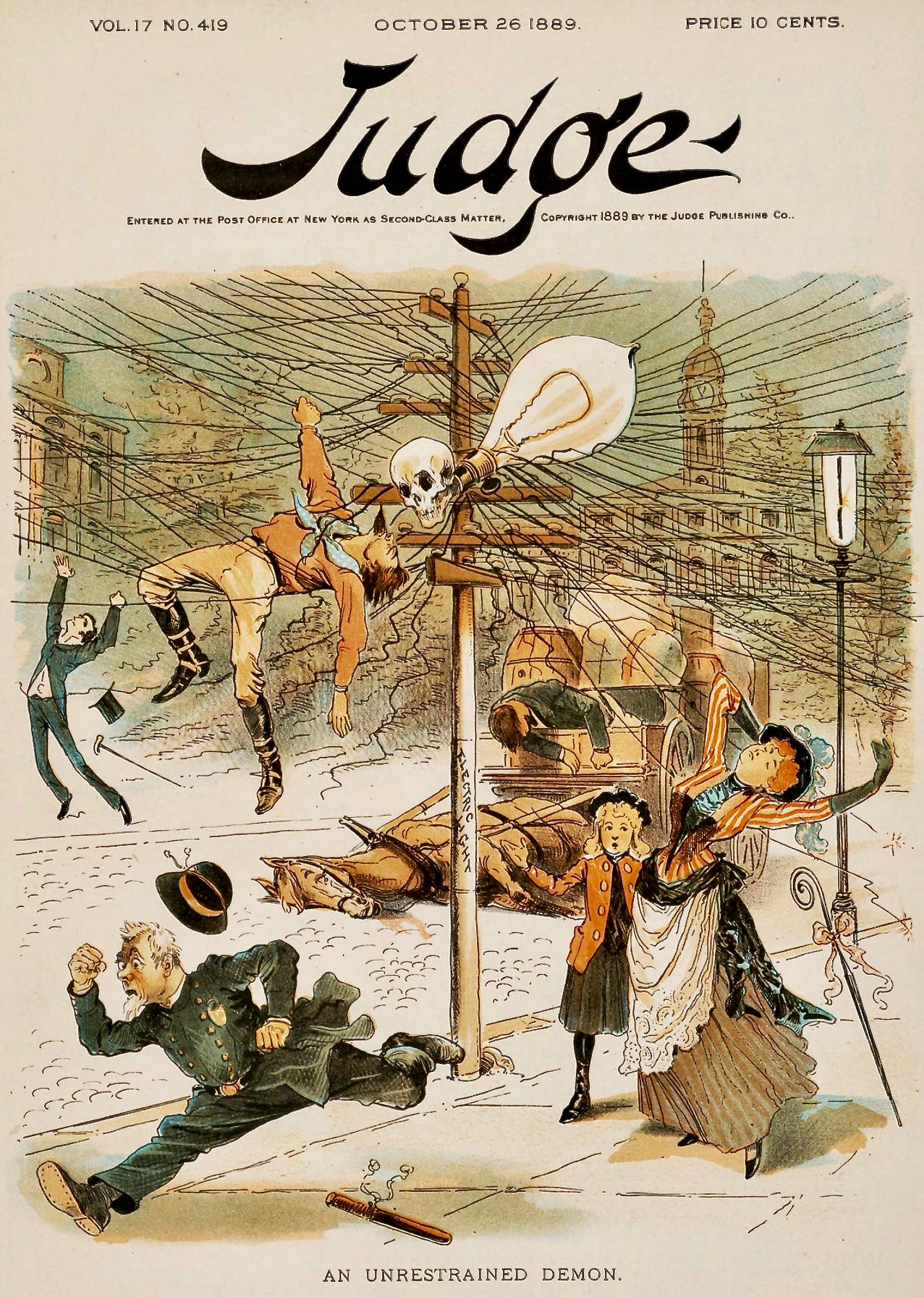
So tiring
Endymio
Posts: 5,605 +5,232
It's fallacious to believe that LLMs -- particular consumer-facing gp models -- are the entirety of the machine-learning marketspace. They're only a small slice of the generative AI sphere, and predictive AI is even larger than generative (though it doesn't get the same level of hype).I've been pretty unimpressed by LLMs in my field when I occasionally use them. The only field that has been significantly impacted is software dev on the security side. Customer service chatbots are another change, but I wouldn't call it important. Other than that what you wrote is just hype.
Last edited:

This argument of China as the evil force is tiring as well, to be honest. This is from a Stanford study. Notice how the general population sees AI vastly differently from the West? And we know how far ahead they are in China regarding AI and robotics. Why do you think that is? Because AI is used in very practical and beneficial ways for society. Ever seen Shenzhen? Robotaxis, drones delivering food, clean, everything electric. It's literally just the West that is in such a panic about AI.
It's weird how a "dictator country" is so positive in its population generally about AI, doesn't fit the narrative, right? AI is not the issue.
It's weird how a "dictator country" is so positive in its population generally about AI, doesn't fit the narrative, right? AI is not the issue.
Endymio
Posts: 5,605 +5,232
No, it was incredible ten years ago. At one point in my life, I taught multivariate regression to college students. While most could grasp single-variable regression easily enough and some two, when the topic verged into 3D hypersurfaces, eyes glazed over rapidly. Yet I regularly work with AI models performing regression on 10,000+ variables ... and these are tiny by modern standards.I don't have recent experience with predictive AI, but it was not incredible 10 years ago. Nice to read it caught your cancer. I expect there will be some use case breakouts, but I'm not hyped about it and don't expect much beyond specialized tools.
It's not an overstatement to say that predictive AI has revolutionized literally every scientific and technical field in existence, from cosmology to materials science to aerospace engineering to forensic accounting.
Similar threads

- Replies
- 34
- Views
- 396


- Replies
- 12
- Views
- 76


Latest posts
-
 Tesla says some Model Y owners could join its Robotaxi fleet around Q2 2027
- Plutoisaplanet replied
-
 Valve publicly mentions HLX, which might be Half-Life 3, for the first time
- Megalomaniac replied
-
Nintendo Switch 2 jailbreaking is here, with homebrew, modding, and reverse engineering
- The Talking Tech replied

-
TechSpot is dedicated to computer enthusiasts and power users.
Ask a question and give support.
Join the community here, it only takes a minute.