First look: Microsoft is sticking with smaller, incremental Windows 11 updates, and its next release will follow the same pattern. There's no major feature rollout tied to Windows 11 26H2. Like version 25H2, it will arrive as an enablement package that toggles changes already present in the OS. On PCs already running Windows 11 24H2 or 25H2, the upgrade should be a quick enablement download, a single reboot, and a few minutes of install time, with no obvious changes on the desktop.

This approach dates back to Windows 11 24H2, released in October 2024, which marked the last traditional feature update. Since then, Microsoft has kept new versions on the same underlying platform. In practice, 25H2 and now 26H2 mostly exist to extend support timelines rather than add new capabilities.
New features are no longer tied to these annual releases. Instead, Microsoft is delivering them through monthly cumulative updates, allowing changes to roll out continuously. Recent updates have added a Low Latency Profile, with support for a movable taskbar expected in an upcoming Patch Tuesday release.
As a result, the annual "feature update" now acts more like a maintenance marker than the main way new features arrive.
Microsoft has positioned this update model as a way to reduce disruption, particularly for enterprise environments where stability is critical. "The next annual update for Windows 11 is coming soon… continues our focus on delivering a predictable, low-disruption update experience for organizations and IT professionals," the company said in recent documentation.
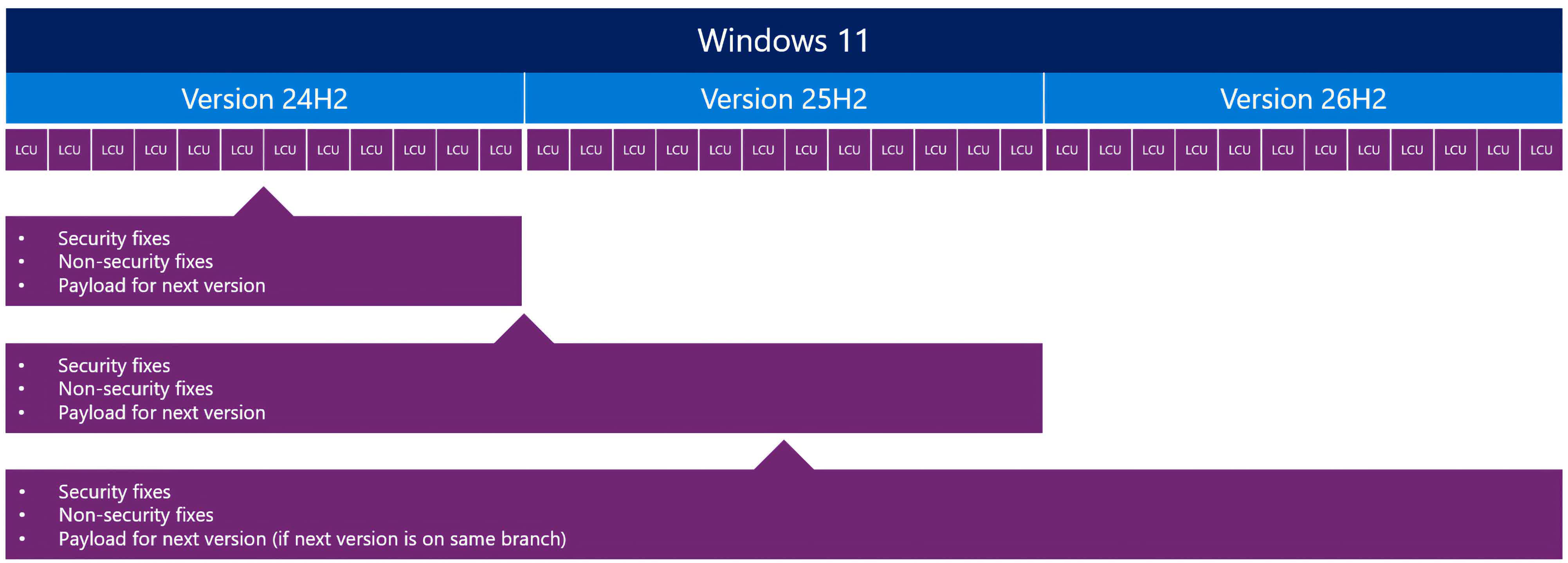
Enablement packages are small, often under 500KB, and work by activating dormant code already present in the OS. Because the platform itself doesn't change, installation is faster and tends to be less disruptive than a full upgrade.
That shift also changes what a version number represents. Moving from 24H2 to 26H2 doesn't bring a new feature set; it keeps the same codebase while advancing the support timeline for that installation.
For 26H2, support runs through October 2028 for Home, Pro, Pro EDU, and Pro for Workstations. Enterprise, Education, and IoT Enterprise versions will receive updates until October 2029, in line with Microsoft's standard lifecycle model.
Hardware requirements remain unchanged. Any system capable of running Windows 11 24H2 or 25H2, which requires at least 4GB of RAM, 64GB of storage, and a 64-bit dual-core processor, will support the new version.
A separate release, Windows 11 26H1, is tied to newer silicon platforms such as Nvidia N1 and Snapdragon X2. It's based on a different platform baseline and doesn't introduce exclusive user-facing features, so for most users, it isn't a meaningful upgrade.
The broader shift is that Windows is now evolving through steady, incremental updates rather than periodic overhauls. The most meaningful changes arrive through monthly patches, while annual releases serve primarily to maintain and extend the platform.
Microsoft hasn't said whether this model will continue beyond 2026, and didn't confirm if the same approach will apply to a future 27H2 release. For now, though, the company appears committed to a cadence built around smaller updates and more predictable deployment.
Windows 11 26H2 continues Microsoft's shift to smaller and faster updates


