Windows 11 catches up to Windows 10 just months before support deadline

Daniel Sims

Posts: 2,422   +73
Staff
Recap: Microsoft's efforts to convince Windows 10 users to upgrade to Windows 11 finally appear to be showing results. In June 2025, the newer OS saw a significant increase in user share, bringing it to near parity with Windows 10. Although Windows 10 reaches its end of life in three months, customers still have several options to delay or avoid switching to its successor.

According to StatCounter's June 2025 report, 47.8% of Windows users worldwide now use Windows 11, placing Microsoft's latest operating system just over one percentage point behind Windows 10, which stands at 48.8%. The difference is likely within the margin of error. Microsoft has recently intensified its efforts to encourage Windows 11 upgrades before support for Windows 10 ends on October 14.

Windows 11 took nearly three years to catch up to its predecessor, gaining adoption much more slowly than previous versions. Its strict system requirements played a significant role. Most CPUs manufactured before 2017 do not support the operating system, leaving an estimated 240 million PCs ineligible for the upgrade.

In addition, many users see little difference between the two versions. Our last benchmark from 2024 showed that most applications run identically on Windows 10 and 11.
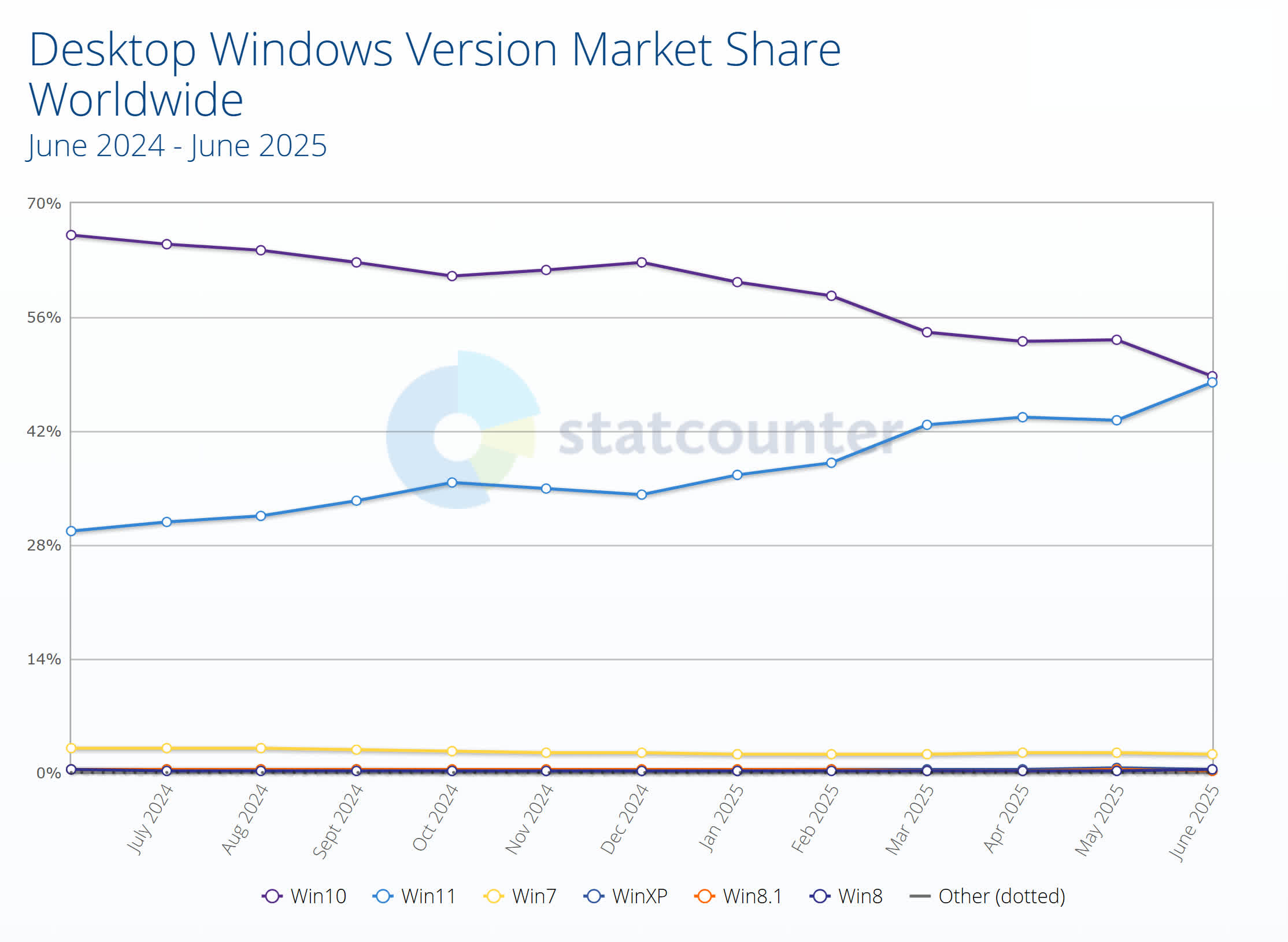
However, Windows 11 began gaining significant user share earlier this year. Both March and June saw increases of over four percentage points. Still, millions of Windows 10 devices may be left behind when support ends in October.

Those unable to upgrade can pay $30 for an additional year of security updates, receive them for free by enrolling in Windows Backup, obtain unofficial updates through 0patch, or convert their aging machines to Linux. A limited-time deal on our store allows compatible machines to upgrade to Windows 11 for just $10.

Meanwhile, Microsoft recently revised a statement about the growth of Windows' total user base, prompting discussion about the future of the PC market.

In 2022, the company reported that combined Windows 10 and 11 installations had grown from 1.3 to 1.4 billion since the previous year. However, a blog post published earlier this month stated only "over a billion," leading to speculation that Windows had lost around 400 million users.

Microsoft has now edited their blog that now reads "over 1.4 billion," suggesting that Windows has grown less over the past three years than it did between 2021 and 2022. Those years saw a surge in PC sales due to the pandemic, but the market has since stabilized. Windows also faces growing competition from Macs and mobile devices.

Permalink to story:

 
So I'm totally a SMIDGE biased, but I think people(especially those higher up on the tech ladder) are actually just tired of dealing with my M$ cycle of good/bad operating systems. It seems a couple times a year I a new version of Linux comes out that makes me want for even less, makes me use the command line even less. I think we've reached a point where people are willing to put in the effort to learn something like Linux, especially with things like Proton support for Valve. Unless Windows 12 ends up being Windows 7.2, I don't think people are legitimately making the switch. It's now more effort to debloat W11 than it is to just get things to work to work on Linux.
 
The number of home consumers running Microsoft Windows now is inversely proportionate to the number of games supported by Proton.
 
Considering your "typical home user" is just browsing the web, social media and what not, they could probably use Linux instead of bloated windows.
I use both because I have several programs that REQUIRE windows. I use a VM for Linux on my PC.
 
As soon as a bunch of online games stop supporting W10 and require TPM, secure boot, VBS etc enabled, many people will likely force themselves over to W11 one way or the other.

Higher performance on the previous OS is worthless if you can't play the games on it.
 
Considering your "typical home user" is just browsing the web, social media and what not, they could probably use Linux instead of bloated windows.
I use both because I have several programs that REQUIRE windows. I use a VM for Linux on my PC.
I'm in the same situation as you, I run Win 10 LTSC and Linux in several VM's. I do all of my browsing in Mint and experiment with various Linux for fun. Waiting for the general release of Steam OS to try that and see how it goes.
 
So I'm totally a SMIDGE biased, but I think people(especially those higher up on the tech ladder) are actually just tired of dealing with my M$ cycle of good/bad operating systems. It seems a couple times a year I a new version of Linux comes out that makes me want for even less, makes me use the command line even less. I think we've reached a point where people are willing to put in the effort to learn something like Linux, especially with things like Proton support for Valve. Unless Windows 12 ends up being Windows 7.2, I don't think people are legitimately making the switch. It's now more effort to debloat W11 than it is to just get things to work to work on Linux.

A f*cked-up reactivation after a MB upgrade made me finally jump ship to Linux Mint on my main system. It proved a bumpy start - not for novice users - but now that things have settled, it's mainly smooth sailing. Two other systems in our household are also running Linux now (1 for productivity; 1 for testing purposes). And I curse the obligatory W11 on my laptop every day due to small annoyances and bigger faults. Many of which could be easily corrected if MS would truly take users into account.
 
Considering your "typical home user" is just browsing the web, social media and what not, they could probably use Linux instead of bloated windows.
I use both because I have several programs that REQUIRE windows. I use a VM for Linux on my PC.

Once fully configured, yes. And as long as users don't want to install "tools" themselves.

But hardware compatibility (especially Wifi and printers) and installing the right alternatives still make initial setup not straightforward. (The same can be said regarding Windows, but there things happen in a more 'clickable' way.)
 
But hardware compatibility (especially Wifi and printers) and installing the right alternatives still make initial setup not straightforward. (The same can be said regarding Windows, but there things happen in a more 'clickable' way.)

WiFi I get. Always been a bit of a sore point due to the manufacturers involved there, but printers? I've always had far far less issues with printers under Linux. Although as with all hardware with Linux I've always stuck to the golden rule of not trying anything that's just been released. Got to give 'the community' a little extra time to get things working.
 
So I'm totally a SMIDGE biased, but I think people(especially those higher up on the tech ladder) are actually just tired of dealing with my M$ cycle of good/bad operating systems. It seems a couple times a year I a new version of Linux comes out that makes me want for even less, makes me use the command line even less. I think we've reached a point where people are willing to put in the effort to learn something like Linux, especially with things like Proton support for Valve. Unless Windows 12 ends up being Windows 7.2, I don't think people are legitimately making the switch. It's now more effort to debloat W11 than it is to just get things to work to work on Linux.

Win7? lol what a crap OS. people loved it just 'cause it came after Vista - and I never had any issue with it, using since pre beta.
 
WiFi I get. Always been a bit of a sore point due to the manufacturers involved there, but printers? I've always had far far less issues with printers under Linux. Although as with all hardware with Linux I've always stuck to the golden rule of not trying anything that's just been released. Got to give 'the community' a little extra time to get things working.

Regarding the community: the Linux Mint Forums are also a great help to get unstuck.
 
"many users see little difference between the two" - not sure if you got carried away with Ctrl-C /Ctrl-V there, but it also depends on what you're measuring - it's not just speed.
 
For a very long time there is a debate between Windows and Linux like which is the best to use as your primary working computer.

Linux used to be always behind against the "innovating" Microsoft ... well I believe this is a myth.

The main reason that Microsoft Windows is still the primary operating system is because his support from the big software companies that businesses are hostages, even Today.

I came to the conclusion that the usefull applications are the key of a succesfull software platform. The open-source movement showed it is possible.

If Google was not that egocentric, aggresive and dominant against the other mobile OSes, and it was more open like it was in the beginning it could beat Windows instantly on the computer industry.

The future is not going to be different, as Microsoft moves to the cloud computing and cloud services users get drown by it.

There is no escape as the big software companies remain royal to Microsoft, and the industries get sucked with them.


So, you may stay whining all day, but your workplace will remain on Microsoft products until the end of time, period.
 
Microsoft would deny the fact that the Sun rises every day if it fit their Marketing purposes. I bet they have lost more Windows users than they are willing to admit.
 
... I came to the conclusion that the usefull applications are the key of a succesfull software platform.
...
So, you may stay whining all day, but your workplace will remain on Microsoft products until the end of time, period.

Microsoft offers unbeatable packages to companies.
They make sure that they have everything in their portfolio that companies want - often by buying an independent vendor -, and offer it in package deals.
Even if competing software is vastly superior, companies decide for MS because the price increase for their MS package with the MS equivalent included comes lower than buying a license for the standalone software of another vendor.
Very seldom, management is knowledgeable or open to qualitative differences between the options. They want to tick the box at the lowest possible cost. And MS marketing makes them think that the MS offering is solid, anyway. And unless they have a too large gap to bridge, MS is reluctant (and slow anyway) to really make the new addendum to their portfolio shine.

Even with an OS + Office suite + some extra tools you cannot offer the same as MS in terms of quantity (available solutions), price and the perceived ease that doing business with only one party brings (SPOC, invoicing...).
 
Simply put, I find the whole issue of OSs highly depressing.

Thanks a bunch MS.
 
Back