Windows 95 developers didn't have enough time to give the OS its own setup program

Alfonso Maruccia

Posts: 2,515   +935
Staff
Retro Potato: Raymond Chen is once again sharing an intriguing behind-the-scenes story about the making of Windows 95. It turns out that building the setup process for the consumer-oriented operating system was far more complex than initially expected.
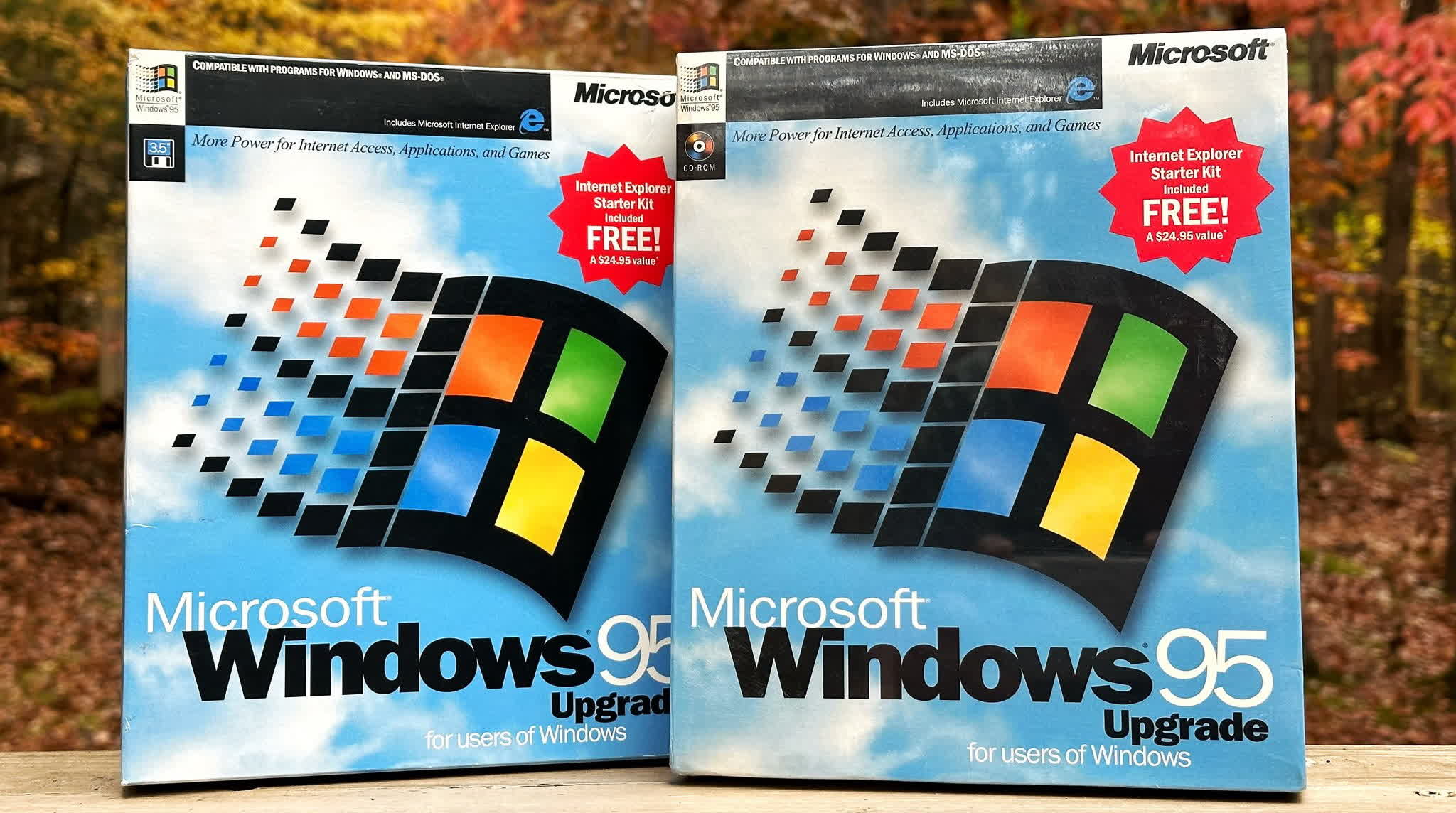
Raymond Chen, a Microsoft veteran who has worked on Windows development for more than 30 years, recently explained that the Windows 95 setup caused developers more than just a headache. The final installation process was a hybrid of three different operating systems, because relying solely on the brand-new Win32 technology would have been too cumbersome for consumers.

A few months ago, Chen described how the first stage of the Windows 95 setup was a DOS program designed to install a "miniature" version of Windows 3.1, which then managed the next step. The second stage was a proper 16-bit Windows program that handled most of the setup work. This 16-bit code served as the starting point for users installing Windows 95 from within the Windows 3.1 environment, or even from an existing Windows 95 instance.

"Some people wondered if the MS-DOS and Windows 3.1 versions could install a miniature Windows 95 rather than a miniature Windows 3.1. That would allow the bulk of the work to be done in a fully 32-bit operating system and take advantage of new Windows 95 features," Chen said in his latest post.
The miniature Windows 95 solution was technically feasible but difficult to implement. First, developers would have needed to create a shrunken down version of Windows 95 solely for the setup process. The Windows 95 project was already notoriously behind schedule, Chen noted, meaning the new idea would have been "instantly" rejected by management.

Additionally, Microsoft already had a fully debugged and supported miniature version of Windows 3.1 that could be adapted to manage the new OS installation. Creating a stripped-down version of Windows 95 to just start the Win95 environment would have been theoretically possible as modders have previously demonstrated by reducing the OS to just a few megabytes.

The "Mini.cab" archive included with the Windows 95 setup disk is 441,905 bytes and unpacks to 815,307 bytes. Chen estimates that a miniature Win95 could fit on just two floppy disks, which would have been manageable despite the added complexity and code duplication.

However, the final user experience would have suffered. Using a mini-Win9x setup would have required at least two system reboots, violating the team's "only one reboot" principle. Ultimately, relying on the miniature Windows 3.1 provided the best solution to the problem.

Permalink to story:

 
I feel that this story comes out of context… kind of reads like chapter 8 of a 20 chapter novel… might there be links to the previous and future chapters?
 
I feel that this story comes out of context… kind of reads like chapter 8 of a 20 chapter novel… might there be links to the previous and future chapters?
I suppose it would be neat for TechSpot to run a series on the development of various bits of technology. In this case it links to a Microsoft Blog, so unless there's a series of Blogs on this topic over there, there'd be nothing for Techspot to link to here (unless it had its own series already going). But that would of course mean Techspot would have researched and had enough material to write the series from the start, this particular blog is recent.
 
I suppose it would be neat for TechSpot to run a series on the development of various bits of technology. In this case it links to a Microsoft Blog, so unless there's a series of Blogs on this topic over there, there'd be nothing for Techspot to link to here (unless it had its own series already going). But that would of course mean Techspot would have researched and had enough material to write the series from the start, this particular blog is recent.
I seem to recall reading a previous article awhile back on here about the history of Win95… was wondering if I remembered accurately…
 
This is the sole reason I cannot recommend Windows 95 for production use in 2025. You should be running at least Windows 98 SE for the best desktop experience and the smoothest deployments.
 
This is the sole reason I cannot recommend Windows 95 for production use in 2025. You should be running at least Windows 98 SE for the best desktop experience and the smoothest deployments.
A very taxing recommendation indeed, I usually go for Windows 3.1.
 
I remember the Windows 95 setup well. While the OS had its problems, overall it was a fantastic work and MS steadily improved it up to about Windows 7. That was the peak for me, and they should have left it largely alone in terms of scope of features and general operation of the GUI. Everything after that has detracted from a once great OS.
 
I feel that this story comes out of context… kind of reads like chapter 8 of a 20 chapter novel… might there be links to the previous and future chapters?
Just search "Raymond Chen" in the search box.

In any case, not much of a context, just an MS veteran sharing random tidbits every now and then.
 
You don't happen to have a config.sys configuration that frees enough memory to run CODBO7.EXE
LOL, I use to be able to write my own config.sys & autoexec.bat file from memory..
Today? About all I remember is DOS=HIGH,UMB
 
Back