Topaz Photo AI supercharges your image quality so you can focus on the creative part of photography.
Topaz Photo AI is auto-pilot for your image quality needs. Import an image to Topaz Photo AI and it will use specially trained AI models to first detect the unique problems in detail, clarity, and resolution before intelligently applying adjustments that will maximize your image quality. This software by the team at Topaz Labs is created to be an all-in-one solution to enhance your images using the power of machine-learning AI technology.
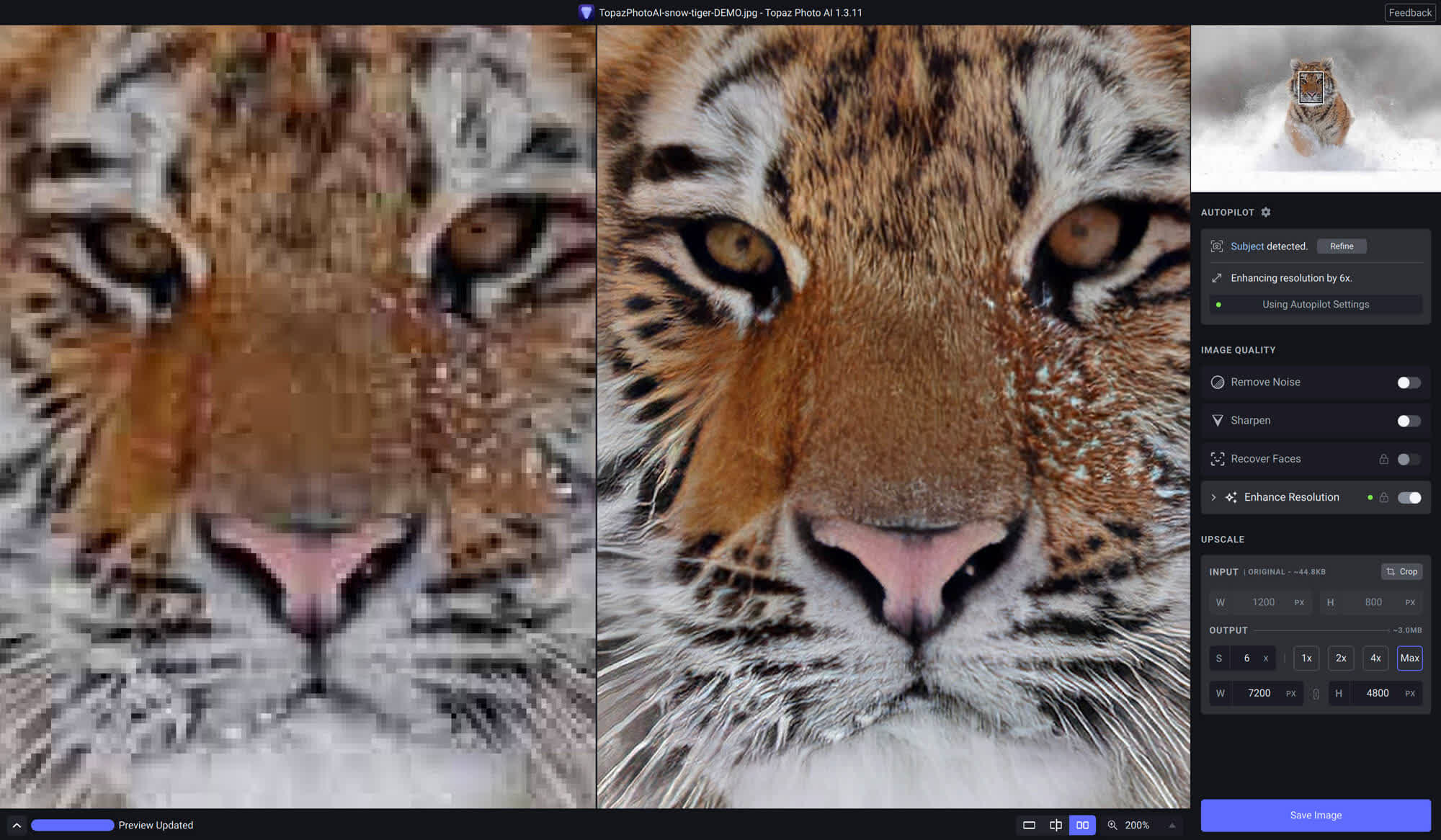
For users experienced with Topaz Labs image quality applications, it combines the functionality of DeNoise AI, Sharpen AI, and Gigapixel AI into one application with an intelligent auto setting that can pick adjustments with strengths for you.
Note: You can download Topaz Photo AI from here and run the installer. When you open Topaz Photo AI, you will be prompted to activate the application, purchase it, or to use the demo mode. Click the demo mode to use the trial. The trial lets you use all the features of the application with the exception of saving/exporting a file. All features and plugins are included when you install. Make sure to take a look at the Topaz Photo AI Quick Start Guide to learn the basics of using this application.
System Requirements
Windows
- Windows 11 - most updated version
- Intel OR AMD Processor CPU, with AVX instructions, released after 2020
- 24GB RAM
- Nvidia RTX series - 8GB VRAM or more
- AMD 5000 series - 8GB VRAM or more
- Intel ARC - 8GB VRAM or more
- 37GB+ of disk space
Mac
- macOS 15
- Apple M-series (Pro, Max, or Ultra)
- 24GB of Memory RAM
- 20GB of Disk Space
What's New
Neuroserver Speed Improvements for Mac and Windows
In this release are many improvements to NeuroServer which speeds up both Mac and Windows processing in different ways. Overall, NeuroServer runs efficiently compared to previous versions, which benefits all NeuroServer-based models: Wonder 2, Wonder 3, Super Focus v3, Denoise Max, and Recover Faces 3.
Mac
On Mac, two things changed. First, NeuroServer initialization and model loading are significantly faster. The first run after installing should start up noticeably quicker, and subsequent runs load faster too. Second, processing now uses both the GPU and Neural Engine together. Combined, Mac processing is 2x faster across all NeuroServer models.
Windows
On GPUs that meet the minimum VRAM requirements (8GB and 12GB cards) NeuroServer was running inefficently due to memory usage. We have reduced requirements to allow faster image processing on these devices which were bottlenecked by memory. For 8GB and 12GB VRAM GPUs, the speed improvement is up to 4x.
in our testing with an NVIDIA 4060 Laptop GPU with 8GB VRAM, we upscaled a 24MP image to 96MP (2x upscale) with the following results. Note that devices with more GPU have lower improvement due to no memory bottleneck in processing.
- 1982s (33m) processing time on v1.6.0
- 450s (7.5m) processing time on v1.6.1, a 4x increase
If you've been avoiding these models for larger images or batches because of processing time, this update changes that calculation.
Changelog
- Add color correction to High Fidelity 3 to prevent color shift
- Limit output to 192MP for Wonder 2 and Wonder 3 local render due to NeuroServer limitations
- Remove unnecesary warning when using Wonder with Raw files
- Block NeuroServer local processing for devices below minimum GPU requirements
- Block Face Recovery 3 when generative AI is disabled in settings
- Fix selection appearing for Dust & Scratch 2, the model does not use selection
- Fix resolution settings not applying properly from upscale menu
- Fix RAW denoise not adding in batch processing when images are not loaded and analyzed
- Fix filmstrip tooltip information
- Fix Denoise MAX having no way to reprocess and change strength
- Fix processing deselected faces in Recover Faces when another enhancement is added
- Fix face recovery default sometimes selecting 0 faces
- Fix enterprise seat claiming
- Fix window controls on top left not centered on Mac