WinRAR is a powerful archive manager. It can backup your data, reduce the size of email attachments, open and unpack RAR, ZIP as well as create new archives in these and other popular file formats. By consistently creating smaller archives, WinRAR is often faster than the competition.
Is WinRAR free?
WinRAR offers a free trial period (usually 40 days), but the app continues to work with full functionality even after the trial expires, though it will remind you to purchase a license. A single WinRAR license costs $29, which will remove any pop-up messages.
Is WinRAR available for macOS?
WinRAR developers do offer a macOS version they call RAR for macOS, however it's only a command-line only application. macOS supports native zip compression, for RAR compression support and a fully featured GUI we recommend The Unarchiver or Keka.
How do I create a password-protected file?
When creating a new archive, click "Set password…" in the archive options and enter your desired password. This will encrypt and protect any files contained within the RAR with a password.
How can I fix a "corrupt archive" error?
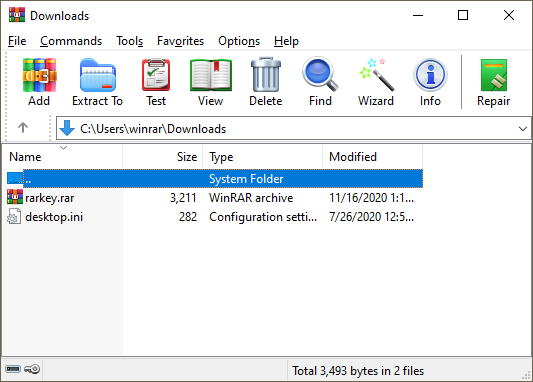
Try using WinRAR's built-in "Repair Archive" tool: Open WinRAR, select the file, and click the "Repair" button in the toolbar.
Features
- WinRAR supports all popular compression formats (RAR, ZIP, CAB, ARJ, LZH, ACE, TAR, GZip, UUE, ISO, BZIP2, Z and 7-Zip).
- WinRAR is ideal for multimedia files. WinRAR automatically recognizes and selects the best compression method. The special compression algorithm compresses multimedia files, executables and object libraries particularly well.
- WinRAR allows you to split archives into separate volumes easily, making it possible to save them on several disks for example.
- WinRAR is also ideal, if you are sending data through the web. Its 128 bit password encryption and its authenticated signature technology will give you the peace of mind you have been looking for.
- WinRAR is shareware, meaning you have the chance to thoroughly test it. The program can be used absolutely free of charge for 40 days.
What's New
- Heap overflow vulnerability is fixed in RAR5 recovery volume data reconstruction code. It affects WinRAR, RAR and UnRAR. UnRAR.dll library doesn't include recovery volume processing, so it is not affected.
- We are thankful to Arjun Basnet from Securin Labs for letting us know about this security issue.
- Symbolic link pointing outside of destination folder could be created even without -ola switch, when extracting a specially crafted RAR archive by WinRAR, RAR, UnRAR or UnRAR.dll library.
- Further check in extraction code prevents placing files to such folder even in case of multiple extraction commands, excluding the possibility of path traversal attack for WinRAR, RAR or UnRAR based extraction. It limits the potential threat to a case where another tool uses this symbolic link to store files.
- We are thankful to scofaild23-bnomran for letting us know about this security issue.
- 7zxa.dll 7z extraction library is updated to version 26.02 to include bug and vulnerability fixes by the library developer.
- Switch -iver prints RAR version even if -idc is specified in the command line, configuration file or RARINISWITCHES environment variable. Previously -idc blocked -iver action.
- Also a new line character is added to -iver output.
Previous Release Notes:
WinRAR properly recognizes archives with a wrong file extension, containing an archive in another format stored without compression. For example, if host.rar, storing nested.zip inside, was renamed to host.zip, WinRAR 7.20 could display nested.zip contents when opening such host.zip. This version displays host.zip contents.
Similarly to Windows Explorer, the first click on size and time columns in WinRAR file list sets the reverse sort mode with largest and latest files at the top.
Switch -s=e performs the case insensitive file extension comparison in Windows. Unlike previous versions, solid statistics isn't reset anymore for file extensions differing only by case.
If self-extracting archive attempts to extract files to a folder requring administrator rights and elevation prompt is cancelled by user, the archive quits silently instead of issuing the folder access error.
Bugs fixed
- WinRAR 7.20 could produce a broken archive when deleting files from solid archives in old RAR4 format. As a result of this fix, deleting files in solid RAR4 archives now involves the full archive repacking, similar to WinRAR versions preceding 7.20. It doesn't affect archives in the modern RAR5 format
- With a rare combination of source data type and compression parameters, WinRAR 7.x could crash when compressing source data. Such crash was more likely when processing large amount of poorly compressible data
- WinRAR 7.20 couldn't unpack ZIP archives containing file comment fields; d) switch -tl didn't set the latest time when used with RAR 7.20 "ch" command
- Extraction command didn't automatically replace device names like "aux", when unpacking archives containing such reserved names
- If folder shortcut was double clicked in "Save WinRAR settings as" dialog when exporting WinRAR settings, folder shortcut itself was overwritten with settings data instead of opening a target folder.
Performance improvements when deleting files in solid RAR archives:
- if there are no non-zero files after deleted files, archive recompressing isn't performed
- part of archive before deleted files is copied as is, without repacking. Its contents is unpacked to memory if necessary, but not recompressed
- semi-solid archive processing involves only solid blocks containing deleted files. Unaffected solid blocks are copied as is.
"Generate archive name by mask" archiving option and -ag command line switch:
- new 'K' format character defines the current day of week name as a text string
- new 'O' format character defines the current month name as a text string regardless of format character number. Unlike "MMM" mask, it allows to use shorter or longer than 3 character names, such as -agOO
- excessive format characters exceeding the available field width are now ignored instead of appending to archive name. So it is possible to use full month or week day names by providing format characters in the amount equal or exceeding the longest name, such as -agKKKKKKKKKK for day of week names.
Command line -s switch:
- switch -s accepts the optional parameter preceded by '=' character. Switches -s, -se, -sv, -sv-, -s- are replaced by -s=f, -s=e, -s=v, -s=d, -s=-. Previous versions of these switches are still supported in the current version, but can be removed in the future. It is allowed to combine multiple modifiers in the same switch, such as -s=e100f.
- new switch -s=r resets the solid statistics before adding new files to existing archive.
Switch -tk now accepts the optional date parameter in YYYYMMDDHHMMSS format. If used without parameter when modifying an archive, it preserves the original archive time. If optional parameter is present, it is assigned to archive modification time. It is allowed to insert separators like '-' or ':' to the date string and omit trailing fields. For example, switch -tk2025-06-01 is correct.
"Specified time" is added to "Set archive time to" options on "Time" page of archiving dialog. It allows to assign the manually entered time to newly created or modified archives.
UTF-8 output format and byte order mark options are added to "Generate report" command.
"Cloud files" option is added to "Where to check for SFX archives" group in "Settings/Integration/Context menu items..." dialog. If this option is off, WinRAR shell extension will not attempt to detect if archive is self-extracting, when right clicking an executable cloud file not available locally. This detection involves data read and can be slow for such files. This option relies on file attributes returned by a cloud storage provider and can be ignored if required attribute isn't supported by specific cloud service.
"Copy to clipboard" button at the bottom of "Search results" dialog places current results of "Find files" command to clipboard.
It takes less time to open a large archive with a lot of files and folders in WinRAR file list. This is most noticeable for ZIP archives containing millions of files.
Improved extraction speed of TAR and TAR based archives, such as .tar.gz or tar.xz. It is most visible for hard disk drives with slower seek time and large archives containing a lot of files.
SFX module sets sfxnamenoext environment variable, containing SFX archive name without path and extension. It allows to append the archive name to user defined destination path like: Path=c:\Util\%sfxnamenoext%"
"minsize" parameter, defining the minimum file reference size in -oi[0-4][:] switch, now can include an optional trailing unit size character. So -oi:1m is the equivalent of -oi:1048576.
Switch -x recognizes exclude paths with both Windows and Unix style path separators, so -xfolder\file and -xfolder/file do the same. Previously only -xfolder\file excluded the file.
Bugs fixed
- "Files to exclude" field of archiving dialog was ignored for all but first ZIP archives if "Put each file to separate archive" option was turned on
- when processing "Convert archives" command, "Use for all archives" option in the password prompt was available only for encrypted archives with file name encryption and couldn't be enabled when converting archives without encrypted file names.
Previous release notes
Another directory traversal vulnerability, differing from that in WinRAR 7.12, has been fixed. When extracting a file, previous versions of WinRAR, Windows versions of RAR, UnRAR, portable UnRAR source code and UnRAR.dll can be tricked into using a path, defined in a specially crafted archive, instead of user specified path. Unix versions of RAR, UnRAR, portable UnRAR source code and UnRAR library, also as RAR for Android, are not affected. We are thankful to Anton Cherepanov, Peter Kosinar, and Peter Strycek from ESET for letting us know about this security issue.
Bugs fixed
- WinRAR 7.12 "Import settings from file" command failed to restore settings, saved by WinRAR versions preceding 7.12
- WinRAR 7.12 set a larger than specified recovery size for compression profiles, created by WinRAR 5.21 and older.
WinRAR 7.12 Changelog
- When extracting a file, previous versions of WinRAR, Windows versions of RAR, UnRAR, portable UnRAR source code and UnRAR.dll can be tricked into using a path, defined in a specially crafted archive, instead of user specified path.
- Unix versions of RAR, UnRAR, portable UnRAR source code and UnRAR library, also as RAR for Android, are not affected.
- We are thankful to whs3-detonator working with Trend Micro Zero Day Initiative for letting us know about this security issue.
- Previously "Generate report" command included archived file names into HTML report as is, allowing to inject potentially unsafe HTML tags into the report. To prevent such injection the current version replaces < and > file name characters in HTML report with < and > strings.
- We are thankful to Marcin Bobryk (github.com/MarcinB44) for bringing this security issue to our attention.
- If "Test archived files" and "recovery volumes" archiving options are used together, recovery volumes are also tested. Previous versions completed the test before creating recovery volumes, so they hadn't been verified.
- Nanosecond file time precision is preserved for Unix file records when modifying RAR archive in Windows. Previously it was converted to Windows 100 nanosecond precision.