
In context: While generative AI has quickly gained traction in drafting marketing copy and customer service responses, replacing complex, billion-dollar enterprise software remains a much bigger challenge. Analysts and executives agree that core business software continues to play a central role, even as AI enables new forms of innovation.
Leading software companies, including Workday and Salesforce, are racing to add AI features to their offerings, focusing primarily on agent tools – AI-powered chatbots that perform business functions for end users. The Wall Street Journal reports RBC analysts believe that while most SaaS providers offer some form of agent-based automation, the greater value will come from "multi-agentic" systems that coordinate tasks across multiple software platforms, a technical hurdle that remains unresolved.
According to RBC, a sales manager could onboard an employee by describing tasks in natural language, triggering automated actions across onboarding, identity management, expenses, and training workflows. Yet analysts like Brent Thill of Jefferies remain skeptical, citing the "meaningful complexity" of enterprise software environments and arguing that AI faces substantial obstacles to completely replacing human intervention.
Global spending on enterprise software is set to top $1.2 trillion this year, a nine-percent increase from last year's $1.1 trillion, according to Gartner forecasts. The sector's scale and momentum make it the largest single category in corporate technology budgets.
Amid this growth, artificial intelligence is raising new questions about the industry's future. Tools such as ChatGPT can generate basic applications in minutes, prompting speculation that AI could eventually streamline – or even replace – commercially available, pre-built software packages.
During a live demonstration earlier this month, OpenAI unveiled its GPT-5 model, showing how a team could quickly assemble an educational app using simple natural language prompts. OpenAI Chief Executive Sam Altman called "software on demand" the signature feature of the GPT-5 era, envisioning a future where non-programmers can create digital tools spontaneously, without traditional coding skills.
Such ambition is not unique to OpenAI. Nvidia CEO Jensen Huang predicted as early as 2017 that "AI is going to eat software," a phrase that has gained traction in industry discussions. However, this possibility remains theoretical at this point.
Economic uncertainty is also affecting enterprise technology budgets. A recent Gartner analysis noted that many organizations are holding off on new technology investments as they navigate trade tensions, ongoing military conflicts, and inflation risks. At the same time, companies are allocating increasing resources to build AI infrastructure, sometimes at the expense of other software categories.
This climate has put pressure on software stocks. Wall Street analysts, using data from AlphaSense to track quarterly calls and industry events, have noted a surge in questions about potential AI disruption. The BVP Nasdaq Emerging Cloud Index, which follows software-as-a-service companies, has fallen nearly six percent over the past month and is the only major technology subsector showing negative returns for the year.
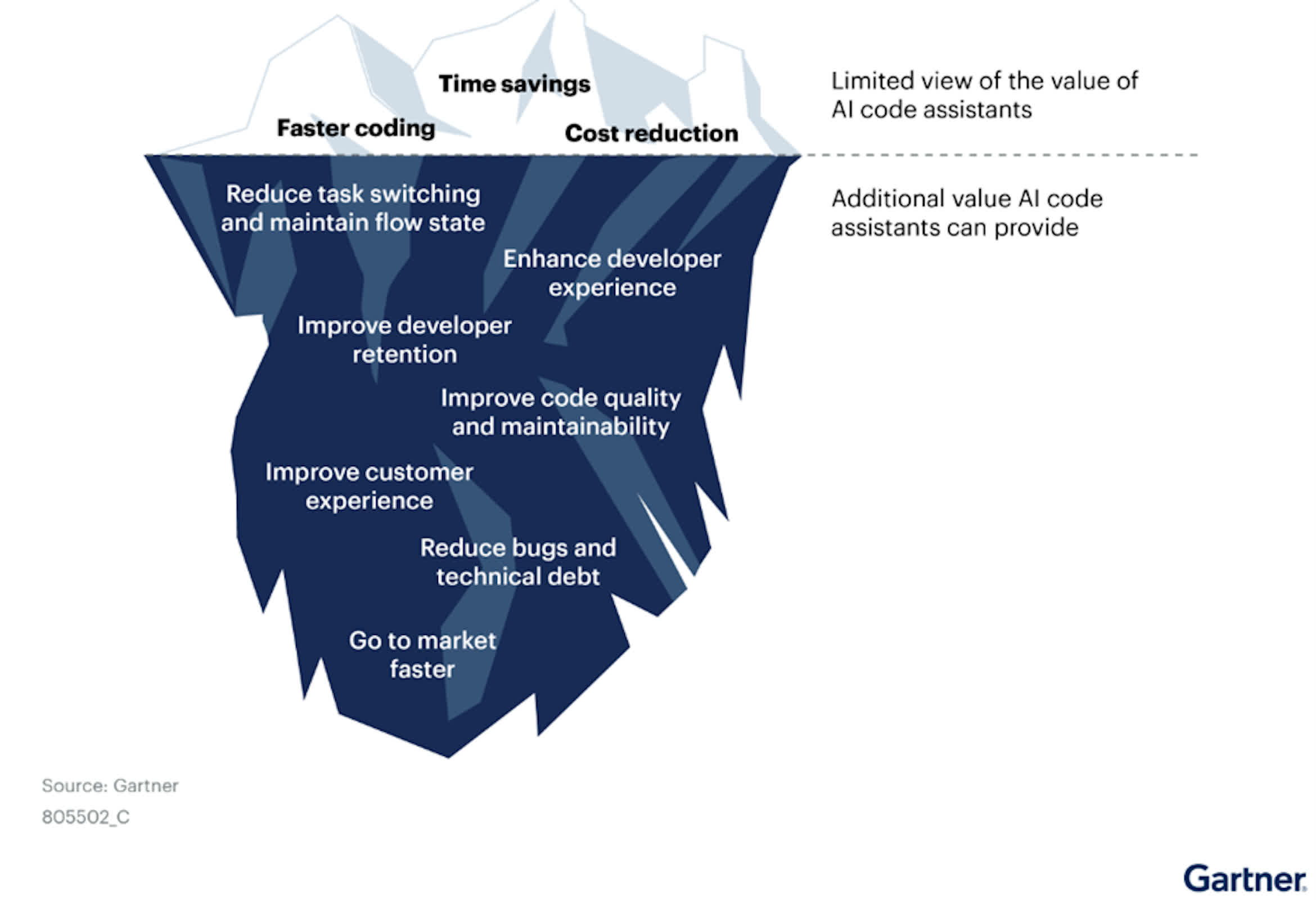
For some, the promise of AI-enabled code generation has already arrived. JPMorgan Chase CFO Jeremy Barnum told analysts in May that he had experimented with such tools and found the experience "pretty amazing." Gartner projects that by 2028, 75 percent of enterprise software engineers will use AI code assistants, up sharply from fewer than 10 percent in early 2023. A third-quarter 2023 survey found that 63 percent of organizations are now piloting, deploying, or have already implemented AI code assistants.
Still, replacing complex, business-critical applications remains a daunting challenge. Systems handling sensitive financial and human resources data, subject to strict regulatory controls, demand more than a clever chatbot interface. Carl Eschenbach, CEO of Workday – used by more than 65 percent of the Fortune 500 – dismissed the idea that AI rivals could quickly displace established enterprise solutions.
"Not one of them is going to say 'Come in here, AI startup, and run my back office and financial controls,'" Eschenbach told The Wall Street Journal.
Complications extend beyond technical barriers. The rollout of significant AI products has been uneven. OpenAI's GPT-5 launch, for example, faced widespread criticism for generating inaccurate chatbot responses, even though executives described the model as providing expertise equivalent to having a team of Ph.D.-level specialists at your disposal.