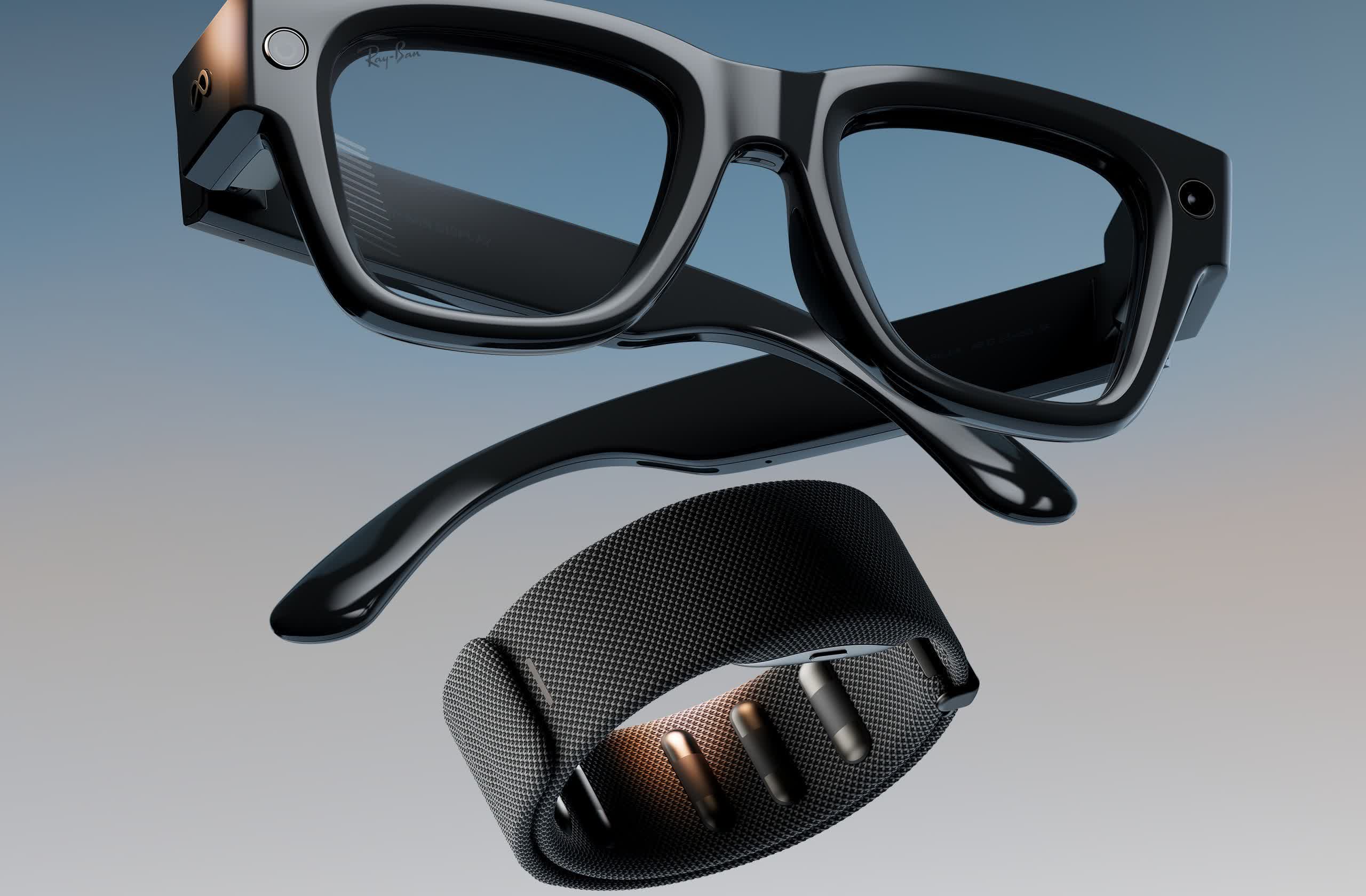
Through the looking glass: Users have so far interacted with Meta's smart glasses mainly through cameras, speakers, and touchpads. The company's new flagship model shifts several functions from smartphones to an augmented reality display, while a neural band introduces gesture-based controls. Meta has also updated its standard Ray-Ban glasses and launched a premium Sport model.
Meta introduced what it calls a new category of smart glasses at its 2025 Connect event on Wednesday. The flagship device is the first in its lineup to integrate a display, enabling augmented reality features, while an accompanying wristband translates muscle activity into gesture-based controls.
The company positioned the Ray-Ban Display glasses as a way to handle quick interactions with apps without needing to check a smartphone or smartwatch, reducing distractions.
A full-color microdisplay embedded in the right lens delivers a 600 × 600 resolution image at up to 90Hz, supporting messaging, music apps, turn-by-turn pedestrian navigation, an AI chatbot interface, and video calls. Additional features include a camera viewfinder overlay, Instagram integration, and real-time conversation captions.
Auto-brightness management keeps the interface visible in different lighting conditions, while controls fade in and out as needed. Meta's electromyographic wristband allows users to control apps with simple gestures such as a pinch, wrist flick, or clenched fist.

The integrated camera now includes a viewfinder and 3x digital zoom. The microphone array has been upgraded with a sixth mic, and the touchpad has been expanded from a two-way to a four-way design.
However, the Ray-Ban Display does make some compromises compared to the other two models announced this week. The AR glasses record video only in 1080p at 30 frames per second rather than 3K, and they lack 12-megapixel photo capture, according to Meta's comparison page.
Sometimes, the demo just doesn't work. At Meta Connect, Mark Zuckerberg's showcase for how AI can help a chef put together a BBQ sauce came to an awkward end. pic.twitter.com/RmkRKXUyoa
– TechCrunch (@TechCrunch) September 18, 2025
The 960-megawatt-hour battery provides up to six hours of mixed usage, while the charging case adds another 24 hours, and the wristband lasts up to 18 hours. The glasses are equipped with 32GB of internal flash storage and 2GB of LPDDR4x RAM.
Available in black or sand with clear-to-grey transitions, the Ray-Ban Display AR glasses support prescription ranges from – 4.00 to +4.00 total power. Pre-orders are currently limited to in-store purchases.

Meanwhile, the second-generation Ray-Ban Meta glasses, priced at $379, are already available. They closely resemble the HSTN model introduced in June but add 3K video recording, three frame styles, and an eight-hour battery life.
Rounding out the lineup, the new Oakley Meta Vanguard AI glasses feature a more rugged design and extended battery life tailored for athletic use.