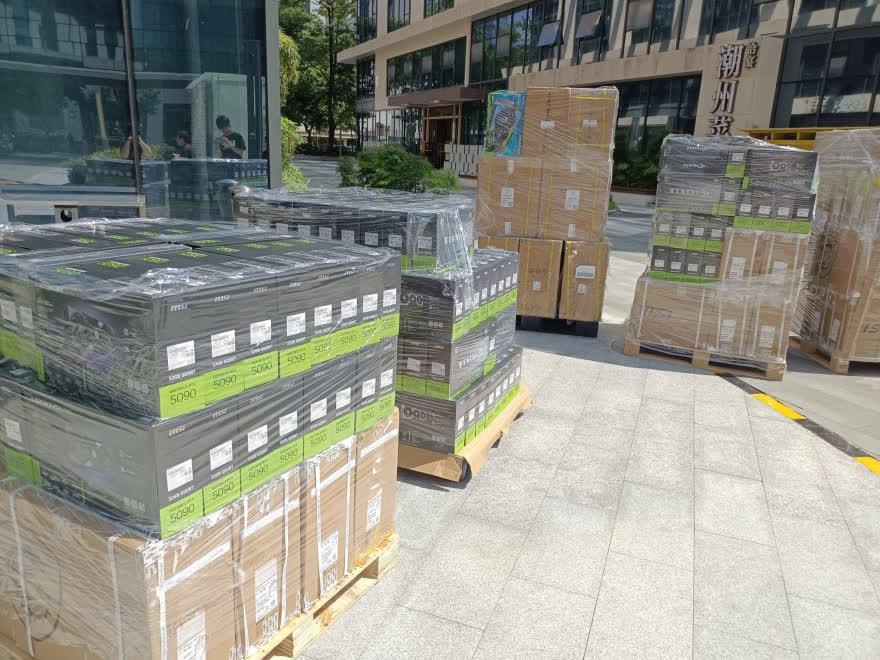
In context: MSI has put out a statement in response to an image showing hundreds of its RTX 5090 cards on pallets in China. The card is subject to US export controls on certain high-end GPUs destined for China, but MSI said the ones in the photo are parallel imports – i.e., bought and imported from another country, thereby circumventing the official distribution network.
A photo recently posted on Chinese social media appears to show several pallets somewhere in China holding dozens of MSI-branded RTX 5090 boxes.
What's caught people's attention is that the cards aren't the cut-down RTX 5090 D or RTX 5090 D V2, which Nvidia designed specifically for the Chinese market to comply with US export rules – they're the full-fat RTX 5090.
As the standard global RTX 5090 is effectively not allowed to be exported into China under current US export control rules, MSI has now responded to the image.
The company emphasizes that it has never officially sold or distributed the RTX 5090 in China, and that any units found locally are not from MSI-authorized channels.
MSI added that it offers only the GeForce RTX 5090 D and GeForce RTX 5090 D V2 in China – versions designed to meet local regulatory requirements.
The AIB partner tracked the cards' serial numbers to confirm that these RTX 5090s arrived in China through parallel channels, also known as the gray market.
Parallel imports are a common method of avoiding export restrictions and sanctions against a country. It's a practice especially popular in Russia; its Ministry of Industry and Trade allows parallel imports of certain foreign tech products even if the manufacturer doesn't allow it.
As pointed out by MSI, there are plenty of risks when it comes to purchasing products through non-official channels. They have often been tampered with and aren't eligible for the manufacturer's warranties, repair services, or technical support.
In 2022, it was reported that 40% of the CPUs Russia was importing from the Chinese gray market were defective.
MSI concluded its statement by promising to reinforce channel management and product traceability, and work with international partners to prevent unauthorized distribution.