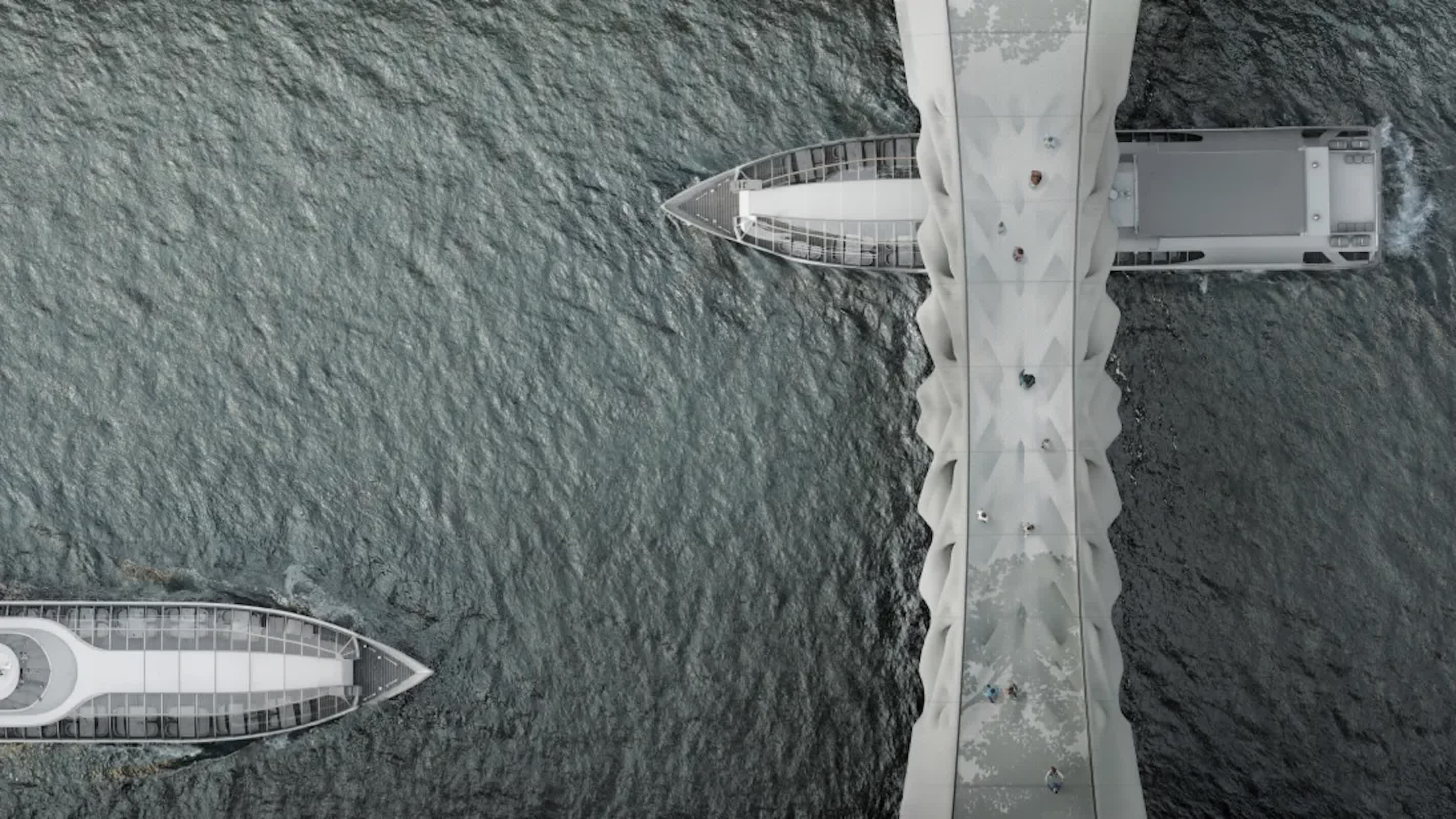
Why it matters: At the University of Pennsylvania's Polyhedral Structures Laboratory, a team of architects and engineers is rethinking how one of the world's most polluting building materials could become part of the climate solution. Concrete is responsible for nearly 8% of global carbon emissions, and demand for it keeps rising as cities grow. If even a fraction of that material could be redesigned to store carbon instead of emit it, the environmental impact would be enormous.
Led by Professor Masoud Akbarzadeh, the Penn group has developed Diamanti, a 3D-printed structural system that uses both geometry and material science to turn concrete into a potential carbon sink. With robotics, nature-inspired forms, and a reformulated cement mix designed by materials scientist Shu Yang, the project demonstrates how design innovation and sustainability can work together to build the next generation of infrastructure.
Diamanti combines structural design and material science to address one of the construction industry's biggest environmental issues – carbon emissions. Instead of pouring concrete into standard molds, the Penn team uses robotic 3D printing to make modular components refined by digital algorithms.
Each piece is designed to withstand pressure and tension while using minimal material. The curved, hollow forms strengthen the structure and increase its surface area, allowing more carbon dioxide to interact with it and turning each piece into a small carbon sink.
Concrete production is responsible for around 8% of global carbon emissions, mainly due to cement, its key ingredient. Cement manufacturing requires heating limestone to about 2,000 degrees Celsius, an energy-intensive process that releases large amounts of CO₂. To reduce this, Diamanti replaces part of the cement with diatomaceous earth, a silica-rich mineral made from fossilized algae.
Shu Yang's materials science team found that this additive increases porosity, allowing carbon dioxide to spread deeper and react chemically with calcium-based compounds. Tests show that the modified concrete blend can absorb more than 140% as much CO₂ as traditional concrete under the same conditions.
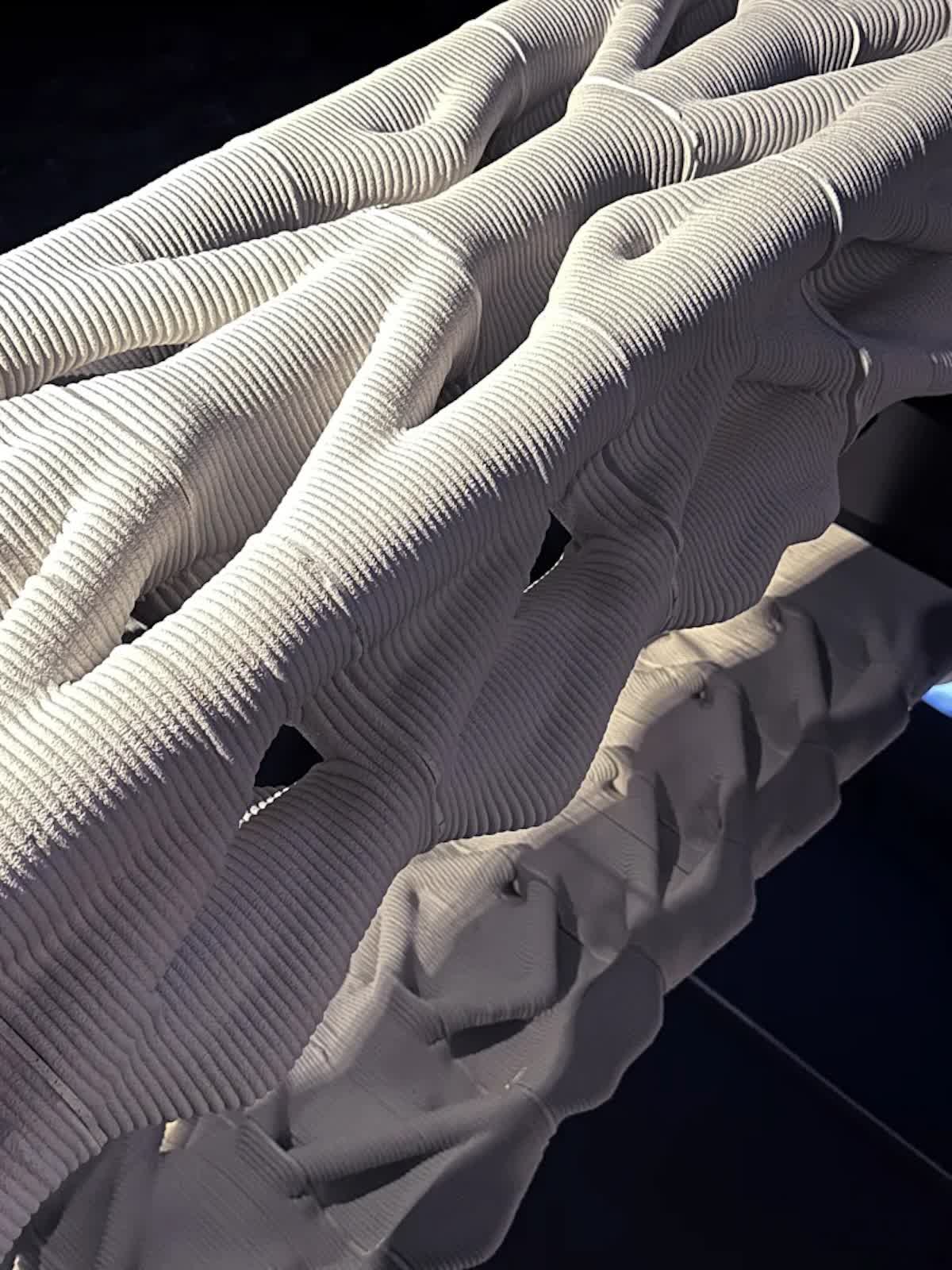
Building on this materials breakthrough, the project also redefines how structures can work. Drawing inspiration from biological forms – especially the porous framework of bone – the researchers used triply periodic minimal surface structures that distribute loads efficiently while keeping mass low. Robotic 3D printing allows these intricate designs to be built without molds, creating lightweight but strong components that use about 60% less material than conventional concrete.
To bring the concept out of the lab, the team built a prototype bridge to test its performance. Displayed at the European Cultural Centre's "Time, Space, Existence" exhibition in Venice, the 2.5-meter bridge consists of nine prefabricated modules printed by a robotic arm. Each piece features cavities and surface textures that enhance both strength and carbon capture. Instead of adhesives or grout, the modules are joined using eight ungrouted steel cables in a reversible, post-tensioned system. This approach reduces the need for steel reinforcement – a major source of emissions – and allows the bridge to be taken apart and reused.
Those initial tests paved the way for larger prototypes. At France's CERIB research institute, Diamanti passed load tests on both five-meter and ten-meter models, the latter made using Sika's concrete mix and printed by the French robotics firm Carsey3D. The project's engineering relies on polyhedral graphic statics, a mathematical method that optimizes how tension and compression move through a structure.
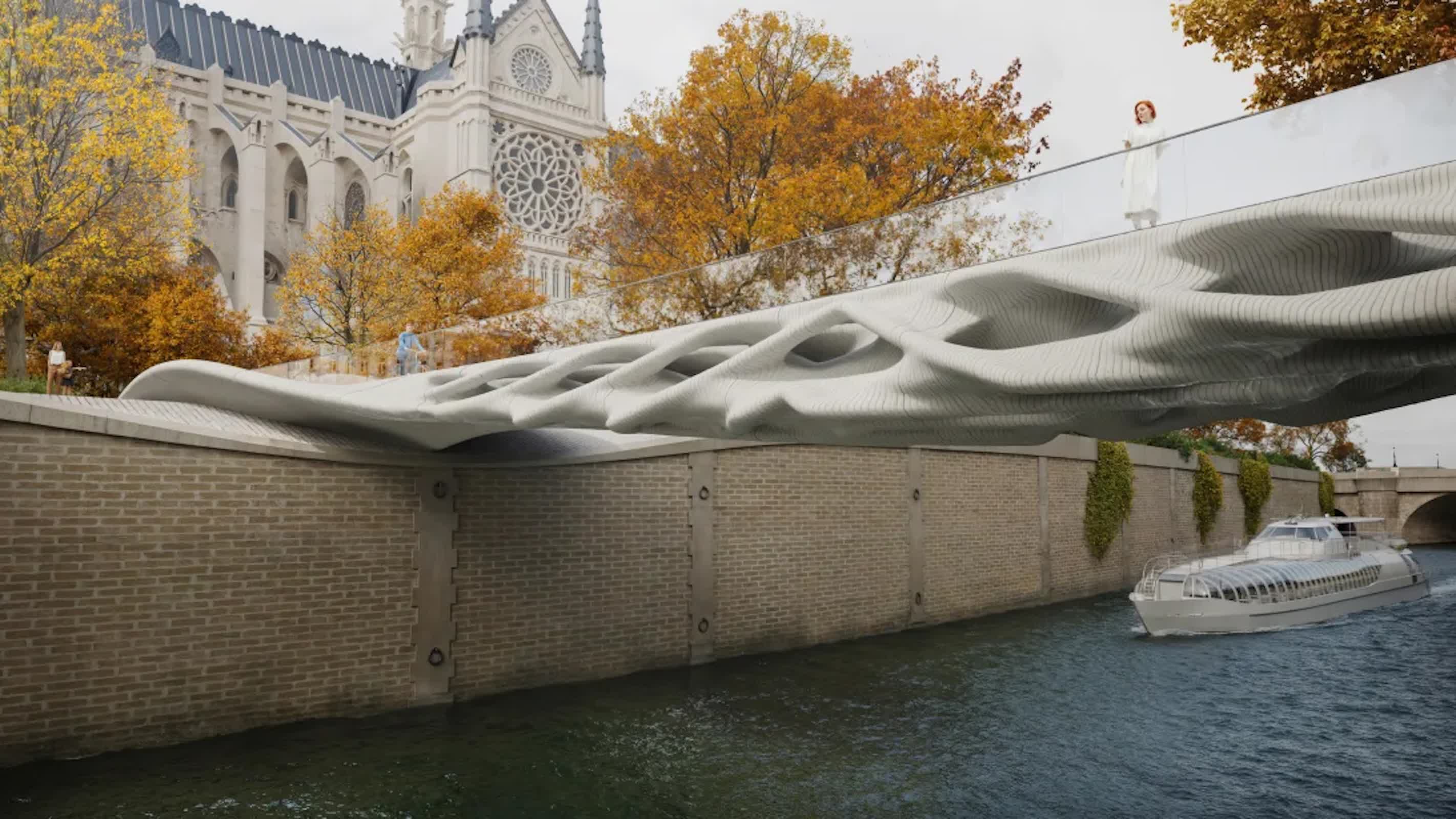
After that success, the team returned to Venice, where Diamanti became a focal point in conversations about sustainable construction. Following the exhibition, researchers began planning its first full-scale bridge in France, with several possible sites in Paris under review. The project has been published in the journal Advanced Functional Materials, making it one of the best-documented examples of carbon-capturing concrete technology to date.
The research now extends beyond bridges. The Penn team is adapting Diamanti's principles to modular floor systems and façade panels that use the same geometric and chemical logic. Scaling the method remains difficult due to the limited global supplies of diatomaceous earth; however, regions with natural deposits could utilize it to produce greener construction materials.
Experts view Diamanti not as a complete replacement for traditional building methods, but rather as a significant step toward reducing emissions in the world's most widely used construction material. Since concrete is used everywhere, even minor improvements can have a significant environmental impact.
As Akbarzadeh explained, nature achieves strength through efficiency, not excess. Diamanti carries that idea into architecture – proving that smarter design and better materials can build stronger structures with less concrete, while also cleaning the air.
Image credit: CNN