
In context: Industry analysts expect 2026 to mark a year of recalibration for the electric vehicle market as both supply and demand adjust. For now, however, it remains in flux – its promise of cleaner transportation tempered by the hard economics of depreciation.
The global electric vehicle market is facing an unexpected reckoning. Once hailed as the future of transportation, battery-powered cars are now rapidly losing value, eroding the finances of private owners and corporate fleets that invested heavily in them.
Over the past year, electric vehicles have depreciated at nearly twice the rate of comparable gas-powered cars. Analysts say the reason lies in one of the EV's defining features – the battery – whose uncertain lifespan and replacement costs have upended traditional models for calculating resale value.
In India, the problem became painfully visible earlier this year when BluSmart, the country's first all-electric ride-hailing startup, collapsed amid allegations of financial misconduct. The company's fleet of thousands of EVs, once valued at more than $12,000 each, flooded the used market at roughly a quarter of that price. Industry observers say it was the first large-scale example of what happens when the theoretical risks of electric depreciation turn real.
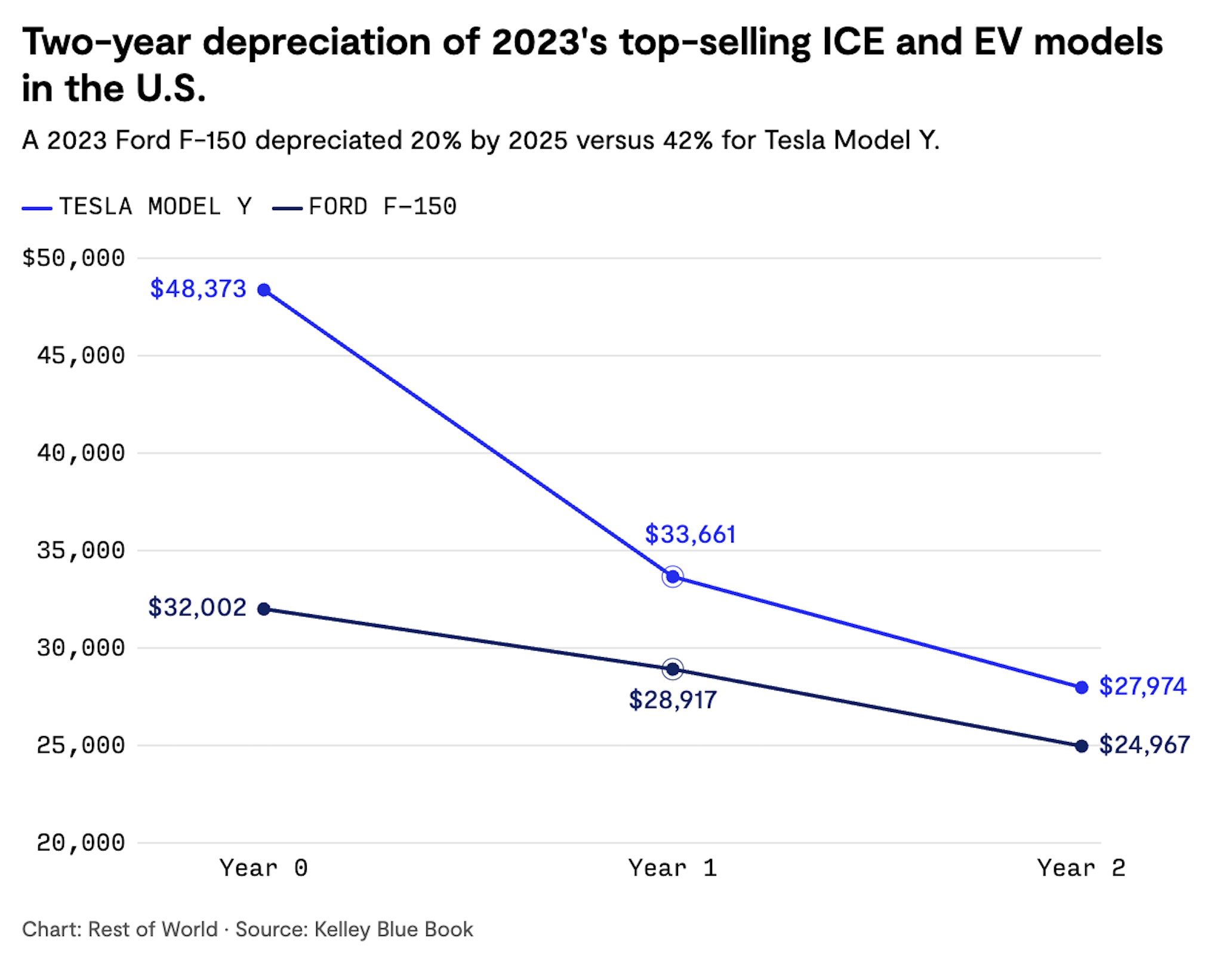
In the United States, the same pattern is emerging. A Tesla Model Y purchased new in 2023 is now worth about 42 percent less than its sticker price, according to resale tracking data. Over the same period, a Ford F-150 has lost only about 20 percent of its value. Studies from both the United Kingdom and South Korea show a similar trend, with three-year-old EVs losing more than half their value – far more than conventional vehicles of the same age.

"The fundamental problem is that nobody really knows what electric cars are worth in the secondhand market, as their value is largely tied to batteries with uncertain lifespans," Andrew Garberson, head of growth and research at Recurrent, a Seattle-based startup that evaluates the wear and tear on used EVs to bring transparency to the secondhand market, told Rest of World. "For gas cars, there's a 100-year process behind them based on odometer and major maintenance schedules and the expected life of combustion engine parts. Electric cars have fewer moving parts, and a lot of the value of the car is tied up in one component – the battery."
The impact is particularly severe for companies operating large vehicle fleets. From ride-hailing to delivery services, firms that embraced electrification as part of their sustainability goals are now struggling to reconcile green ambitions with financial losses.
Florida-based rental giant Hertz illustrates the scale of the challenge. The company purchased 100,000 Teslas in 2021, aiming to transition much of its fleet to electric. But by 2024, plunging resale prices, high repair costs, and extended maintenance times had turned that bet into a $2.9 billion loss. Hertz began selling off roughly 30,000 EVs – many for less than half their purchase price. A Tesla Model Y listed for resale this month was priced around $27,000, down from the $45,000 it cost just two years earlier.
"Fleet operators feel the risk most acutely because their entire business model depends on predicting total cost of ownership," said Jack Carlson, chief executive of Carvai.ai, an automotive analytics platform. "Retail buyers worry about range and charging; fleets worry about what happens when they try to resell thousands of cars."
Not all electric cars depreciate equally. Tesla vehicles have held their value better than most, reflecting both their longer market presence and stronger brand recognition. Chinese manufacturers such as BYD, XPeng, and Nio, though growing quickly, have struggled to build similar resale confidence abroad, according to Mariusz Sawula, head of the Poland-based vehicle history provider autoDNA. "Premium brands – whether gas or electric – consistently retain higher value," Sawula said. "The uncertainty comes with newer names that buyers don't yet trust."
Market geography also plays a role. In Europe and parts of Asia, where shorter commutes and government incentives make EVs more practical, secondhand prices have remained relatively stable. Countries such as Norway and China continue to show strong consumer demand for used electrics. But in North America, long distances, variable climates, and uneven charging infrastructure have depressed resale potential.
The volatility has prompted new approaches aimed at restoring confidence in the sector. Battery-as-a-service programs, in which fleet operators lease batteries rather than own them, are gaining traction. The model allows companies to isolate battery risk and treat it as a predictable operating expense rather than an unknown liability.
"Without predictable residual values, even profitable fleets can become unsustainable once vehicles reach their replacement cycles," said Anirudh Damani, managing director of Artha Venture Fund, an investor in India's Everest Fleet. "Battery leasing is one of the few mechanisms that can stabilize that risk."
Despite the turmoil, recent data suggest that the batteries themselves may be more durable than many assume. Recurrent's research shows modern EV batteries degrade by only one to two percent per year, with fewer than one percent of vehicles built after 2016 requiring replacement. Older models, by contrast, had a replacement rate exceeding 13 percent.
Some automakers and dealers are adapting. Certified pre-owned programs specific to electric vehicles now include detailed state-of-health battery reports, giving buyers the kind of transparency long taken for granted in traditional car sales. The rapid innovation cycles that once made older EVs seem outdated have also slowed, as manufacturers emphasize range stability and long-term reliability over frequent redesigns.
Image credit: Rest of World