
The takeaway: Apple's 2025 MacBook Pro lineup, built around the new M5 processor, is showing SSD performance gains that exceed expectations, according to early independent benchmarks. Although Apple advertises "up to 2x faster" speeds over the M4 generation, real-world testing indicates the new storage subsystem outperforms that estimate by a wide margin.
YouTuber Max Tech conducted a series of controlled comparisons using identical 14-inch MacBook Pro configurations running the M4 and M5 chips. Both machines featured 512GB of storage and identical cooling assemblies, each featuring a single fan, one heat pipe, and two NAND flash modules.
The benchmarks centered on the Blackmagic Disk Speed Test, a standard macOS utility for measuring sustained read and write throughput. The M5 system achieved sequential read speeds of roughly 6,323 MB/s, compared with about 2,031 MB/s on the M4.
Write performance reflected a similar jump, with the M5 reaching approximately 6,068 MB/s versus the M4's 3,293 MB/s. Max Tech repeated the tests multiple times to confirm consistency and reported stable results across all runs.
Averaged across read and write metrics, the M5's internal SSD delivered roughly 2.5x the throughput of its predecessor, suggesting that Apple's official figures were conservative. Follow-up testing using random read and write patterns also showed substantial improvements in responsiveness, particularly during small-file transfers and rapid directory operations – areas that synthetic benchmarks often underrepresent but that heavily affect real-world usability.
The gains appear to stem from a redesigned SSD controller integrated into the M5 architecture. Apple's storage interface still routes PCIe lanes directly from the SoC, and analysts believe the updated controller is what enables performance levels approaching full PCIe Gen4 parity.
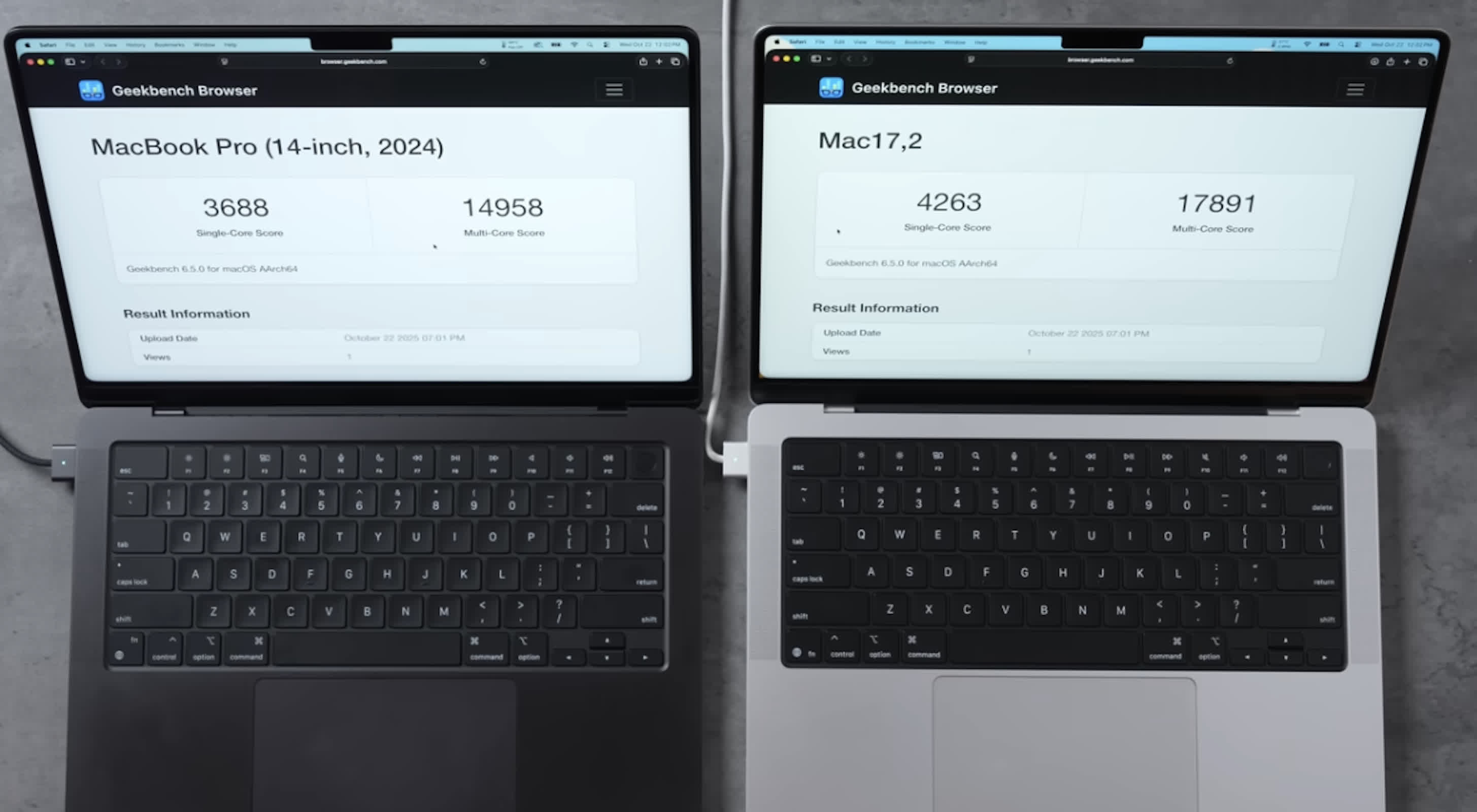
On the standard M5 chip, Apple continues to provide four PCIe lanes to the NAND subsystem – the same configuration used in previous base-tier M-series chips, with the wider 8-lane interface expected to on the upcoming M5 Pro and Max variants. The dramatic uplift therefore appears to come from controller refinements and faster flash, pushing sustained throughput into the range typically seen on high-end PCIe Gen4 NVMe SSDs.
Max Tech's teardown also confirmed identical NAND density across both models (dual 256GB modules) implying that firmware improvements, including better queue management and more efficient wear leveling, account for much of the uplift.
Overall, this represents one of the largest gen-to-gen SSD improvements Apple has delivered in its laptops. Beyond benchmarks, users should notice faster project load times in Final Cut Pro, improved caching during large Photoshop or Xcode builds, and smoother scrubbing with multi-stream 8K footage.