
WTF?! DRAM prices have seen a steep rise in recent months, primarily driven by surging demand for high-bandwidth memory from AI data centers. The situation has gotten so bad that some high-end server memory kits now cost more than luxury SUVs and sports cars.
Nemix, an American company supplying memory and storage devices to US government agencies and contractors, has listed a 4TB DDR5 PC5-51200 memory kit on its website for an eye-popping $77,000. The kit comprises 16 modules of 256 GB ECC RDIMMs running at 6400 MT/s with a CAS latency of 52.
The same memory modules are listed on Amazon in multiple configurations, starting at $99 for a single 64GB DIMM. At the high end, the 2TB kit is listed for a whopping $38,999. It includes eight 256GB modules with the exact same specifications as the 4TB and 64GB kits. Another 2TB kit, in 8 x 128GB configuration, is listed at $45,999.
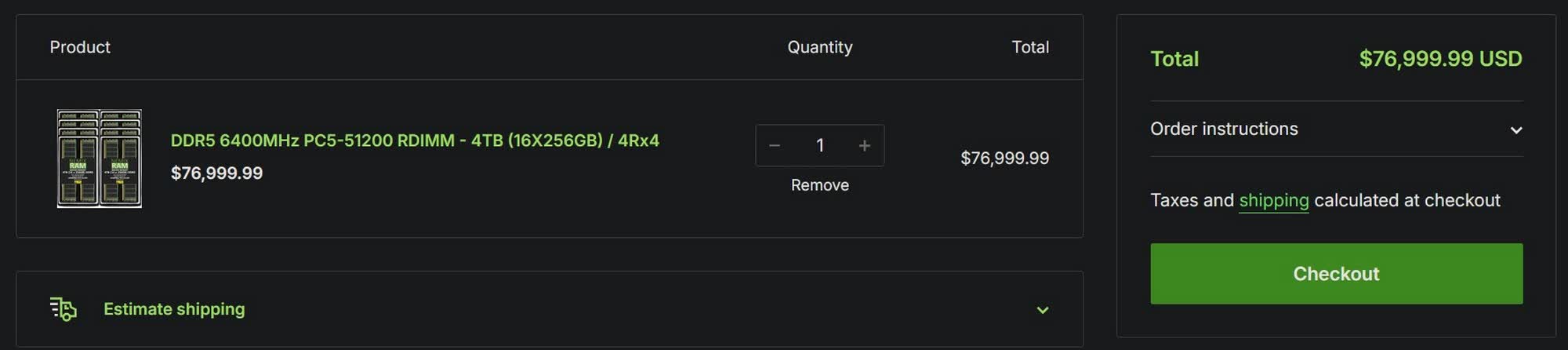
For perspective, the insane prices for the memory kits are higher than what you'd pay for the Porsche 718 Cayman or the Range Rover Evoque, which start at around $75,000 and $49,000, respectively. Even the Defender 110 costs around $64,000 in the base trim before dealer-level discounts and incentives.
The Nemix memory kits cited above are designed for ultra-high-end servers, so they're probably not the best yardsticks to judge consumer RAM prices. However, according to the reliable Amazon price tracker CamelCamelCamel, the 2TB kit on Amazon was listed at $32,997.49 on November 30, meaning it surged around 20 percent in less than a month.
It is worth noting that the current crisis primarily affects DDR5 memory, with DDR4 modules still available at relatively more affordable prices. For example, a Nemix 2TB (8 x 256GB) DDR4 kit is listed for $13,468 on Amazon, while a single 256GB module is priced at $1,698.
The AI boom has driven DRAM prices to record highs this year, and with PC OEMs and system builders panic-buying memory, the trend is expected to continue well into 2027. According to a recent study by IDC, PC and smartphone prices could jump around 8 percent next year if the shortages continue.