
Big quote: At the close of 2025, Instagram head Adam Mosseri used his personal account to post a 20-page presentation examining what he called the "new era of infinite synthetic content." The slideshow, which reads like a digital memo to the future of photography, argues that technology has permanently blurred the distinction between authentic and artificial imagery – and that Instagram, once defined by its personal photo diaries, has already moved beyond that stage.
Mosseri said the traditional, more intimate feed was "dead" years ago. What replaces it now, he suggested, is a world in which users must adapt to a new default assumption: that not everything they see is real. "For most of my life I could safely assume photographs or videos were largely accurate captures of moments that happened. This is clearly no longer the case and it's going to take us years to adapt," he wrote.
He described a shift from trust to verification as the foundation of visual culture online. "We're going to move from assuming what we see is real by default, to starting with skepticism. Paying attention to who is sharing something and why. This will be uncomfortable – we're genetically predisposed to believing our eyes."
Also read: More than 20% of YouTube's feed is now "AI slop," report finds
Mosseri's comments reflect a growing unease among technology observers about the collapse of photographic truth. Last year, The Verge's Sarah Jeong wrote that the default assumption about a photo is about to become that it's faked, because creating realistic and believable fake photos is now trivial to do. Mosseri's reflections, though focused on Instagram's role, echo that prediction.
The Instagram chief outlined what he described as a necessary evolution in platform design: "We need to build the best creative tools. Label AI-generated content and verify authentic content. Surface credibility signals about who's posting. Continue to improve ranking for originality."
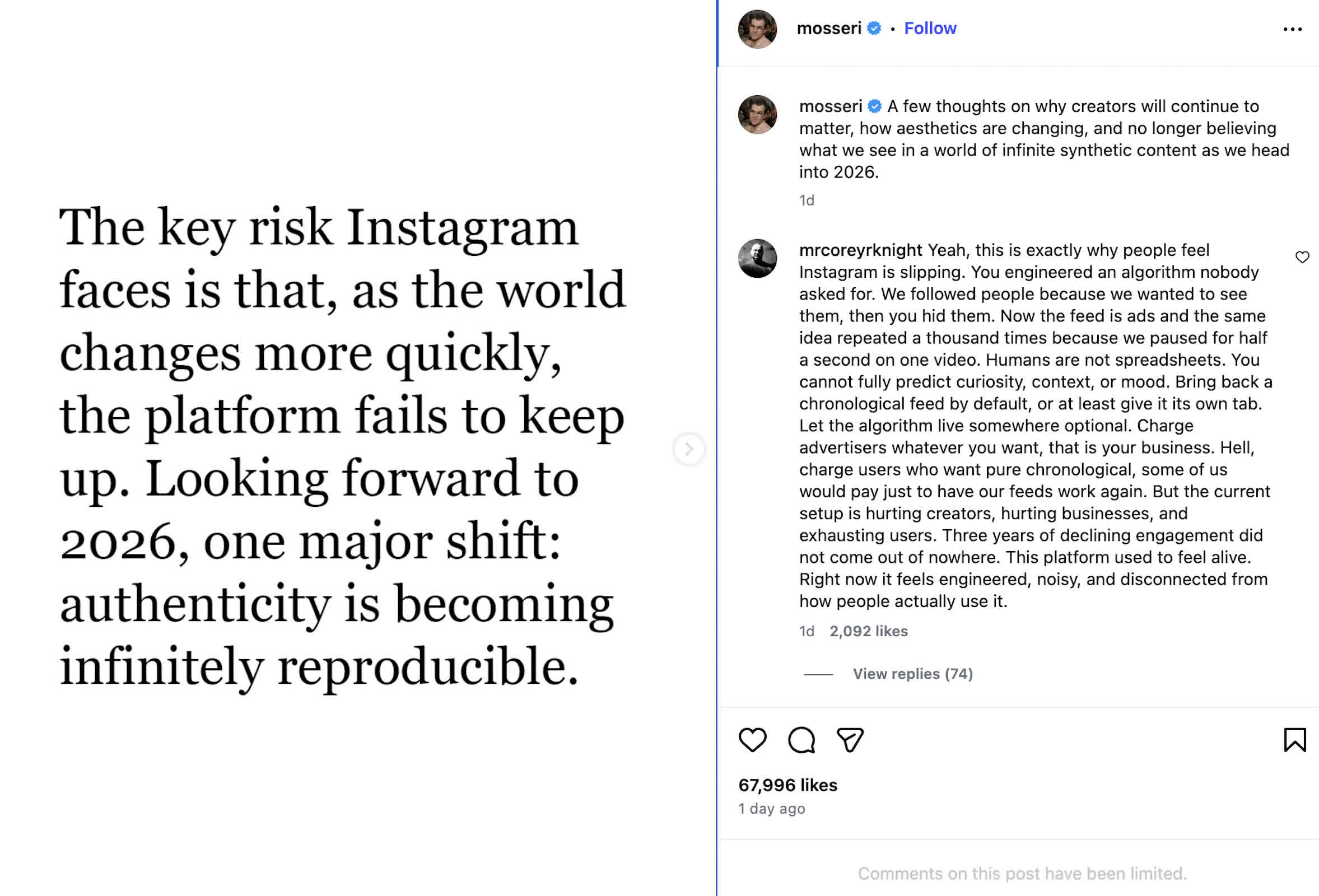
These steps, if implemented, would shift more responsibility to Meta's systems for distinguishing between synthetic and authenticated visual media. This problem is increasingly pressing as generative AI models drive new waves of image production at scale.
He also addressed the ongoing debate over the aesthetics of AI imagery, pushing back on the idea that all generative output should be dismissed as low-value filler. People like to complain about AI slop, but there's a lot of amazing AI content, Mosseri claimed, though he gave no examples or specific reference to Meta's own AI initiatives.
In a subtle critique of conventional camera makers, he argued that companies chasing hyperrealistic effects – tools that can "make everyone look like a pro photographer from 2015" – may be missing the larger transformation already underway.
The presentation concludes a year in which discussions about authenticity, attribution, and misinformation in visual media intensified across the tech industry. As 2026 begins, Mosseri's warning – that audiences must learn to see with skepticism first – signals not just a design challenge for social platforms but a cultural recalibration of what counts as proof in an age of infinite synthesis.