
First look: Qualcomm unveiled its Snapdragon X2 Plus processors for Windows laptops at CES 2026, claiming faster performance and better efficiency than comparable Intel and AMD chips. New synthetic benchmarks now add much-needed nuance to those claims, highlighting where the gains appear real and where they fall short.
PC Magazine tested the X2 Plus against the Intel Core Ultra 7 268V, Core Ultra 9 285H, Ryzen AI 9 HX Pro 375, and Ryzen AI Max+ Pro 395 across multiple popular benchmarking apps. The lineup also included a 2024 14-inch MacBook Pro powered by Apple's M4 chip. The results suggest the new processor largely trades blows with Intel and AMD offerings, but falls behind Apple silicon in most CPU and GPU workloads.
In Cinebench 2024's single-core test, the 10-core Snapdragon X2 Plus outperformed the Core Ultra 7 268V, Core Ultra 9 285H, and Ryzen AI 9 HX Pro 375, but trailed the Ryzen AI Max+ Pro 395 and Apple's M4. In multi-core workloads, the X2 Plus fell behind the 285H and AI Max+ 395, but narrowly edged out the M4.
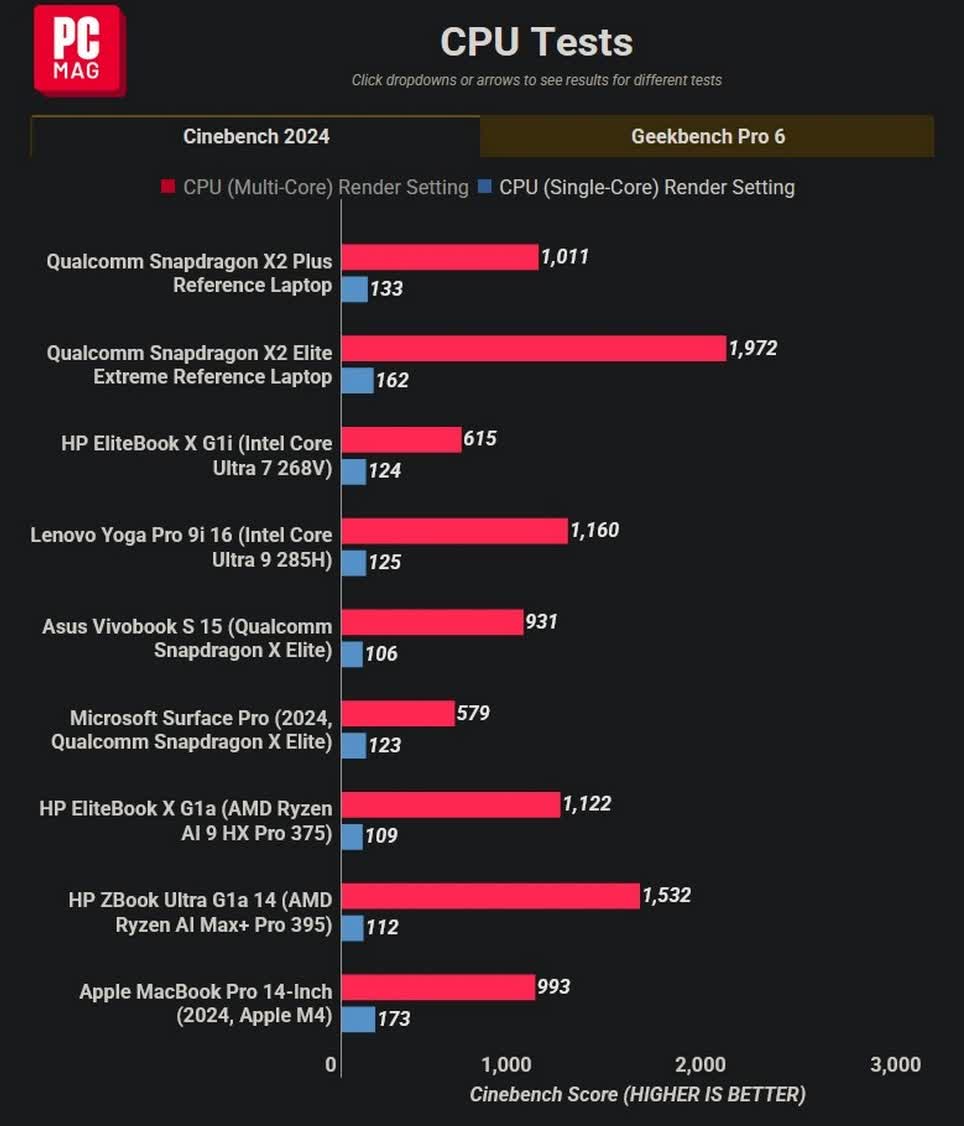
In Geekbench 6 Pro, the Snapdragon X2 Plus posted a strong 3,311 in the single-core test, outpacing all four Intel and AMD processors, but trailing the Apple M4. In the multi-threaded benchmark, the X2 Plus fell short of the Core Ultra 9 285H, Ryzen AI Max+ Pro 395, and M4.
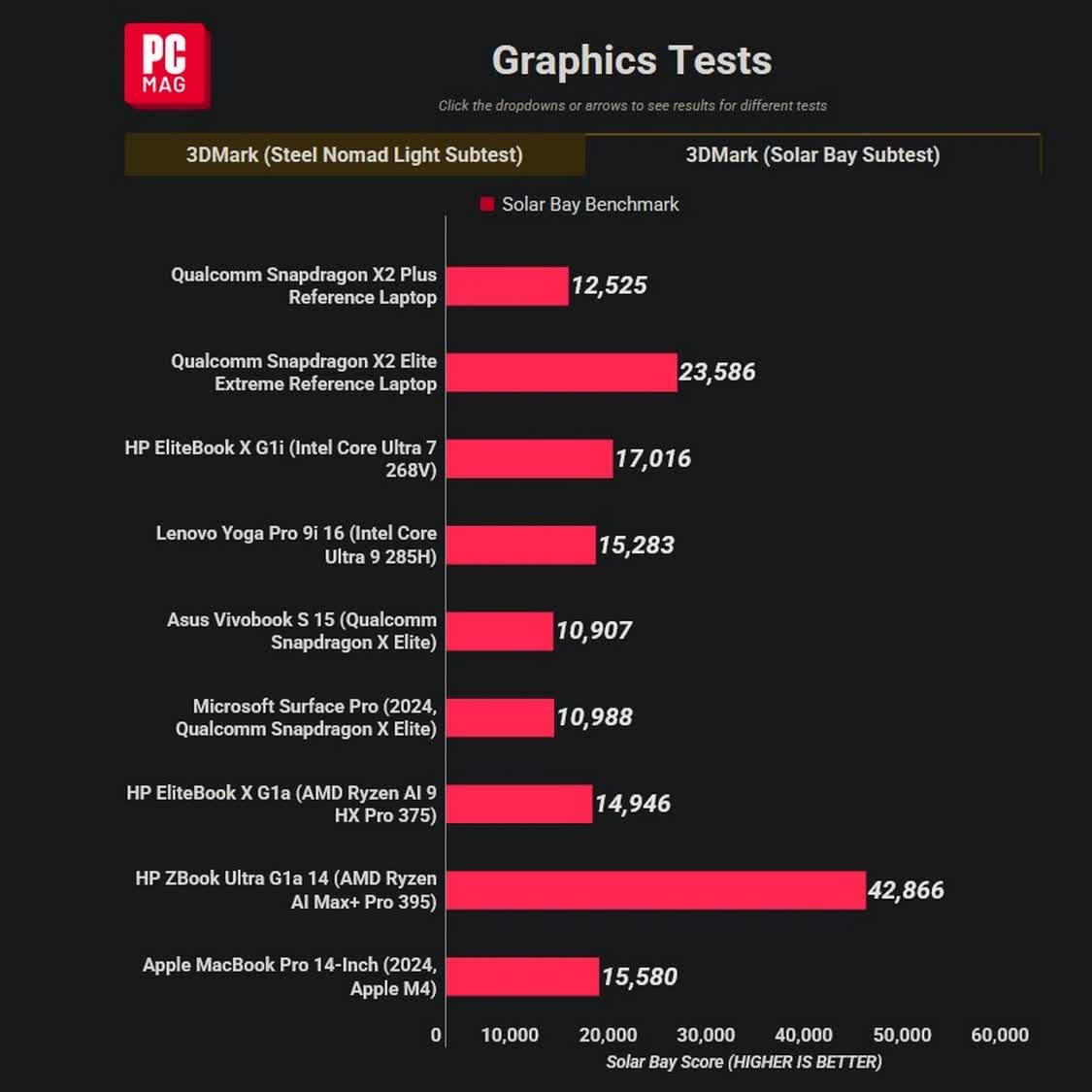
PC Magazine also ran GPU tests to evaluate graphics performance. In the 3DMark Steel Nomad Light benchmark, it lagged behind all its competitors. Results were similar in the 3DMark Solar Bay subtest, where the X2 Plus again scored lower than the Intel, AMD, and Apple chips.
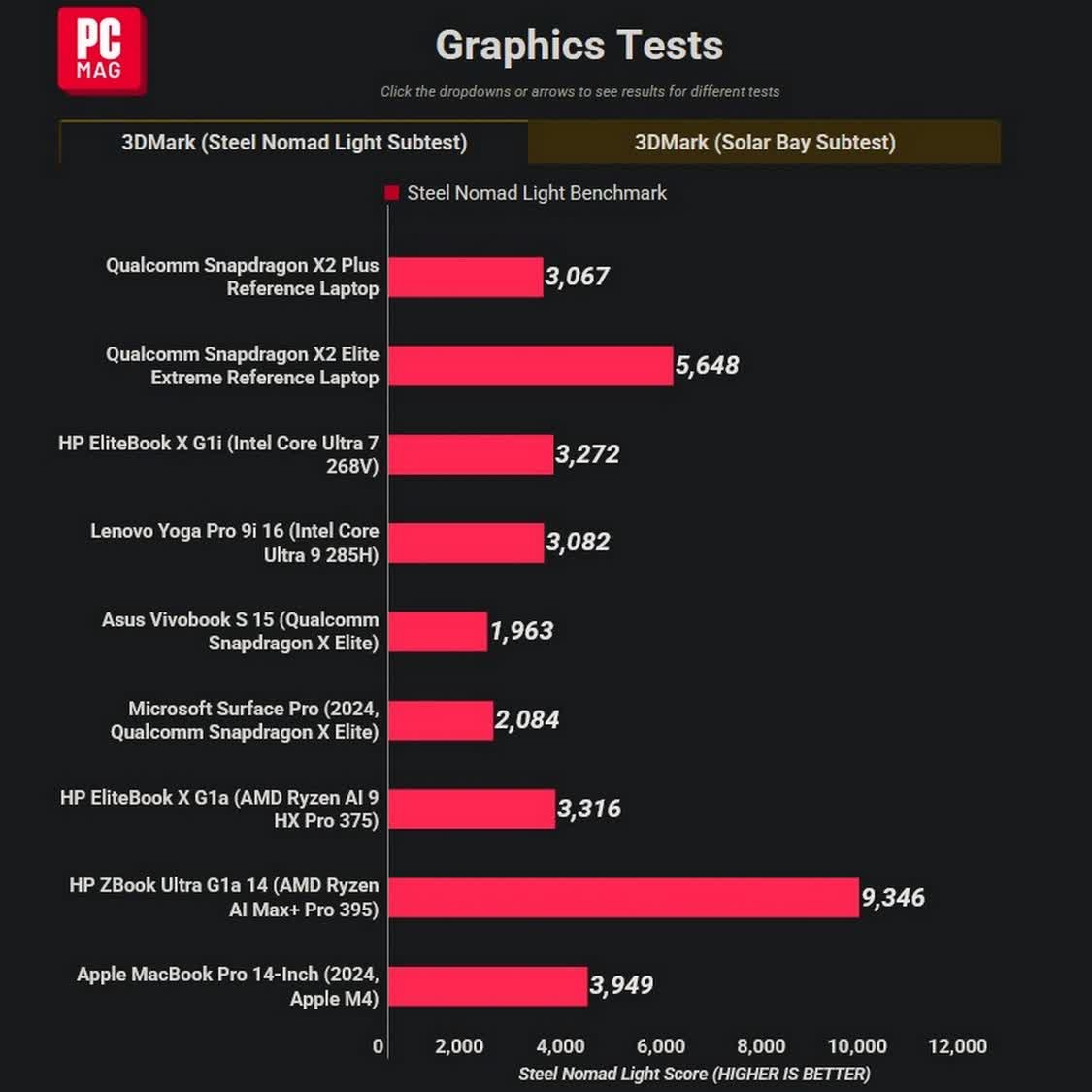
On the positive side, the X2 Plus scored roughly 15 to 50 percent higher than the X Elite in most benchmarks, showing it is significantly faster than its predecessor. However, its struggles against Apple silicon and x86 chips indicate it still has a long way to go before challenging Apple, Intel, and AMD in the laptop market in terms of raw performance.
It is worth noting that the benchmarked Snapdragon X2 Plus ran on a reference platform, while testers used commercially available products for the other chips. This is a key caveat, as results can vary widely depending on chip binning, cooling, power limits, SSD speed, memory latency, and installed apps.
Benchmarks by PC Mag