Winners & losers: Sales charts have long shown that AMD is steadily siphoning Intel's CPU market share. However, recent analysis indicates that Apple's transition toward in-house Arm-based processors has compounded the effect, and the Cupertino giant's notebook CPUs are now nearly as successful as Team Red's.
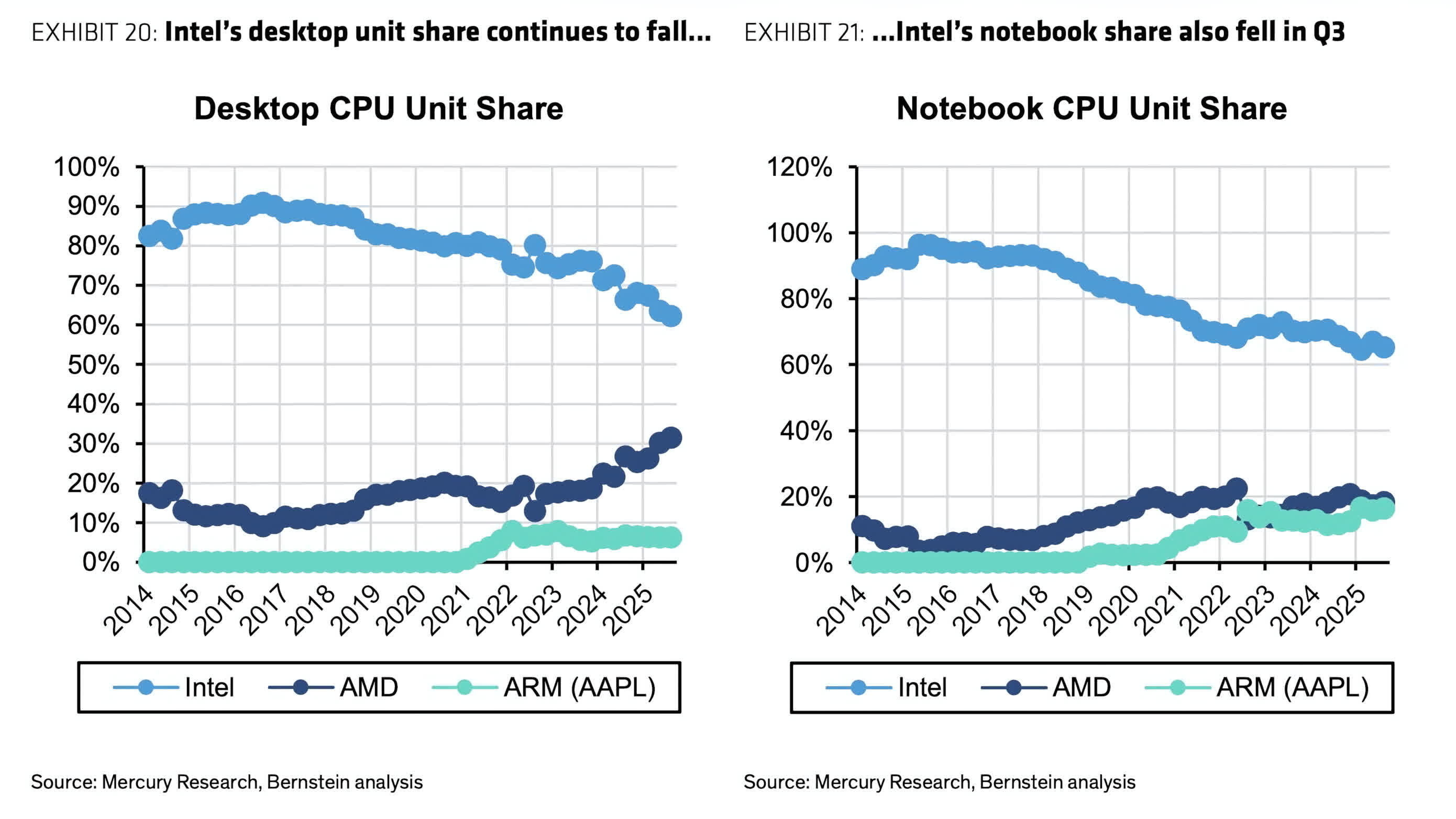
According to recent data from Mercury Research and Bernstein Research obtained by Citrini Research, Apple's laptop CPU market share has reached approximately 20%, matching AMD's. Combined, the two companies have dragged Intel's share down by over 20% since 2018. A similar situation has occurred in the desktop sector, although AMD's impact there is significantly more pronounced than Apple's.
Before 2018, Intel sold roughly 90% of desktop CPUs and over 80% of notebook CPUs. Although the company still commands a 60% market share in both segments, AMD has been chipping away at them since it introduced its Zen processors in 2017. Apple's decision to shift away from Intel chips to design its own has accelerated Chipzilla's decline.
Here's Intel's data center CPU market share – something I'm sure many of you are curious about: https://t.co/LJjtg89DoO pic.twitter.com/gqst4kp5gu
– Jukan (@jukan05) January 21, 2026
AMD's desktop CPU market share growth intensified in 2022, when it began introducing its fourth-generation Zen processors to compete with Intel's Alder Lake and Raptor Lake. Amid controversy stemming from stability issues, Intel's consumer CPUs have been described as stagnant, with no response to AMD's successful 3D V-Cache technology. Fifth-generation Zen chips have almost entirely dominated recent sales charts, and AMD's CPUs now account for more than 40% of Steam users.
Meanwhile, Apple's M-Series processors have occupied a stable 10% of the desktop market since the company introduced the M2 line in 2022. The number likely represents the portion of desktop users who had always preferred Macs as they gradually retired their Intel models.

In contrast, MacBook sales appear to be increasing, contributing to a sharper downturn in the notebook market for Intel. Chipzilla's recently released Core Ultra 3 series (Panther Lake) processors, the first fabricated on its 2nm-class 14A node, aim to resist intensifying competition from AMD's new Ryzen AI 400 lineup and Apple's M5.
While Apple currently represents virtually the entire Arm CPU market in Mercury's latest data, future reports might show an impact from emerging players such as Qualcomm and Nvidia. Qualcomm launched a series of chips for Arm-based Windows laptops in 2024, and Nvidia is expected to follow suit soon. However, user enthusiasm for the emerging platform remains unclear.