
The big picture: In deep-space travel, the race is no longer about who has the biggest rocket – it's about who can build the smartest plasma engine. As the competition to reach Mars intensifies, engineers in the US, Russia, and China are accelerating development of propulsion systems that trade conventional fuel for charged particles and magnetic fields.
Once confined to laboratory experiments and speculative research, the technology now stands at the forefront of interplanetary innovation and represents the most credible path to cutting travel times from months to mere weeks.
Plasma propulsion transforms an inert propellant – often hydrogen – into plasma, a superheated mix of ions and electrons. Magnetic fields then funnel and accelerate the plasma to extreme velocities, generating thrust.
Because the process relies on electromagnetic forces rather than combustion, plasma engines are far more fuel-efficient than chemical rockets, though they require substantial power input. The current challenge is not whether the concept works – it does – but whether it can produce enough thrust to propel a crewed spacecraft across the solar system.
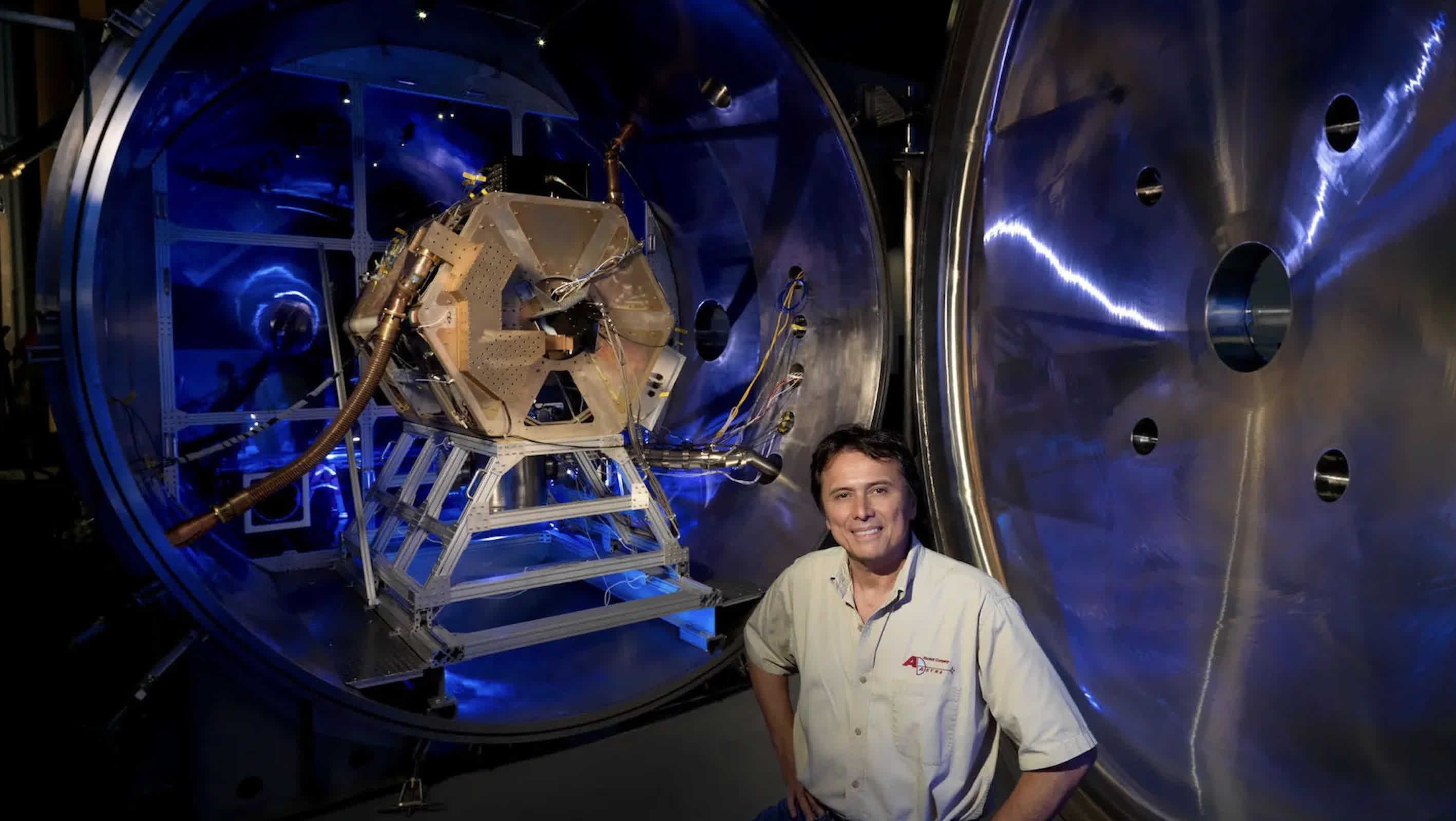
NASA has explored multiple designs through its Innovative Advanced Concepts program. These include the Pulse Plasma Rocket, which uses controlled bursts of plasma for propulsion, and the Variable Specific Impulse Magnetoplasma Rocket, developed by Ad Astra Rocket Company in Texas. Both designs draw heavily on magnetic confinement and ion acceleration technologies refined in fusion research.
For perspective, a conventional chemical rocket takes roughly eight months to reach Mars when planetary orbits align favorably. Vasimr and the Pulse Plasma Rocket aim to compress that travel time to about 45 to 60 days.
Russia's state-owned nuclear conglomerate, Rosatom, has entered the field with a magnetoplasma accelerator developed at its Troitsk Institute near Moscow. Announced in early 2025, the system reportedly achieves a specific impulse – essentially, exhaust velocity – of up to 100 kilometers per second, powered by a 300-kilowatt energy source. For comparison, most engines of this type operate in the 30- to 50-kilometer-per-second range.
Rosatom claims the technology could enable a one-month Mars trip, with officials targeting 2030 for a flight-ready prototype. The figures, while impressive, come amid significant financial and operational challenges in Russia's broader space sector.
In mid-2025, RSC Energia chief Igor Maltsev openly criticized the industry's deteriorating condition, warning that expectations had outpaced realistic capabilities. Whether Rosatom can deliver a functioning plasma engine within the decade remains uncertain.
China has also entered the plasma arena through its Xi'an Aerospace Propulsion Institute, whose researchers report developing a "high-thrust magnetic plasma thruster," according to state media.
Meanwhile, a separate team at Wuhan University is exploring how similar ionized-gas technology could improve high-altitude aircraft engines, potentially enabling plasma-based thrust within Earth's atmosphere.
Skeptics caution that despite decades of experimentation, turning plasma physics into practical propulsion remains a monumental engineering challenge. Issues such as power generation, heat dissipation, and material endurance under plasma bombardment are still unresolved. Yet the promise of high-velocity travel across the solar system at previously unthinkable speeds, fueled not by combustion but by controlled electromagnetism, is too great to ignore.
The momentum behind plasma propulsion marks a clear turning point in the story of human spaceflight. Chemical rockets opened space; plasma engines may finally make it traversable.